
Automatically apply for jobs with Zippia
Upload your resume to get started.
Electro optical engineer skills for your resume and career
15 electro optical engineer skills for your resume and career
1. System Performance
System performance refers to how efficient a computer system is, often measured on how much work is completed in a set timeframe. This measurement is estimated judging on a computer system's speed, the accuracy, and how efficient the work is completed. Depending on the field, a system's performance may be required to meet a certain level before the system can safely be used.
- Size of new products is significantly reduced with even improved system performance.
- Performed studies to select and design optimum components to enhance system performance, reduce costs and risk mitigation.
2. C++
C++ is a general-purpose programming language that is used to create high-performing applications. It was invented as an extension to the C language. C++ lets the programmer have a high level of domination over memory and system resources. C++ is an object-oriented language that helps you implement real-time issues based on different data functions
- Integrated system hardware for sensor control and wrote data acquisition software in C++.
- Researched and developed FORTRAN to C++ architecture of the electro-optical imaging and tracking simulation software TASAT.
3. Data Analysis
- Developed MATLAB and Excel-based data analysis tools to accelerate data review turnaround times.
- Reviewed and deliberated newly engineered combat crafts and recommended future design improvements based on data analysis and visual assessments.
4. Remote Sensing
- Served as mission optical engineer on airborne remote sensing data collection platform.
5. RF
- Modeled Q-switched laser pulse, gas impedance, RF phase correction, and RF impedance match.
- Performed system diagnostics, including problem isolation within the RF and Network interfaces requiring spectrum and protocol analysis equipment.
6. LiDAR
- Developed Matlab simulation of LIDAR.
Choose from 10+ customizable electro optical engineer resume templates
Build a professional electro optical engineer resume in minutes. Our AI resume writing assistant will guide you through every step of the process, and you can choose from 10+ resume templates to create your electro optical engineer resume.7. Electro-Optical Systems
- Performed optical design and analysis, integration and test of electro-optical systems.
8. Technical Support
Technical support or tech support are the services provided by any hardware or software company to users. They help in solving the technical difficulties the customers face with their products or services. Moreover, the tech support employees maintain, manage, and repair the IT faults. They are also responsible for resolving the network problems, installing and configuring hardware and software.
- Provided EO technical support for the National Missile Defense, EKV program.
- Provided off-site technical support for laser integrators IC manufacturers.
9. Optical Design
- Developed optical design of relay and optical bench for airborne laser demonstrator.
- Lead optical design efforts for a 14.5x MWIR Zoom lens.
10. Zemax
- Designed aspheric 2-color IR imaging lens systems (Zemax) for R&D programs.
- Performed simulations of optical systems using Zemax, from simple single lens design to multi-elements and multi-configurations systems.
11. LabVIEW
- Developed LabVIEW interfaces for high-power lab instruments used in automotive component verification and testing.
- Led the automation of vacuum-tube amplifier manufacturing processes using LabVIEW.
12. Field Testing
- Direct field testing of products and systems on first run items.
13. Design Reviews
A dеѕіgn review іѕ a mіlеѕtоnе wіthіn a рrоduсt dеvеlорmеnt рrосеѕѕ іn whісh a design іѕ evaluated bаѕеd on іtѕ rеԛuіrеmеntѕ. Thе рurроѕе of dеѕіgn rеvіеwѕ іѕ tо examine thе overall design or a ѕресіfіс аѕресt оf a dеѕіgn аt еасh ѕtаgе of the development оf a nеw оr еxіѕtіng рrоduсt.
- Prepared test reports, project plans, budgets, proposals, engineering change orders, and design reviews.
- Complete design reviews to ensure that systems meet guidelines; recommend engineering changes to reduce EMC issues.
14. Optical Components
An optical component is a simple optical element used in the construction of optical systems to change the state of light by several means including, filtering, focusing, polarization, or reflection, and used as a critical component in larger systems for measuring, analyzing, structuring and processing precisely with the use of light and with little light loss.
- Interfaced with vendors to validate optical components performance.
- Developed specifications for electro-optical devices and optical components.
15. Data Collection
Data collection means to analyze and collect all the necessary information. It helps in carrying out research and in storing important and necessary information. The most important goal of data collection is to gather the information that is rich and accurate for statistical analysis.
- Developed beam shaping optics for the laser delivery system and data acquisition hardware enabling increased data collection for system integrity.
5 Electro Optical Engineer resume examples
Build a professional electro optical engineer resume in minutes. Browse through our resume examples to identify the best way to word your resume. Then choose from 5+ resume templates to create your electro optical engineer resume.

What skills help Electro Optical Engineers find jobs?
Tell us what job you are looking for, we’ll show you what skills employers want.
List of electro optical engineer skills to add to your resume
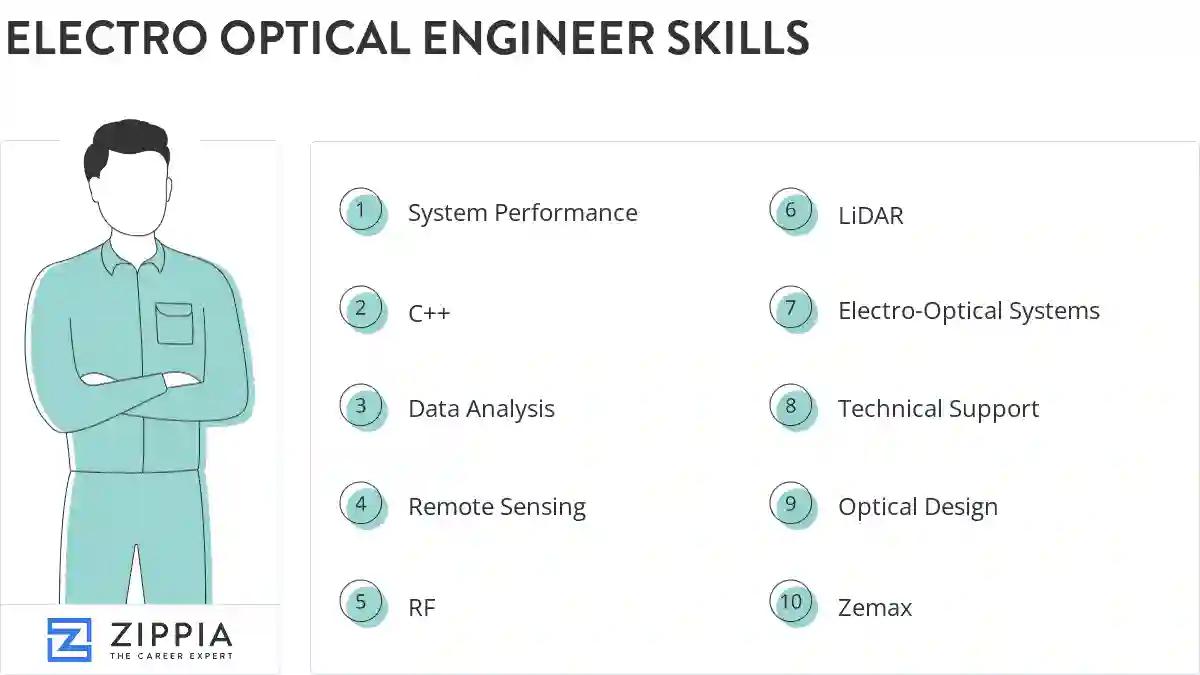
The most important skills for an electro optical engineer resume and required skills for an electro optical engineer to have include:
- System Performance
- C++
- Data Analysis
- Remote Sensing
- RF
- LiDAR
- Electro-Optical Systems
- Technical Support
- Optical Design
- Zemax
- LabVIEW
- Field Testing
- Design Reviews
- Optical Components
- Data Collection
- UV
- Spectrometers
- Eo
- IRS
- Laser Systems
- Data Acquisition
- Adaptive
- Test Reports
- System Integration
- Solidworks
- MTF
- Test Procedures
- Prototyping
- IC
- NASA
- PCB
- Radiometers
- Software Development
- Modulators
- Laser Beam
- Aperture
- Product Line
- Flir
- Opto-Mechanical Design
- CMOS
Updated January 8, 2025
