
Automatically apply for jobs with Zippia
Upload your resume to get started.
Electronics engineering manager skills for your resume and career
15 electronics engineering manager skills for your resume and career
1. Career Development
Career development is a term referring to the process and idea of furthering one's career or otherwise altering its path by a number of processes and methods. A career development plan can be unique to the individual and might simply be to continue working the job one does in a singular company and moving up, in terms of positions and salary. Or it might be an entirely different plan, such as moving on from the position, the company, and perhaps even the industry as a whole, and doing other work somewhere else.
- Managed all department functions including budgets, employee performance evaluations and career development plans.
- Reviewed engineers and guided their career development.
2. RF
- Evaluate alternate components through RF measurement and certification testing for emissions
- Direct responsibility for design through fabrication, assembly, test, and yield of various RF and microwave transistors.
3. Project Management
- Applied project management skills coordinating between development, vendors, and manufacturing.
- Major responsibilities include Project Management, Technical and Engineering Documentation, Product Verification Test, Component Engineering, and Agency Compliance.
4. Power Electronics
- Led circuit design for power electronics, Tier 2 supplier selections, board layouts and EMC compliance.
- Led technical engineering team for hybrid power electronics.
5. Product Development
Product development is the complete procedure of creating a product from concept until release of the final product. Product development has many stages after which a product is released into the market. Identifying the need, creating the opportunity, conceptualizing a product, and providing a solution, all are different stages of product development.
- Identified key supplier technologies to accelerate product development and provide innovation.
- Provided progressive product development and team formation.
6. Direct Reports
- Hold complete responsibility for conceptualization, developing Architecture, design and development and managing team of 7 direct reports.
- Established new training curriculum for direct reports in Facilities Engineering and Maintenance Systems departments within FDA guidelines and requirements.
7. Analog
An analog system refers to a system that uses continuously variable signals.
- Project manager for Power, DSP, Motor Control and Analog PCB circuit designs.
- Designed gauges that utilize analog and digital I/O to display data through the use of LCDs, stepper motors and/or LEDs.
8. FPGA
- Devised a method of performing random vibration control (frequency profiling) in FPGA hardware, using time domain constructs.
- Design and implement FPGA logic, digital PLL and MicroBlaze in the OEM laser system.
9. PCB
The PCB (Printed Circuit Board) refers to the hardware part housing all of the device's electrical connections.
- Developed quotes and proposals, tracked budgets and headcount needs, and managed outsourcing of high-volume PCB or tester builds.
- Directed through supervisors and managers - Engineering Services, PCB Design and Production Test Engineering and Production manufacturing team.
10. Electronic Hardware
- Designed/manufactured electronic hardware, firmware and software for research studies.
11. Test Equipment
Test equipment is a mechanical tool or a device which is used create signals and gather response from an electronic device under test. It helps in detecting any faults in the device and it also proves the proper operation of the electronic device.
- Created fixtures and test equipment for vendors and production, meeting specification requirements and ensuring customer satisfaction.
- Designed aircraft test fixture assembly drawings for test equipment used to simulate airplane electric power system installation.
12. Electronic Equipment
Electronic equipment is equipment in which electrons are conducted in a controlled manner, especially in a gas or vacuum, or semiconductor amplifier. These equipment are components for controlling the flow of electrical current for information and signal processing, telecommunications, and system control.
- Service electronic equipment: computers, printers, process control and scale systems Supervised service and engineering personnel.
13. Sigma
In Greek alphabets, sigma is the 18th letter that means "to sum up". In statistics, the lower case symbol of sigma is the unit of measurement for standard deviation which is used to assess the variability in a given set of data. While the upper case symbol is for summation notation means to add up all the given numbers in the data set.
- Used Sigma 8630 and 8640 platforms as a reference platform to validate SDK.
- Implemented Six Sigma and Lean problem-solving techniques.
14. Technical Support
Technical support or tech support are the services provided by any hardware or software company to users. They help in solving the technical difficulties the customers face with their products or services. Moreover, the tech support employees maintain, manage, and repair the IT faults. They are also responsible for resolving the network problems, installing and configuring hardware and software.
- Directed the activities of several universities and consultants that provided technical support for new products and technologies.
- Provided technical support to management, marketing, quality control, and manufacturing.
15. Cost Estimates
- Created project plans, schedules, and cost estimates.
- Prepared proposal inputs including budgetary and final cost estimates.

What skills help Electronics Engineering Managers find jobs?
Tell us what job you are looking for, we’ll show you what skills employers want.
What skills stand out on electronics engineering manager resumes?
Dr. John Ballato
J. E. Sirrine Endowed Chair and Professor, Clemson University
Another point about skills that stand out is a simple one - do your homework. There are few things more irritating than receiving a resume or email asking for a job, and the student clearly didn't care enough to look up what we do. The resume is a copy and paste and isn't personalized to the specific position, Group, or company. That stands out like a sore thumb.
What soft skills should all electronics engineering managers possess?
Dr. John Ballato
J. E. Sirrine Endowed Chair and Professor, Clemson University
What hard/technical skills are most important for electronics engineering managers?
Dr. John Ballato
J. E. Sirrine Endowed Chair and Professor, Clemson University
What electronics engineering manager skills would you recommend for someone trying to advance their career?
Yi Yang PhD
Associate Professor, Pennsylvania State University - Abington
What type of skills will young electronics engineering managers need?
Matthew Barry Ph.D.
Assistant Professor, University of Pittsburgh
What technical skills for an electronics engineering manager stand out to employers?
Patrick Atkinson
Professor, Kettering University
List of electronics engineering manager skills to add to your resume
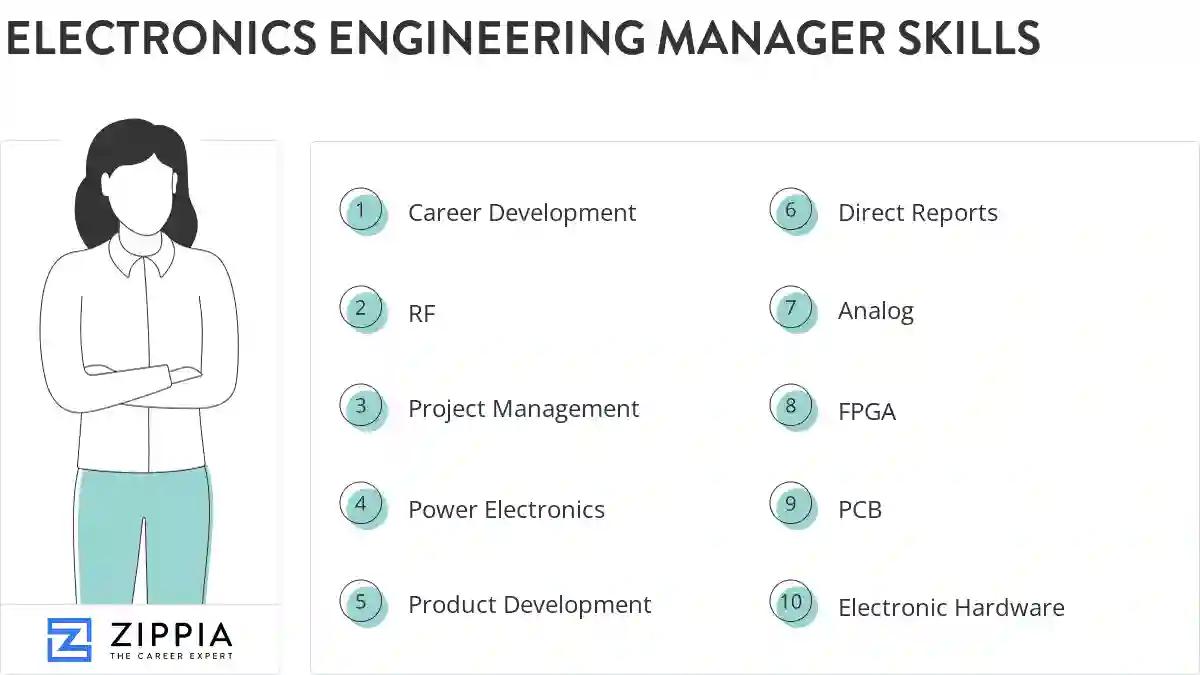
The most important skills for an electronics engineering manager resume and required skills for an electronics engineering manager to have include:
- Career Development
- RF
- Project Management
- Power Electronics
- Product Development
- Direct Reports
- Analog
- FPGA
- PCB
- Electronic Hardware
- Test Equipment
- Electronic Equipment
- Sigma
- Technical Support
- Cost Estimates
- CAD
- I/O
- Control Systems
- AC
- Microcontrollers
- R
- DFMEA
- FMEA
- Electrical Systems
- Electronic Components
- Verification Testing
- VFD
- System Architecture
- Microelectronics
- Electronic Controls
- Data Collection
- PC
- OEM
- EW
- A/C
- PLC
Updated January 8, 2025
