
Automatically apply for jobs with Zippia
Upload your resume to get started.
Electronics instructor skills for your resume and career
15 electronics instructor skills for your resume and career
1. Curriculum Development
- Performed course revisions and updates utilizing the task based curriculum development process to incorporate new technology or changes in training requirements.
- Exercised direct supervision over Cadre of hand-picked instructors; responsible for curriculum development and education of 1,600 mid-level leaders annually.
2. Laboratory Experiments
A laboratory experiment is an experiment that is carried out in a dedicated room or set of rooms under strictly controlled conditions where precise measurements are possible. Laboratory experiments allow detailed examination of a wide range of parameters and flows and offer a cost-effective way to quantify processes and verify the bounds of validity of the theory.
- Designed, introduced, reviewed, and evaluated student laboratory experiments.
- Developed manuals and procedures for laboratory experiments.
3. Electronic Devices
Electronic devices are instruments used to control the flow of electrical currents for information sharing and system control. These devices are usually small in size and come in bundles of integrated circuits. The most prominent examples are transistors and diodes. Following are some examples of electronic devices; computers, laptops, mobile phones, remotes, and cameras.
- Prepared and conducted classes in electronic devices, circuits, basic electricity and in digital logic circuits and systems.
- Assisted and instructed undergraduate students in classroom and laboratory setting * Instructed students in the area of electronic devices(semiconductors)
4. Electronic Theory
- Talented in the delivery of advanced concepts of electronic theory common to all communication-electronics equipment.
- Demonstrated vast knowledge of electronic theory and effective troubleshooting ability.
5. Microprocessors
- Develop and implement 900-hour course in all electronic disciplines, including Robotics, microprocessors, micro-computing and machine language programming.
6. Electrical Safety
- Instructed Surgical Tech students in Physics and Electrical Safety for medical equipment at Crossville.
Choose from 10+ customizable electronics instructor resume templates
Build a professional electronics instructor resume in minutes. Our AI resume writing assistant will guide you through every step of the process, and you can choose from 10+ resume templates to create your electronics instructor resume.7. Mathematics
- Prepared lesson plans and assignments for computer applications, computer programming, information technology, project management, and mathematics classes.
- Tutored students ranging from K-12 in mathematics and increasing student attentiveness through incentives and innovative learning methods.
8. Course Materials
- Maintained technical proficiency necessary to conduct classes and to develop and revise course material.
- Performed academic counseling, maintained academic and maintenance records and updated course material.
9. PLC
- Provide Programmable Logic controller instruction to students using Allen Bradley PLC's and RsLogix 500 and 5000 ladder software.
- Conducted labs on PLC operations, advanced motor control, service installation, and raceways.
10. Digital Electronics
- Co-instructed senior-level digital electronics/microprocessor system design course: 16/32-bit Motorola 68000-based controller systems.
- Developed & executed lesson plans and examinations to instruct students in Digital Electronics theory and Alternating Current theory.
11. RF
- Created test products for troubleshooting RF hardware using circuit separation methodology.
- Lectured students in field of electronics to include analog, digital, radio frequency (RF), and communications.
12. Ac
AC (Alternating Current) is the electric current that periodically changes its polarity and magnitude. Most devices, which are connected to the electrical grid directly, operate on AC. Electrical outlets in commercial areas and homes also supply electrical current.
AC may also refer to Air Conditioning as it relates to working to install duct work and air conditing units as part of an HVAC system.
- Instructed students in the theoretical and practical aspects of electronics including DC, AC, analog and digital circuits.
- Instructed personnel in the theory and practical application of electronics in DC, AC, and digital circuits.
13. Dc
- Teach classes in Digital, DC, and microprocessor classes at college level.
- Provided training on DC motor control systems and programmable logic controllers for surface mining equipment to employees and mining personnel worldwide.
14. Electronic Systems
- Instructed students for the ability to repair electronic systems to the component level.
- Teach installations of various electronic systems Teach AC/DC circuit theory, testing, troubleshooting, and repair.
15. Fiber Optic
Fiber optic is a technology used for the super-fast transmission of information as pulses of light over long distances. It is achieved to optical fiber wires, which are almost as thin as human hair and is made from glass or plastic. Fiber optic technology is generally used for providing super-fast internet and mobile networking services.
- Teach fiber optics communications and optical network design.
- Delivered Fiber Optic Repair lectures and demonstrations.
5 Electronics Instructor resume examples
Build a professional electronics instructor resume in minutes. Browse through our resume examples to identify the best way to word your resume. Then choose from 5+ resume templates to create your electronics instructor resume.

What skills help Electronics Instructors find jobs?
Tell us what job you are looking for, we’ll show you what skills employers want.
List of electronics instructor skills to add to your resume
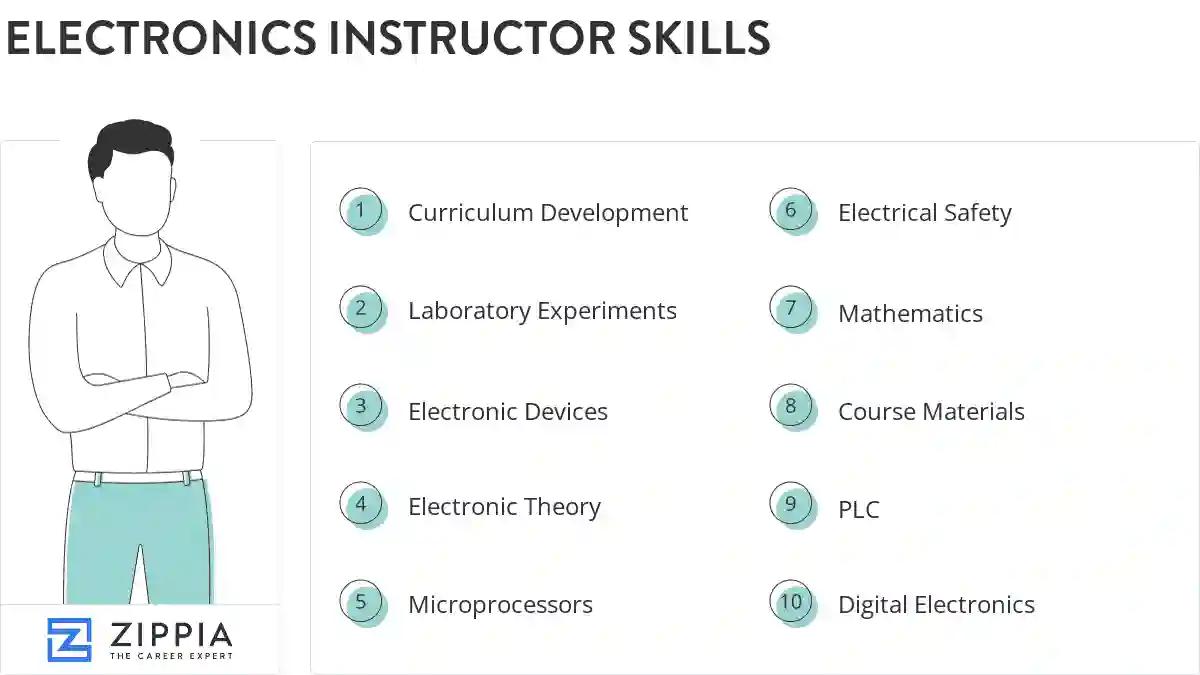
The most important skills for an electronics instructor resume and required skills for an electronics instructor to have include:
- Curriculum Development
- Laboratory Experiments
- Electronic Devices
- Electronic Theory
- Microprocessors
- Electrical Safety
- Mathematics
- Course Materials
- PLC
- Digital Electronics
- RF
- Ac
- Dc
- Electronic Systems
- Fiber Optic
- Electronic Warfare
- Digital Logic
- Computer Repair
- A+
- Logic Controllers
- Radar
- Course Curriculum
- Training Materials
- Electronic Components
- PC
- Master Training
- Technical Training
- Engineering Technology
- Syllabus
- Circuit Design
- Course Content
- GPA
- Nida
- Instructional Techniques
- Course Development
Updated January 8, 2025
