
Automatically apply for jobs with Zippia
Upload your resume to get started.
Electronics tester skills for your resume and career
15 electronics tester skills for your resume and career
1. Test Results
- Documented test results in the computer tracking system and maintained logs to generate daily reports of production.
- Performed diagnostic test on printed circuit boards, analyzed test results to determine cause of failures.
2. Level Troubleshooting
- Provide first level troubleshooting support in order to resolve minor to moderately complex assembly line problems.
3. Manual Tests
- Load units into test fixture and make necessary connections to perform manual test as well as computerized test.
- Test circuit boards on Genrad machines * Manual test circuits * Program micro chips in circuit boards * Pass/fail tested circuit boards
4. Transducers
- Operated assembly equipment associated with the manufacture of ultrasound transducers.
- Experience with XY plotters, pressure transducers and oscilloscopes.
5. Surface Mount
- Repair circuit cards using soldering techniques for through-hole and surface mount components.
- Prepared component level parts for surface mount circuit boards.
6. Test Procedures
Test procedure i defined as a tool for conducting an experiment to analyze or observe the specifications of a process or application.
- Followed Functional Test procedures to verify proper function en every electronic unit.
- Test Circuit Card Assemblies by following Test Procedures.
Choose from 10+ customizable electronics tester resume templates
Build a professional electronics tester resume in minutes. Our AI resume writing assistant will guide you through every step of the process, and you can choose from 10+ resume templates to create your electronics tester resume.7. ISO
- Ensured compliance with ISO 9000 regulatory and safety standards in an ISO certified manufacturing facility.
- Prepared and assembled cables according to IPC printouts and ISO standards and revisions.
8. Engineering Specifications
- Review documentation for the PCB/Component including engineering specifications and procedures.
- Studied and interpreted all engineering specifications, blue prints and service bulletins for conducting tests.
9. ATE
- Test of electronic circuit boards using ATE equipment Sent Failed units to debug department for repair Passed units for shipping
10. RF
- Program Calibrate Test and Troubleshoot RF Generators.
- Interpreted electrical schematics for electrical and RF function testing and inspections.
11. Electronic Devices
Electronic devices are instruments used to control the flow of electrical currents for information sharing and system control. These devices are usually small in size and come in bundles of integrated circuits. The most prominent examples are transistors and diodes. Following are some examples of electronic devices; computers, laptops, mobile phones, remotes, and cameras.
- Worked in a warehouse environment testing a variety of electronic devices for basic functionality and quality.
- Tested electronic devices (T1, T3, and ATM, DSL) using software to detect potential failures.
12. Electronic Products
- Recorded pass or fail of each electronic product into the tracking database.
- Test electronic products and approve whether or not they are suitable to be resold online.
13. Troubleshoot
Troubleshooting is the process of analyzing and fixing any kind of problem in a system or a machine. Troubleshooting is the detailed yet quick search in the system for the main source of an issue and solving it.
- Develop prototypes and troubleshoot custom made IBM Computers.
- SERVICE * Troubleshoot, test, and update automated A/C drives for customers.
14. Electronic Assemblies
- Test and Troubleshooting of Networked digital and analog Electronic assemblies to the printed circuit boat (PCB) and component level.
- Test the function of electronic assemblies, components, and parts.
15. Test Data
- Analyzed and interpreted test data and removed and straightened components and reordered joints to repair misaligned and damaged assemblies.
- Set up and tested monitors and calculators and recorded test data per engineering and quality specifications.
5 Electronics Tester resume examples
Build a professional electronics tester resume in minutes. Browse through our resume examples to identify the best way to word your resume. Then choose from 5+ resume templates to create your electronics tester resume.

What skills help Electronics Testers find jobs?
Tell us what job you are looking for, we’ll show you what skills employers want.
List of electronics tester skills to add to your resume
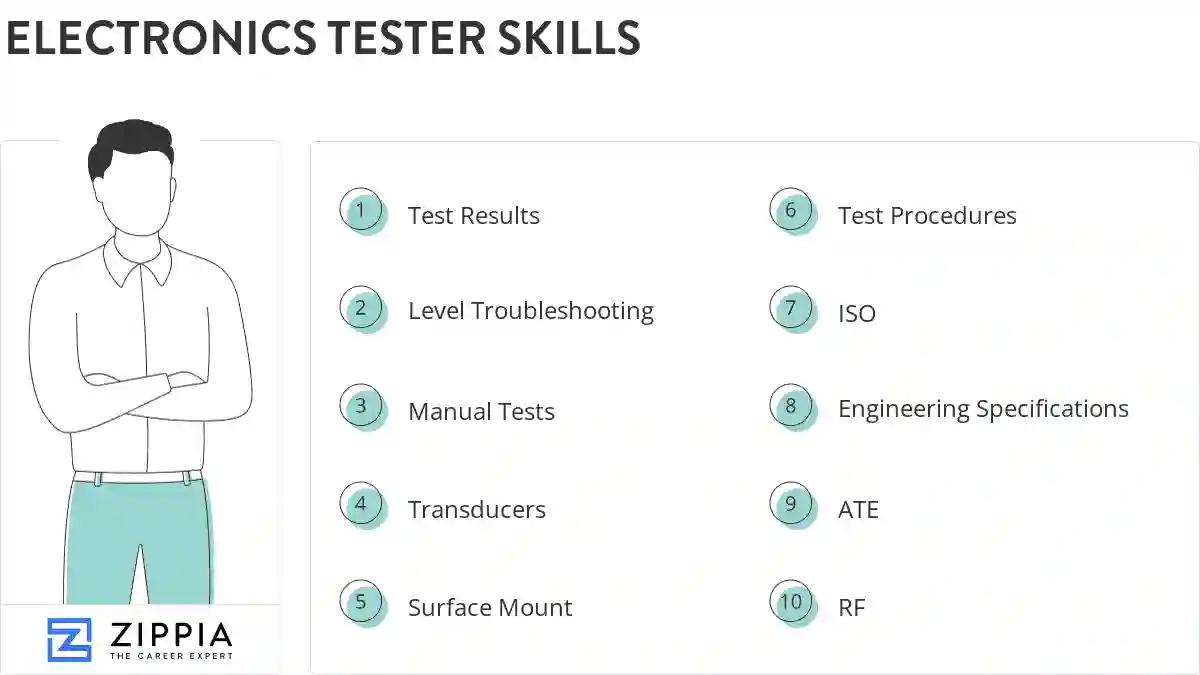
The most important skills for an electronics tester resume and required skills for an electronics tester to have include:
- Test Results
- Level Troubleshooting
- Manual Tests
- Transducers
- Surface Mount
- Test Procedures
- ISO
- Engineering Specifications
- ATE
- RF
- Electronic Devices
- Electronic Products
- Troubleshoot
- Electronic Assemblies
- Test Data
- ESD
- Mechanical Assembly
- Cell Phones
- Test Fixtures
- Microprocessors
- Functional Test
- SMT
- Assembly Line
- Soldering Irons
- Quality Standards
- ICT
- Radar
- Proper Functionality
- RAN
- Visual Inspections
- Resistors
- Performance Specifications
- QC
- Engineering Drawings
- Electronic Systems
- GPS
- RAM
- Customer Specifications
Updated January 8, 2025
