
Automatically apply for jobs with Zippia
Upload your resume to get started.
Embedded systems engineer skills for your resume and career
15 embedded systems engineer skills for your resume and career
1. Embedded Systems
- Designed and implemented embedded systems software firmware.
- Designed and developed embedded systems.
2. Python
Python is a widely-known programming language. It is an object-oriented and all-purpose, coding language that can be used for software development as well as web development.
- Implemented a significant portion of the software on flagship systems using C and Python.
- Developed web based application used in AED's using Python based object oriented web application server Zope.
3. Software Development
Software development is the mechanism by which programmers create computer programs. The Software Development Life Cycle (SDLC) is a framework for developing applications that follow technological needs and consumer requirements. It consists of many stages. The SDLC establishes an international standard that software developers can use to enhance and create their programs. It provides a well-defined framework for software developers to pursue in the production, maintenance, and design of premium quality software. The aim of the software development process is to create high-quality software on time and within budget.
- Developed software for evaluation, customer demonstration, and deployment using a software development process.
- Recommended, planned and implemented quality process plan for a software development project that lacked quality oversight for over a year.
4. C
- Developed embedded system firmware in C and Assembly language targeted to various micro-controller technologies, utilizing real time operating system services.
- Identified issues caused by C run-time model redefinition and identified work-around solutions.
5. C++
C++ is a general-purpose programming language that is used to create high-performing applications. It was invented as an extension to the C language. C++ lets the programmer have a high level of domination over memory and system resources. C++ is an object-oriented language that helps you implement real-time issues based on different data functions
- Modified a parser program written in MFC using c++ Lithium ion Battery life monitor using PIC18.
- Enhanced several c++ algorithms designed using Rational Rose and built using the Cygwin toolset.
6. Linux
Linux is a Unix-like operating system. Just like Windows, Mac OS, and IOS, Linux is an operating system used by millions across the globe. Android itself is powered by the Linux operating system. Linux manages all the hardware resources that are associated with your computer. The software is famous because of the protection it grants from viruses, malware, and crashes. The Linux operating system is entirely free and is an open-source software meaning it can be altered by those equipped with the knowledge to code.
- Developed and tested the interfacing programs in the VxWorks, LINUX/UNIX and PetaLinux Operating System.
- Designed and developed a wireless system to replace a legacy product based on linux and java.
Choose from 10+ customizable embedded systems engineer resume templates
Build a professional embedded systems engineer resume in minutes. Our AI resume writing assistant will guide you through every step of the process, and you can choose from 10+ resume templates to create your embedded systems engineer resume.7. SPI
SPI stands for "serial peripheral interface," which is a communication interface that transfers data between two electronic devices. This allows data to be transferred in both directions between the devices simultaneously, known as "full duplex mode." This mode differs from a "parallel" interface, which requires more complex and longer wiring.
- Developed SRAM/FRAM SPI interface for use in network communication.
- Develop Low-level Drivers for actuators, which include ADC, EEPROM, SPI, Interrupts, watchdog and Timers.
8. MATLAB
- Spearheaded a MATLAB tool to analyze data collected from drives to sign off vehicles to release.
- Used US06 driving cycle as test standard, modeled and simulated fuel consumption in MATLAB
9. RF
- Developed and implemented algorithms for RF processing.
- Worked with hardware and manufacturing personnel utilizing both RF and fiber-optic interfaces.
10. I2C
12C is a cloud-based database provided by Oracle and it's the first of its kind coming from the company. It's a high-performance database for enterprises with a multitenant framework that allows for seamless consolidation without having to enforce changes in the applications used.
- Verified systems communications using oscilloscopes, logic analyzers, and I2C protocols.
- Developed I2C communication for display data.
11. Prototyping
- Demonstrated technology superiority through prototyping, porting and optimizing legacy applications to IBM technology.
- Perform feasibility study, prototyping and participate in selection of development tools.
12. PCB
The PCB (Printed Circuit Board) refers to the hardware part housing all of the device's electrical connections.
- Designed driver circuit and created pcb for solenoid pump using timer circuit for OEM customer.
- Provided technical engineering support for the design, engineering and development of commercial PCB level electronic control systems.
13. Product Development
Product development is the complete procedure of creating a product from concept until release of the final product. Product development has many stages after which a product is released into the market. Identifying the need, creating the opportunity, conceptualizing a product, and providing a solution, all are different stages of product development.
- Orchestrated significant hardware and software improvements that reduced product development by 4 weeks while optimizing configuration management and I/O performance.
- Developed programs for automating aspects of product development.
14. Debugging
- Participated in electronic design reviews and assisted in hardware debugging.
- Worked on Boards for soldering as well as on testing and debugging of board level designs.
15. Microcontrollers
- Designed and coded a UART based bridge module linking the two microcontrollers used in the fixed access point devices.
- Programmed firmware of a distributed network of microcontrollers, with RF communication.
5 Embedded Systems Engineer resume examples
Build a professional embedded systems engineer resume in minutes. Browse through our resume examples to identify the best way to word your resume. Then choose from 5+ resume templates to create your embedded systems engineer resume.

What skills help Embedded Systems Engineers find jobs?
Tell us what job you are looking for, we’ll show you what skills employers want.
List of embedded systems engineer skills to add to your resume
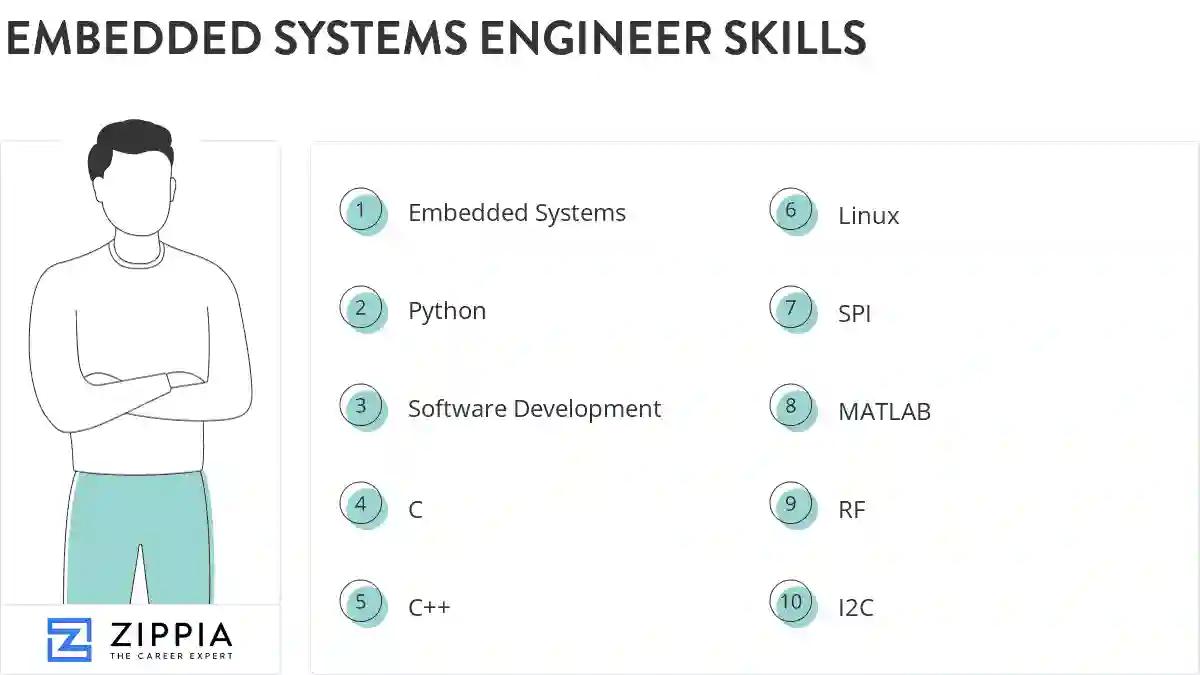
The most important skills for an embedded systems engineer resume and required skills for an embedded systems engineer to have include:
- Embedded Systems
- Python
- Software Development
- C
- C++
- Linux
- SPI
- MATLAB
- RF
- I2C
- Prototyping
- PCB
- Product Development
- Debugging
- Microcontrollers
- Data Acquisition
- System Design
- USB
- Ethernet
- Field Testing
- Embedded C
- RTOS
- Bluetooth
- DSP
- Java
- FPGA
- Analog
- Software Design
- Windows
- Firmware Development
- SOC
- UART
- Wifi
- Control Systems
- Microprocessors
- PC
- ASIC
- Rs-232
- UI
- LabVIEW
- API
- Debuggers
- Eclipse
Updated January 8, 2025
