
Automatically apply for jobs with Zippia
Upload your resume to get started.
Emergency communications technician skills for your resume and career
15 emergency communications technician skills for your resume and career
1. Emergency Communications
- Operate computerized emergency communications telephone equipment.
- Dispatched in Emergency Communications Call Center for National Airport Police and Dulles Airport Police simultaneously.
2. Patient Care
Patient care entails the diagnosis, recovery, and control of sickness as well as the maintenance of physical and emotional well-being through the use of healthcare providers' services. Patient care is described as services provided to patients by health practitioners or non-professionals under guidance.
- Direct patient care, collecting vital signs, drawing blood samples, procedure set-up, assisting with procedures.
3. CPR
Cardiopulmonary resuscitation or CPR is a medical procedure that involves chest compression to help a patient breathe. This artificial ventilation helps in keeping the brain function in place and regulates blood throughout the body. CPR is a lifesaving procedure that is used in emergencies.
- Provided Emergency Medical Dispatch instructions ranging from minor injuries to step-by-step CPR.
- Instructed CPR and First Aid Classes for seven years.
4. Computer Aided Dispatch
- Dispatch police, fire and emergency medical services via two-way radio and computer aided dispatch.
- Use CAD (Computer Aided Dispatch) to record all calls for services provided.
5. Data Entry
Data entry means entering data into a company's system with the help of a keyboard. A person responsible for entering data may also be asked to verify the authenticity of the data being entered. A person doing data entry must pay great attention to tiny details.
- Used Data entry to enter calls and keep inventory for tows.
- Managed all incoming and outgoing emergency calls into dispatch, coordinated officer response to emergency calls, data entry and database management
6. Medical Services
- Provide emergency and non-emergency communications response to individuals and entities requesting police, fire or emergency medical services.
- Dispatch and monitored emergency activity with the police department, fire department and/or emergency medical service.
Choose from 10+ customizable emergency communications technician resume templates
Build a professional emergency communications technician resume in minutes. Our AI resume writing assistant will guide you through every step of the process, and you can choose from 10+ resume templates to create your emergency communications technician resume.7. CAD
- Key Player in creating the design for the new CAD computer and 800 MHz radio system.
- Enter, update, and retrieve information from teletype networks and CAD system.
8. Computer System
- Monitored several complex radio frequencies; operated variety of communications equipment, radio consoles, telephones and computer systems.
- Monitor and operate several complex public safety communication equipment including radio consoles, security cameras, telephones, and computer systems.
9. Ambulances
- Coordinated response of ambulances and public safety units to emergency sites or in-progress crime situations.
- Coordinate response of ambulances and public safety units to emergency and non-emergency sites or in-progress crime situations.
10. Safety Regulations
- Take responsibility for safety in the workplace and comply with safety regulations.
- Complied with workplace and safety regulations.
11. Fire/EMS
- Dispatched Fire/EMS or Police units to alleviate situations that endanger or potentially endanger lives and/or property in Baltimore County.
- Monitor Fire/EMS calls of adjacent jurisdictions.
12. NCIC
- Attended a 40-hour certification course on the SLED/CJIS FBI NCIC Teletype System; PowerPhone Certified Telecommunicator
- Work 12 shifts post certified,gcic/ ncic certified.Apco certified.
13. Criminal Justice
- Accessed various criminal justice databases for information concerning offender status and criminal history.
- Maintained certification in order to access criminal justice databases.
14. Non-Emergency Services
- Processed requests for emergency and non-emergency services via telephone, radio, and computer.
- Received and responded to a variety of emergency and non-emergency services and complaints.
15. Non-Emergency Calls
Non-emergency calls are calls that do not require immediate attention or intervention. They are simply a request for police, fire or rescue service that does not present a life or death situation. In this case, the local non-emergency number should be used if immediate dispatch of the police is not required.
- Process and prioritizes incoming calls emergency and non-emergency calls for assistance and informs appropriate persons.
- Received and answered emergency and non-emergency calls.
5 Emergency Communications Technician resume examples
Build a professional emergency communications technician resume in minutes. Browse through our resume examples to identify the best way to word your resume. Then choose from 5+ resume templates to create your emergency communications technician resume.

What skills help Emergency Communications Technicians find jobs?
Tell us what job you are looking for, we’ll show you what skills employers want.
What type of skills will young emergency communications technicians need?
Bill Seifarth
Executive Director, National Registry of Emergency Medical Technicians
The global pandemic showed us the urgent need for medical professionals, especially those like EMTs and Paramedics in the prehospital setting. Additionally, the role of EMTs and Paramedics is evolving. Today EMS professionals work in diverse settings beyond a traditional prehospital ambulance service. National Registry certifications are held by EMS professionals working in hospitals and emergency departments, private medical practices, and community paramedicine, just to name a few.
List of emergency communications technician skills to add to your resume
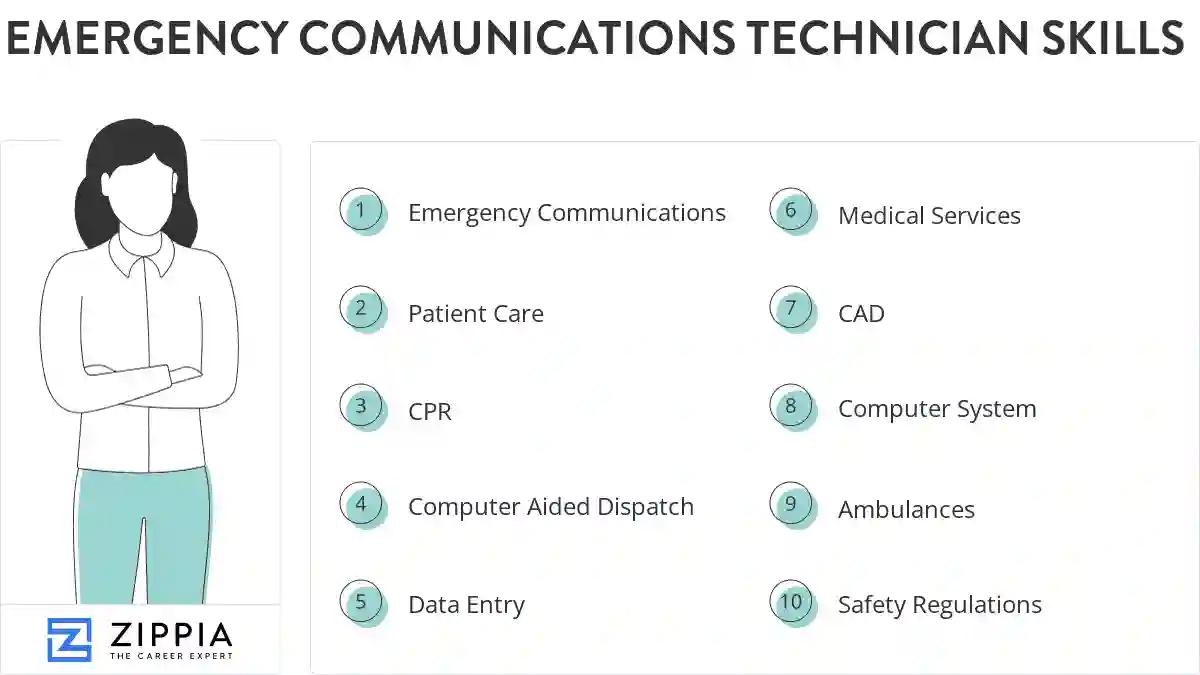
The most important skills for an emergency communications technician resume and required skills for an emergency communications technician to have include:
- Emergency Communications
- Patient Care
- CPR
- Computer Aided Dispatch
- Data Entry
- Medical Services
- CAD
- Computer System
- Ambulances
- Safety Regulations
- Fire/EMS
- NCIC
- Criminal Justice
- Non-Emergency Services
- Non-Emergency Calls
- Non-Emergency Situations
- Reference Materials
- Radio Systems
- Communications Equipment
- Law Enforcement Agencies
- Vital Signs
- GPS
- Appropriate Fire
- Vcin
- Non-Emergency Assistance
- Alarm Systems
- DMV
- Incident Reports
- Computer Equipment
- Computer Terminals
Updated January 8, 2025
