
Automatically apply for jobs with Zippia
Upload your resume to get started.
Emergency preparedness specialist skills for your resume and career
15 emergency preparedness specialist skills for your resume and career
1. Emergency Preparedness
- Lead in the design and implementation of facility emergency preparedness program in accordance with federal regulations and guidelines.
- Develop and implement drill and exercise scenarios to ensure the effectiveness of emergency preparedness activities.
2. Public Health
- Develop and implement plans and procedures related to the County Public Health's response to all hazards and emergencies.
- Develop protocols and procedures for public schools to follow in the event of a public health emergency.
3. Emergency Operations
- Evaluate emergency operations and exercises, providing feedback and corrective actions for improvement.
- Design Emergency Operations Center for activation during actual disasters.
4. Emergency Management
- Perform emergency management-related technical evaluations and analyses.
- Developed, coordinate and update plans, instructions and operational orders in support of customer emergency management programs.
5. Incident Management
Incident management is a set of processes, practices, and solutions designed to restore a damaged service as quickly as possible in an event that could result in the loss or disruption of an organization's operations, services, or functions. The goal of incident management is to maintain and restore normal service operations as quickly as possible and reduce the negative impact on business operations.
- Represented Department's interests to all National Response Plan/Framework, Homeland Security Presidential Directive, National Incident Management System deliberations.
- Implemented new Incident Management System ensuring installations ready to respond to any type of disaster and cooperate with local authorities
6. Incident Command System
Incident command system is a standard format that dictates the control, command, and procedures of emergency responses. Its purpose is to provide a chain of command that first responders from different agencies can use in the event of emergencies. It makes the response system effective and eliminates confusion that may arise from the hierarchy. It was developed to address the challenges faced by inter-agency responses to wildfires in Arizona and California but is now being used in the entire United States.
- HAMMER instructor (Incident Command System, Building Emergency Director, and Building Warden).
- Train administration on NIMS and Hospital Incident Command System.
7. Member Safety
Member safety is defined as the practice of ensuring the members of an organization are safe while availing of the services of the organization. It refers to the practice of an organization to make sure any service they provide is not causing any harm to the member. Any hazardous activity is discouraged, and physical security is prioritized.
- Exceed member expectations by demonstrating concern for member safety.
8. Nims
- Research and stay abreast of current Federal legislation, regulations and policies for sound agency NIMS infrastructure.
- Trained and knowledgeable in the National Incident Management System (NIMS).
9. Hazardous Materials
Any substance or good that is harmful to human health as well as the environment are called hazardous materials. Such materials must be handled carefully to avoid any mishaps. Harmful gases. chemicals, strong medicines or drugs, radioactive elements required for radiation purposes, a human blood sample that carries germs, all of these are considered hazardous materials.
- Provide 24/7 emergency services to all industries that ship, or use hazardous materials within their workplace.
- Coordinate Hazardous Materials, Confined Space Rescue and Fire Brigade Emergency Response Teams (ERT's).
10. AAA
American Automobile Association, commonly pronounced as AAA or triple A, is an organization in North America. AAA is a privately held non-profit driven public party affiliation and administration association with more than 60 million members in the United States and Canada. AAA offers types of assistance to its individuals, including emergency aide.
- Provide emergency roadside assistance to AAA customers Cross Selling Mentor new hires
- Received inbound calls and dispatched roadside assistance for AAA customers who needed help.
11. Technical Assistance
Technical assistance is the non-financial assistance provided by local or international specialists. The purpose of technical assistance is to maximize the project's implementation and quality of the final product. Technical assistance consists of sharing information, the transmission of working knowledge, and other transfer of technical data which would aid the administration, management team and help build the project. The technical assistance focuses on particular needs identified by the beneficiary country and is delivered in the form of missions.
- Supported the domestic preparedness equipment technical assistance program sponsored by the Department of Justice.
- Provided technical assistance and training to intake site personnel.
12. Roadside Assistance
- Processed member requests for roadside assistance while keeping members informed of the status and progress of their requests.
- Handled over 80 inbound calls per day to provide customer with quick and accurate roadside assistance.
13. Action Reports
- Evaluated exercise play and created After Action Reports and Improvement Plans.
- Evaluate lessons learned and develop after action reports from exercises and real-world events for capability improvements.
14. Emergency Response
- Performed emergency response program reviews and audits in several municipalities and jurisdictions while also conducting training and coordinating exercises in same.
- Conduct training for the Emergency Response Organization, developed lesson plans, examinations and maintained records electronically.
15. Natural Disasters
- Responded to all types of emergency situations such as pipeline ruptures, industrial fire cleanup, terriost actions and natural disasters.
- Devise emergency procedures for any and all contingencies involving Homeland Security and/or natural disasters.

What skills help Emergency Preparedness Specialists find jobs?
Tell us what job you are looking for, we’ll show you what skills employers want.
What emergency preparedness specialist skills would you recommend for someone trying to advance their career?
Laura Siebeneck Ph.D.
Professor and Chair, University of North Texas
List of emergency preparedness specialist skills to add to your resume
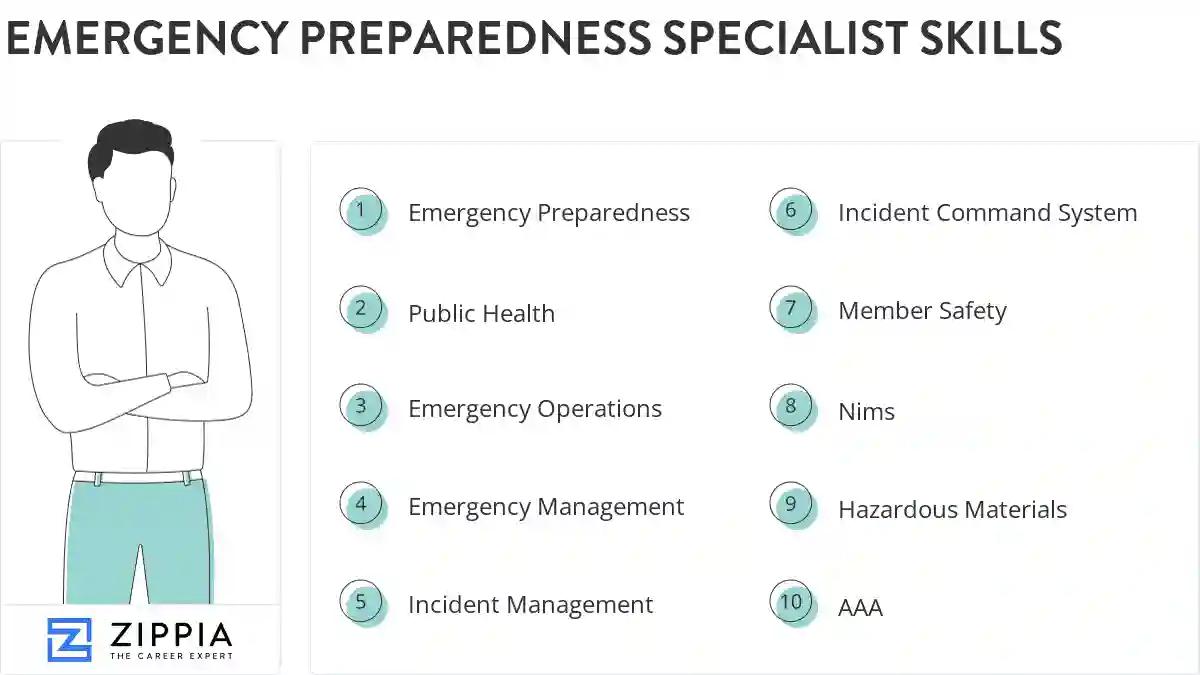
The most important skills for an emergency preparedness specialist resume and required skills for an emergency preparedness specialist to have include:
- Emergency Preparedness
- Public Health
- Emergency Operations
- Emergency Management
- Incident Management
- Incident Command System
- Member Safety
- Nims
- Hazardous Materials
- AAA
- Technical Assistance
- Roadside Assistance
- Action Reports
- Emergency Response
- Natural Disasters
- Hazmat
- Coop
- EOC
- HSEEP
- Emergency Services
- Law Enforcement
- Emergency Situations
- CPR
- Incident Response
- Federal Regulations
- DOD
- Disaster Response
- POD
- EMS
- Training Courses
- Federal Agencies
- Notification System
- ERO
- MRC
- FEMA
- Emergency Calls
- Training Programs
- Local Agencies
- Inbound Calls
- Emergency Room
- SNS
- Nuclear Power
- CDC
- Incident Investigations
- Ambulances
- SME
Updated January 8, 2025
