Explore jobs
Find specific jobs
Explore careers
Explore professions
Best companies
Explore companies
Job outlook for emergency services directors in the United States
Are emergency services director jobs in demand?
Emergency services director job and salary trends over time
Emergency services director jobs over time
Emergency services director job growth rate over time
| Year | # of jobs | % of population |
|---|---|---|
| 2021 | 2,017 | 0.00% |
| 2020 | 1,858 | 0.00% |
| 2019 | 1,823 | 0.00% |
| 2018 | 1,721 | 0.00% |
| 2017 | 1,602 | 0.00% |
Average emergency services director salary over time
Emergency services director salary by year
| Year | Avg. salary | Hourly rate | % Change |
|---|---|---|---|
| 2026 | $135,799 | $65.29 | +3.3% |
| 2025 | $131,501 | $63.22 | +1.3% |
| 2024 | $129,874 | $62.44 | +1.4% |
| 2023 | $128,076 | $61.58 | +1.9% |
| 2022 | $125,719 | $60.44 | +2.2% |
Emergency services director jobs by state
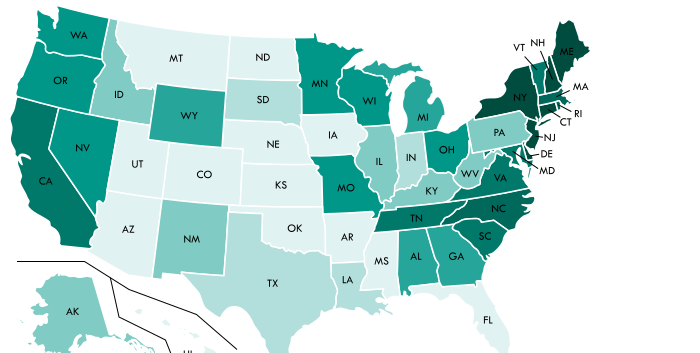
Most common states for emergency services directors
| Rank | State | Population | # of jobs | Employment/ 1000ppl |
|---|---|---|---|---|
| 1 | District of Columbia | 693,972 | 265 | 38% |
| 2 | Minnesota | 5,576,606 | 1,286 | 23% |
| 3 | Iowa | 3,145,711 | 661 | 21% |
| 4 | Massachusetts | 6,859,819 | 1,365 | 20% |
| 5 | New Hampshire | 1,342,795 | 256 | 19% |
| 6 | Louisiana | 4,684,333 | 838 | 18% |
| 7 | Oklahoma | 3,930,864 | 727 | 18% |
| 8 | Maine | 1,335,907 | 235 | 18% |
| 9 | Oregon | 4,142,776 | 717 | 17% |
| 10 | Alabama | 4,874,747 | 797 | 16% |
| 11 | Mississippi | 2,984,100 | 486 | 16% |
| 12 | New Mexico | 2,088,070 | 337 | 16% |
| 13 | Montana | 1,050,493 | 165 | 16% |
| 14 | Alaska | 739,795 | 116 | 16% |
| 15 | Vermont | 623,657 | 102 | 16% |
| 16 | Washington | 7,405,743 | 1,129 | 15% |
| 17 | Delaware | 961,939 | 144 | 15% |
| 18 | South Dakota | 869,666 | 130 | 15% |
| 19 | North Dakota | 755,393 | 114 | 15% |
| 20 | Connecticut | 3,588,184 | 488 | 14% |
Most common cities for emergency services directors
| Rank | City | # of jobs | Employment/ 1000ppl | Avg. salary |
|---|---|---|---|---|
| 1 | Allen Park | 1 | 4% | $137,275 |
| 2 | Fredericksburg | 1 | 4% | $154,491 |
| 3 | Jackson | 1 | 3% | $135,753 |
| 4 | Madison Heights | 1 | 3% | $137,650 |
| 5 | Carmichael | 1 | 2% | $159,974 |
| 6 | Leominster | 1 | 2% | $167,547 |
| 7 | Amarillo | 1 | 1% | $120,310 |
| 8 | Kansas City | 1 | 1% | $110,507 |
| 9 | Lynn | 1 | 1% | $168,673 |
| 10 | Palo Alto | 1 | 1% | $160,220 |
| 11 | Sioux City | 1 | 1% | $110,009 |
| 12 | Baltimore | 2 | 0% | $160,498 |
| 13 | Detroit | 2 | 0% | $137,537 |
| 14 | Colorado Springs | 1 | 0% | $110,278 |
| 15 | Gilbert | 1 | 0% | $108,980 |
| 16 | Minneapolis | 1 | 0% | $149,638 |
| 17 | New Orleans | 1 | 0% | $119,894 |
| 18 | New York | 1 | 0% | $176,905 |
| 19 | San Antonio | 1 | 0% | $119,466 |
Emergency Services Director job outlook: Expert opinions
Our panel of emergency services director experts
Texas A&M University - Central Texas
The University of Alabama
Cedar Crest College
Dawn Riess Ph.D., RN, ACUE
Assistant ProfessorTexas A&M University - Central Texas
Registered Nursing, Nursing Administration, Nursing Research And Clinical Nursing
What will help Emergency Services Directors increase their earning potential?
Dawn Riess Ph.D., RN, ACUE: The nursing shortage is an ongoing issue. As the number of nurses decreases, the pay scale increases. Having a varied background in nursing care makes you more marketable. Know your worth by researching what nurses make in different fields and then voice your pay expectations. Advancement is possible in many areas of nursing care. The hospital setting is usually the highest paying employer, as that is where a large percentage of nurses are needed. Having a minimum of a bachelor's degree is required for ongoing advancement. Choosing a specialty (ICU, OR, ED, Cath lab, etc.) area in nursing will also increase your salary potential. Taking advantage of any certifications will also increase your salary and marketability.
Pawn Johnson-Hunter MS, RN, AGPCNP-BC, GERO- BC, CM/DN
Nurse Educator, Nclex Mentor/CoachWhat general advice would you give to an Emergency Services Director?
Pawn Johnson-Hunter MS, RN, AGPCNP-BC, GERO- BC, CM/DN: A few ways to maximize earning potential as a new graduate nurse is through skillful negotiations and previous experience in healthcare, such as degree level, nurse externships, phlebotomy skills, or certifications. Many, if not all, employers appreciate that new graduates are equipped with clinical skills that are strongly recommended for the practice area. While many nurse certifications require experience, some are for entry-level, such as advanced life support (ACLS and PALS) and IV insertion. There are also some specialty practice certifications that new grads can obtain without years of experience; although they may recommend the experience at times, this is optional. All of this demonstrates the applicant's commitment to the profession and interest. Other ways are to work overtime hours, learn about clinical career ladders, or continue formal education.
Dr. Michelle Cheshire
Associate Dean Undergraduate ProgramsThe University of Alabama
Registered Nursing, Nursing Administration, Nursing Research And Clinical Nursing
What Emergency Services Director skills would you recommend for someone trying to advance their career?
Dr. Michelle Cheshire: As nursing education transitions to competency based education I believe that students will graduate from programs more "practice ready". I believe that in the next 3-5 years having strong leadership and delegation skills will be critical for nurses to optimize patient care outcomes. The healthcare team is interdisciplinary so delegation and leadership for fellow nurses is not the only skill you will need. You will need to be able to lead a healthcare team with members from other disciplines within the healthcare arena.
Wendy Robb Ph.D.
Dean & Professor, School of Nursing, Hazel and Walter May Nursing Endowed Chair for Excellence in NursingCedar Crest College
School of Nursing
What type of skills will young Emergency Services Directors need?
Wendy Robb Ph.D.: First and foremost, our newest crop of professional nurses will need resiliency - the capacity to recover quickly from difficulties - toughness!! (Oxford dictionary) These nurses will need mental toughness and will be asked to flex further than they've ever flexed before. As health care professionals we need to support their mental health and professional development as new nurses. Encourage meditation, relaxation, exercise, walks in nature, etc. New graduates entering the current healthcare system may be questioning their choice of profession and their decision to become a nurse, particularly with the overlay of politicism with the pandemic. It is our responsibility to help them through and prepare them, equip them for short-term and long-term successes. We don't know exactly how they will fair, but it is our essential duty to nurture them. They will be a special breed, a group of new nurses who entered the profession during a full-blown pandemic in the Year of the Nurse and Midwife (2020). I wonder what Florence Nightingale would think? I am sure she would be proud and expect nothing less than our best!