
Automatically apply for jobs with Zippia
Upload your resume to get started.
Engineering scientist skills for your resume and career
15 engineering scientist skills for your resume and career
1. C++
C++ is a general-purpose programming language that is used to create high-performing applications. It was invented as an extension to the C language. C++ lets the programmer have a high level of domination over memory and system resources. C++ is an object-oriented language that helps you implement real-time issues based on different data functions
- Performed C++ software development as needed during project development.
- Developed a Bayesian classifier for recognizing hand gestures from a Leap Motion Controller and developed API-level C++ extensions to the controller.
2. Python
Python is a widely-known programming language. It is an object-oriented and all-purpose, coding language that can be used for software development as well as web development.
- Create lift-off animations of launch vehicles such as ARES I (CLV) using Blender and Python.
- Used Python to test board's USB interface.
3. Data Analysis
- Incorporated test equipment software changes that reduced test uncertainty, reduced field-use time and enhanced data analysis capability.
- Performed data analysis and prepared a variety of technical and nontechnical reports, including procedures and plans.
4. DOD
Definition of Done (DoD) is a set of deliverables that are needed to devise software. These deliverables are valuable to the system and can be exemplified by writing code, coding comments, unit testing, integration testing, design documents, release notes, and so on.
- Coordinated with NSA and DoD agencies for certification, approval and fielding of the box.
- Supported a DoD Biometric Matching Service Provider
5. Project Management
- Provided project management oversight of a finite element analysis and optimization program for 747 aircraft assembly.
- Supported project management by preparing and presenting project status and performance data to customers.
6. RF
- Performed RF susceptibility and leakage testing.
- Developed, refined and validated test plans, budget, and schedule prior to performing RF measurements.
Choose from 10+ customizable engineering scientist resume templates
Build a professional engineering scientist resume in minutes. Our AI resume writing assistant will guide you through every step of the process, and you can choose from 10+ resume templates to create your engineering scientist resume.7. Java
Java is a widely-known programming language that was invented in 1995 and is owned by Oracle. It is a server-side language that was created to let app developers "write once, run anywhere". It is easy and simple to learn and use and is powerful, fast, and secure. This object-oriented programming language lets the code be reused that automatically lowers the development cost. Java is specially used for android apps, web and application servers, games, database connections, etc. This programming language is closely related to C++ making it easier for the users to switch between the two.
- Designed, implemented Real-time STX by using existing BBN speech recognition engine in Java.
- Designed and implemented in-house Java graphics toolkit as an extension of Java 2D.
8. Technical Reports
Technical reports are a type of document that is used to indicate either the progress, result, or process of scientific research or the state of problems occurring within such research. A technical report may also showcase the report's overall conclusion and may also include recommendations. This kind of report does not require a peer review and isn't published officially but distributed within the organizations where it was formed.
- Provide interpretation and recommendations via authoring technical reports delivered to the Change Review Board which consists of Directors and Senior Managers.
- Managed and tested all hydrate tests, then wrote technical reports.
9. Technical Support
Technical support or tech support are the services provided by any hardware or software company to users. They help in solving the technical difficulties the customers face with their products or services. Moreover, the tech support employees maintain, manage, and repair the IT faults. They are also responsible for resolving the network problems, installing and configuring hardware and software.
- Provided technical support to the production, engineering and maintenance subdivisions.
- Provide technical support for manufacturing and production issues.
10. Test Results
- Utilized test equipment such as oscilloscopes and signal generators in evaluating and analyzing simulated lightning test results.
- Advised the instrument contractor in the development of test procedure to ensure accurate and meaningful test results.
11. CAD
- Loft aerodynamic surfaces within integrated product CAD models using relational design.
- Designed payload interface brackets and other substructure assemblies for the Space Shuttle program using CATIA and ANVIL CAD systems.
12. PowerPoint
- Performed extensive online and book cetacean research, and, prepared PowerPoint slides displaying cetacean information for regions with naval exercises.
- Worked as a team member building PowerPoint presentations.
13. Linux
Linux is a Unix-like operating system. Just like Windows, Mac OS, and IOS, Linux is an operating system used by millions across the globe. Android itself is powered by the Linux operating system. Linux manages all the hardware resources that are associated with your computer. The software is famous because of the protection it grants from viruses, malware, and crashes. The Linux operating system is entirely free and is an open-source software meaning it can be altered by those equipped with the knowledge to code.
- Delivered on time software models on UNIX / Linux based systems for simulation applications.
- Determined socket port connections using Linux tools and researched TCP errors.
14. System Performance
System performance refers to how efficient a computer system is, often measured on how much work is completed in a set timeframe. This measurement is estimated judging on a computer system's speed, the accuracy, and how efficient the work is completed. Depending on the field, a system's performance may be required to meet a certain level before the system can safely be used.
- Analyzed system performance with computer simulation & field gathered empirical data with respect to atmospheric conditions & counter measures.
- Presented subsystem performance data in regular project status review meetings and finalized rework plan.
15. Prototyping
- Utilized rapid prototyping as proof of concepts for multiple new designs.
- Supported design and prototyping of a small, portable numerical control drill tool.
5 Engineering Scientist resume examples
Build a professional engineering scientist resume in minutes. Browse through our resume examples to identify the best way to word your resume. Then choose from 5+ resume templates to create your engineering scientist resume.

What skills help Engineering Scientists find jobs?
Tell us what job you are looking for, we’ll show you what skills employers want.
What skills stand out on engineering scientist resumes?
Marco Salviato Ph.D.
Assistant Professor in Aeronautics & Astronautics, Adjunct Assistant Professor in Materials Science and Engineering, University of Washington
My advice to students to nurture these skills is to engage as early as possible with student clubs such as UW Design Build Fly (DBF) or SARP (Society for Advanced Rocket Propulsion). Another good idea is to get involved as soon as possible in research activities conducted by faculty in the Department. Finally, I cannot stress enough the importance of participating in summer internships at aerospace companies. For all these activities to be relevant, it is important to make sure there are tangible outcomes and the contribution of the student is evident. A sentence such as, "I worked in a team of twenty people to design a new concept of bracket for an aerospace hydraulic fuel system. I was the leader of a team of five people in charge of the structural design. Leveraging Finite Element Analysis we were able to reduce the weight of the bracket of more than 50 percent compared to legacy design. In addition to the FEM simulations, my responsibilities included organizing weekly meetings with the team to discuss progress, deliverables, and timeline, presenting the results to the company, and writing monthly scientific reports" really stands out in a resume. All the industrial partners I work with told me that having these experiences with tangible outcomes in the resume is one of the key deciding factors for a new hire.
What engineering scientist skills would you recommend for someone trying to advance their career?
Paul Orkwis
Dr, University of Cincinnati
What type of skills will young engineering scientists need?
Dennis Doverspike Ph.D.
Chief People Scientist, Doverspike Consulting/HR LItehouse
What soft skills should all engineering scientists possess?
Tim Keenan Ph.D.
Assistant Professor Biomaterials Engineering, Alfred University
In addition to effective communication, it is also natural to assume that eventually, many positions will once again require on-site labor, and so emotional intelligence will once again become an essential skill for every graduate to develop. It has become easier than ever to express our frustrations throughout the workday, as a simple click of the "mute" and "camera" buttons during meetings allows us to vent in ways which will not be possible once on-site days become normal again, and we can no longer simply disappear from the meetings or workplace. Learning to effectively work alongside both those you adore and those you loathe is not only a skill which will help graduates obtain thier first position, but will also allow them to excel throughout their entire careers.
List of engineering scientist skills to add to your resume
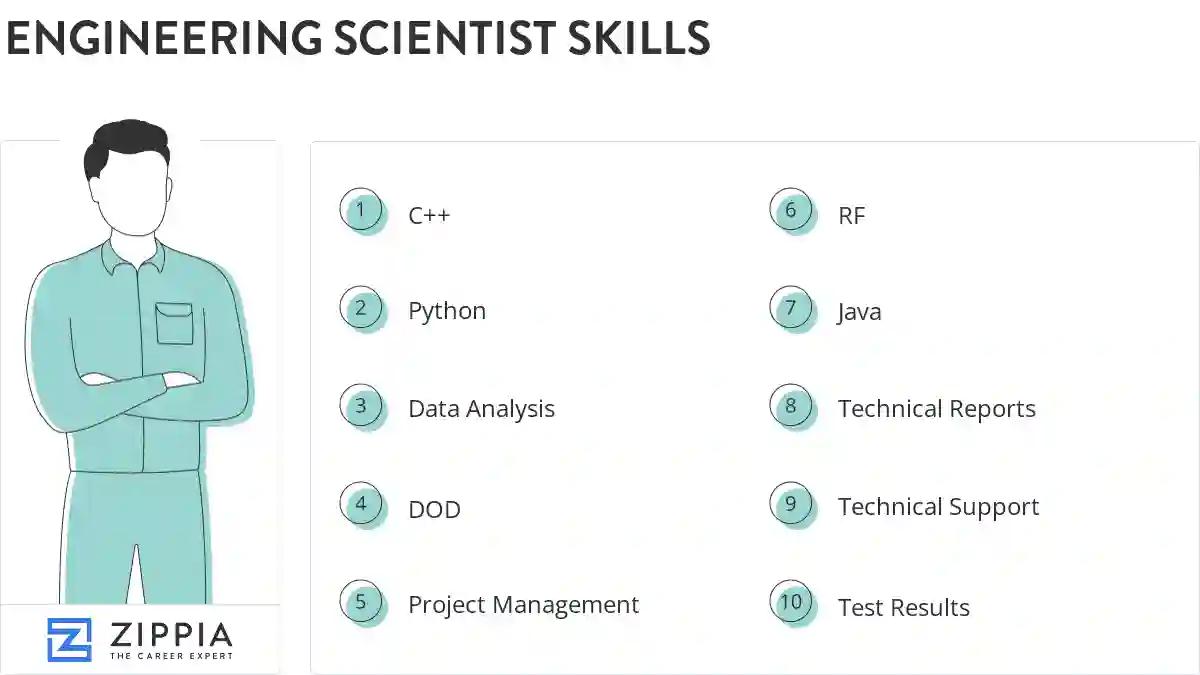
The most important skills for an engineering scientist resume and required skills for an engineering scientist to have include:
- C++
- Python
- Data Analysis
- DOD
- Project Management
- RF
- Java
- Technical Reports
- Technical Support
- Test Results
- CAD
- PowerPoint
- Linux
- System Performance
- Prototyping
- Windows
- Remote Sensing
- Sops
- Signal Processing
- Test Procedures
- Test Data
- Software Tools
- Product Development
- Engineering Support
- Management System
- System Engineering
- Technical Issues
- Renewable Energy
- Profiling
- SQL
- Field Testing
- Visualization
- ISO
- Trade Studies
- R
- Extraction
- Test Equipment
- EMI
- DNA
- Aided Design
- Data Acquisition
- Failure Analysis
- Configuration Management
- Test Reports
- LabVIEW
- Extrusion
- FAA
- Absorption
Updated January 8, 2025
