
Automatically apply for jobs with Zippia
Upload your resume to get started.
Enterprise data architect skills for your resume and career
15 enterprise data architect skills for your resume and career
1. Analytics
- Set the overall architectural direction for Enterprise Data Warehouse, and OBIEE Data Marts for enterprise analytics reporting.
- Coordinate work of technical teams, on/offshore resources and vendors for Data Integrating and BI Analytics Projects.
2. Cloud
Cloud is a server that is accessed over the internet. There are different programs and software that also run on these servers. These clouds can be accessed from anywhere in the world as they are not present in your computer storage, but have their online servers. Cloud consists of data centers all across the world.
- Conducted assessment for Systems Security plan (SSP), Cloud Service Provider, PAAS, SAAS, IAAS.
- Manage all corporate-wide infrastructure including firewalls, virtual environments, cloud environments, and Layer 2-Layer 7 approvals.
3. Python
Python is a widely-known programming language. It is an object-oriented and all-purpose, coding language that can be used for software development as well as web development.
- Supported developers and programmers for Python Security check and code compliance to suit federal standards.
- Developed instrument models and Monte Carlo simulator in Python.
4. Data Management
The administrative process that involves collecting and keeping the data safely and cost-effectively is called data management. Data management is a growing field as companies rely on it to store their intangible assets securely to create value. Efficient data management helps a company use the data to make better business decisions.
- Assessed data management and functional capabilities for potential vendor solutions, assessing the compatibility of products with A7C client requirements.
- Developed classes on data management and advanced data modeling, and various presentations on data architecture and data warehousing.
5. Data Quality
- Build features to support data categorization models, data quality anomaly detection and better data cleansing processes.
- Lead planning of corporate data governance process with concentration on data quality and reference data implementations.
6. Hadoop
Hadoop is an open-source software and procedures framework that is free for anyone to use on the internet. Hadoop aids in big data operations. It allows massive data storage, applications to be run on commodity hardware, and can easily manage to run various tasks occurring at the same time.
- Designed requirements for an enterprise data profiling utility, with Hadoop as primary focus.
- Developed requirements for bringing pricing and orders data into Hadoop enterprise data hub.
Choose from 10+ customizable enterprise data architect resume templates
Build a professional enterprise data architect resume in minutes. Our AI resume writing assistant will guide you through every step of the process, and you can choose from 10+ resume templates to create your enterprise data architect resume.7. AWS
- Helped developers to automate code deployment and features release using AWS Code Deploy.
- Designed and provisioned a sandbox environment of Oracle EnterpriseOne ERP system in AWS EC2 to perform fit/gap analysis.
8. Data Integration
- Provided GIS technical support to data collection, data integration efforts and improved operating protocols governing data reporting and management.
- Put together an architectural vision to reduce complexity, simplify data integration and data provisioning.
9. Azure
- Used Azure Machine learning for predictive models.
- Azure) PostgresSQL, Greenplum, Hawq & Kafka environments; GoLANG Program Architect & Admin.
10. Data Lake
- Worked on IMPALA for building out the tables for supporting reporting from data lake.
- Analyzed data of existing applications for lifting and shifting to data lake environment from existing systems as part of data migration.
11. Metadata
Metadata is a combination of two words, meta and data. Meta is a prefix defined as more comprehensive, and data means collection of data. Metadata is defined as the data that describes other data. It is used to summarize data about data to make the data easier to analyze.
- Provided data element naming conventions consistent with standards and ensured that data dictionaries and metadata are maintained across multiple database environments.
- Advised on data architecture standards and guidelines; modeled metadata requirements to extend the enterprise metadata repository (Platinum).
12. Infrastructure
Infrastructure includes the organizational and physical structures needed to run an area or a society smoothly. It is a group of basic facilities required for any society or firm to run sustainably and efficiently. The infrastructural system is a high investing area and helps majorly in flourishing the economy and prosperity of a country. It is an underlying system needed for ensuring the safety and comfort of the public and to run a country smoothly. All the tasks needed to be performed for a flourishing economy and a happy and healthy public are included in infrastructure.
- Carried out full-scope technology assessment - infrastructure evaluation, software adoptions and hardware procurement in support of overall business-process improvement goals.
- Developed client segmentation strategy for product and infrastructure assignment.
13. Data Governance
Data governance is an assortment of cycles, jobs, arrangements, principles, and measurements that guarantee the successful and productive utilization of data in empowering an association to accomplish its objectives. Information administration characterizes who can make a what move, upon what information, in what circumstances, utilizing what strategies
- Participate in enterprise risk management and adherence to enterprise data governance policies and practice.
- Served as contributing member of Data Governance Council and Data Stewardship and Mobilization Committees.
14. Data Standards
- Defined enterprise data standards for all logical/physical models under development.
- Provide guidance and leadership to state data architects in implementing data model changes that follow enterprise data standards and naming convention.
15. Business Processes
- Map & Gap Analysis of Business Processes and Data for provider and claim subject area using SAP Business Object tool.
- Build the Enterprise Data Warehouse with the top down business processes and bottom up implementation across applications and organizations.
5 Enterprise Data Architect resume examples
Build a professional enterprise data architect resume in minutes. Browse through our resume examples to identify the best way to word your resume. Then choose from 5+ resume templates to create your enterprise data architect resume.

What skills help Enterprise Data Architects find jobs?
Tell us what job you are looking for, we’ll show you what skills employers want.
What skills stand out on enterprise data architect resumes?
James Shields
Design Principal at HGA Architects and Associate Professor of Architecture, University of Wisconsin - Milwaukee
What enterprise data architect skills would you recommend for someone trying to advance their career?
Elaine Chow AIA, RA, NCARB
Director of Student Professional Development, Clinical Assistant Professor - Architecture, NCARB Licensing Advisor, SUNY at Buffalo
What type of skills will young enterprise data architects need?
Clyde Eiríkur Hull
Professor of Strategic Management, Rochester Institute of Technology
What soft skills should all enterprise data architects possess?
Dak Kopec Ph.D.
Associate Professor, Coordinator, BA Interior Architecture and Design and Master of Design Program, University Of Nevada, Las Vegas
What hard/technical skills are most important for enterprise data architects?
Dak Kopec Ph.D.
Associate Professor, Coordinator, BA Interior Architecture and Design and Master of Design Program, University Of Nevada, Las Vegas
List of enterprise data architect skills to add to your resume
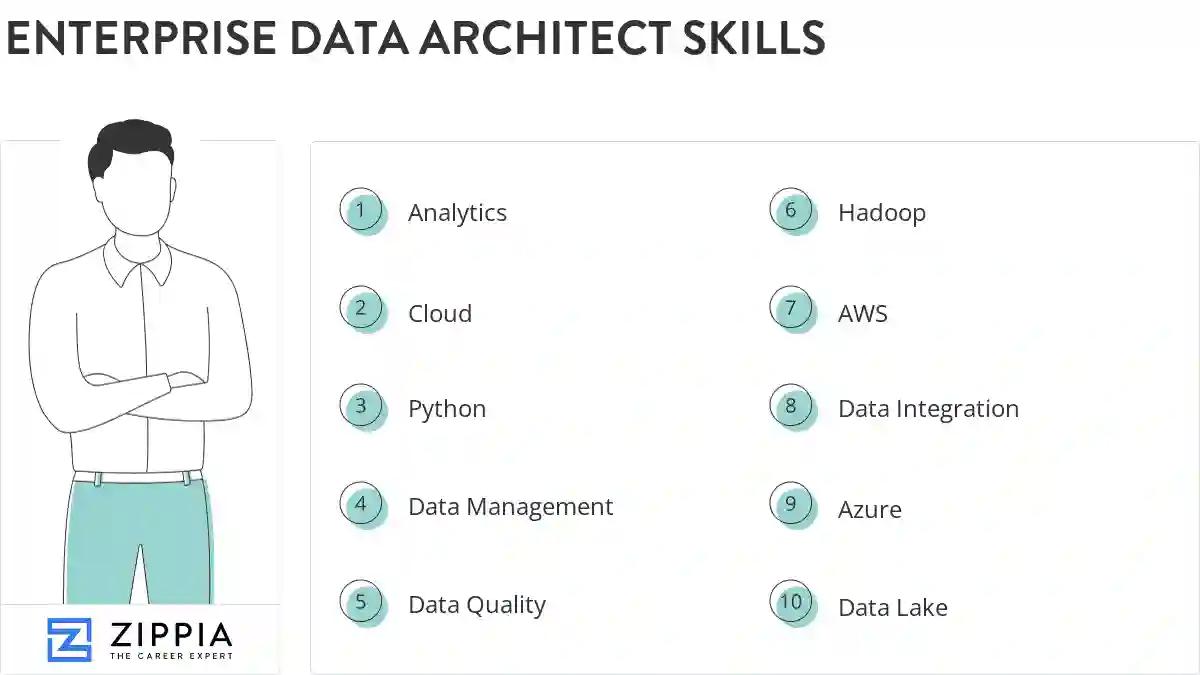
The most important skills for an enterprise data architect resume and required skills for an enterprise data architect to have include:
- Analytics
- Cloud
- Python
- Data Management
- Data Quality
- Hadoop
- AWS
- Data Integration
- Azure
- Data Lake
- Metadata
- Infrastructure
- Data Governance
- Data Standards
- Business Processes
- SQL Server
- Java
- Profiling
- Enterprise Architecture
- ETL
- Emerging Technologies
- Data Warehouse
- Snowflake
- Visualization
- Master Data
- Amazon Web Services
- Business Intelligence
- SDLC
- Tableau
- OLTP
- Data Analysis
- Data Strategy
- Data Warehousing
- OLAP
- Physical Data Models
- Database Design
- DBA
- Sap Hana
- MDM
- EDW
- Lifecycle Management
- Reference Data
- Ssis
- Teradata
- Oracle Sql
- CRM
- Schema
- Business Analysts
- DB2
Updated January 8, 2025
