
Automatically apply for jobs with Zippia
Upload your resume to get started.
Enterprise systems administrator skills for your resume and career
15 enterprise systems administrator skills for your resume and career
1. Troubleshoot
Troubleshooting is the process of analyzing and fixing any kind of problem in a system or a machine. Troubleshooting is the detailed yet quick search in the system for the main source of an issue and solving it.
- Create, Implement and troubleshoot of GPO's within windows 2008 domain environment to resolve server/client problems.
- Establish Active Directory / Remedy accounts for new users; troubleshoot and diagnose account issues.
2. PowerShell
- Process automation: Leverage scheduled tasks; to execute batch Jobs, and or Windows PowerShell scripts.
- Developed custom Active Directory monitoring tools using powershell to ensure 100% availability for Windows roles.
3. Database
A database is a collection of data and information which makes it easy to view, access, and manage. Databases save a lot of time and can store huge amounts of data. Databases make sorting data easier and stores it in certain fields which narrows the searching criteria. A database usually contains tables, graphs, and columns to display data.
- Created the Florida Hospital database to track company device inventory and configurations.
- Worked with database administrators on daily databases issues.
4. Linux
Linux is a Unix-like operating system. Just like Windows, Mac OS, and IOS, Linux is an operating system used by millions across the globe. Android itself is powered by the Linux operating system. Linux manages all the hardware resources that are associated with your computer. The software is famous because of the protection it grants from viruses, malware, and crashes. The Linux operating system is entirely free and is an open-source software meaning it can be altered by those equipped with the knowledge to code.
- Deployed Active Directory/LDAP authentication across entire Linux environment.
- Installed and maintained Highly available server solutions including fail over and load balanced clusters in Windows, Linux and HPUX.
5. Windows Server
- Reviewed Windows server applications and workstation problems and provided corrective actions / recommendations.
- Installed, configured and managed over 300 Windows servers in a 24/7 production environment that included clustering and load-balanced services.
6. SCCM
- Researched, conceptualized, and implemented SCCM 2012 environment to run in parallel for migration from SCCM 2007.
- Provide training courses on the use of the SCCM system to IT personnel located at each regional office.
Choose from 10+ customizable enterprise systems administrator resume templates
Build a professional enterprise systems administrator resume in minutes. Our AI resume writing assistant will guide you through every step of the process, and you can choose from 10+ resume templates to create your enterprise systems administrator resume.8. Management System
A management system is a set of policies, processes, and procedures taken by an organization or a business to ensure it can fulfill its tasks and achieve its objectives. A management system makes sure that the company excels financially and improves the user experience. The management system also takes care of the worker's and employees' needs and manages their workload and oversees their performance. Apart from interior matters of the company, a management system also deals with exterior matters like legislations, tax matters, and law issues.
- Redesigned entire enterprise management system throughout the PAGEMART infrastructure after taking over enterprise management systems.
- Implemented information technology management systems reducing overtime by 500 hours each year.
9. SQL Server
- Converted SQL queries from IBM DB2, UDB and Sybase to MS SQL Server 2000 stored procedures.
- Participated in disaster recovery planning for SQL Servers and implementing database mirroring for constant availability of PeopleSoft FSCM application.
10. DHCP
- Provide TCP/IP to additional DNS servers and DHCP support for Counter IED Targeting Program (CITP) operations.
- Managed Windows 2003 Server, MS SQL management console, Active Directory, DNS, DHCP.
11. DNS
Domain Name Systems, or DNS for short, is the internet's system for converting readable language, i.e., google.com, to machine language, i.e, 192.168. For a simple analogy, some call it the phonebook of the internet. Any website has its own IP address, for example, 192.168.160. Understandably this is hard to remember. So what a DNS does is link the domain name, google.com, with its IP address, 192.168.160.
- Key Achievements/Accomplishments: * Established and implemented DNS caching servers in response to security concerns with DNS recursion.
- Configure and maintain DNS and BIND domain name services on both UNIX and Microsoft platforms.
12. SAN
SAN abbreviation for storage area network is a computer network that provides storage access.
- Supported over 370 SAN 3.0 attached, clustered Exchange 2000 servers, with over a 175,000 users.
- Managed setup of new Continuity of Operations Planning using remote SAN and local NAS and switch configuration.
13. DOD
Definition of Done (DoD) is a set of deliverables that are needed to devise software. These deliverables are valuable to the system and can be exemplified by writing code, coding comments, unit testing, integration testing, design documents, release notes, and so on.
- Served as a System Administrator in a test lab environment (DOD SIPRNET& NIPRNET environment).
- Ensured implementation and enforcement of national, DoD, and Air Force security policies and directives.
14. Desktop
The term desktop commonly refers to the desktop computer also called a personal computer. A PC is named after a desktop as it is placed on or under the desk. A desktop computer consists of different accessories such as CPU, monitor, mouse, keyboard, speakers, etc. The desktop also refers to the graphical user interface that appears on a computer, displaying all the icons on the monitor screen.
- Performed daily system monitoring, verifying the integrity and availability of all desktop hardware.
- Perform Disk Imaging and Image deployment guidance with Norton Ghost and Power Guest in the Desktop manufacturing environment for Disk Duplication.
15. IP
An IP - Internet Protocol is a unique number assigned to all devices connected to information technology, such as printers, routers, modems, etc. Each device or domain that connects to the Internet is assigned an IP address, and as packets are directed to the IP address attached to them, the data goes where it is needed. IP addresses are the identifier used to send information between devices on a network. They contain location information and make devices accessible for communication.
- Configure the router to accommodate IP tunnels at enterprise level.
- Create Ports and CRTs for PCs with a given IP Address.
5 Enterprise Systems Administrator resume examples
Build a professional enterprise systems administrator resume in minutes. Browse through our resume examples to identify the best way to word your resume. Then choose from 5+ resume templates to create your enterprise systems administrator resume.

What skills help Enterprise Systems Administrators find jobs?
Tell us what job you are looking for, we’ll show you what skills employers want.
What skills stand out on enterprise systems administrator resumes?
Austin McCoy
Director of Javelina Engineering Student Success Center, Texas A&M University - Kingsville
-Internship/co-op experience -Research experience
-Good leadership skills and involvement on campus and in the community and activities where the individual works as part of a team.
-Well written resume can tell a lot about the technical writing skill; a resume needs to be clean and comfortable to read; recruiters can find what they are looking for easily.
-Less is sometimes more because students sometimes will put more information on a resume than is pertinent to the position applying for.
What enterprise systems administrator skills would you recommend for someone trying to advance their career?
Dr. Ariful Azad Ph.D.
Director of Graduate Studies for the Dept. of Intelligent Systems Engineering, Assistant Professor of Intelligent Systems Engineering, Indiana University Bloomington
What type of skills will young enterprise systems administrators need?
Vince Bowen
Executive Director, Department Chair Energy Systems Technology & Education Center (ESTEC), Idaho State University
List of enterprise systems administrator skills to add to your resume
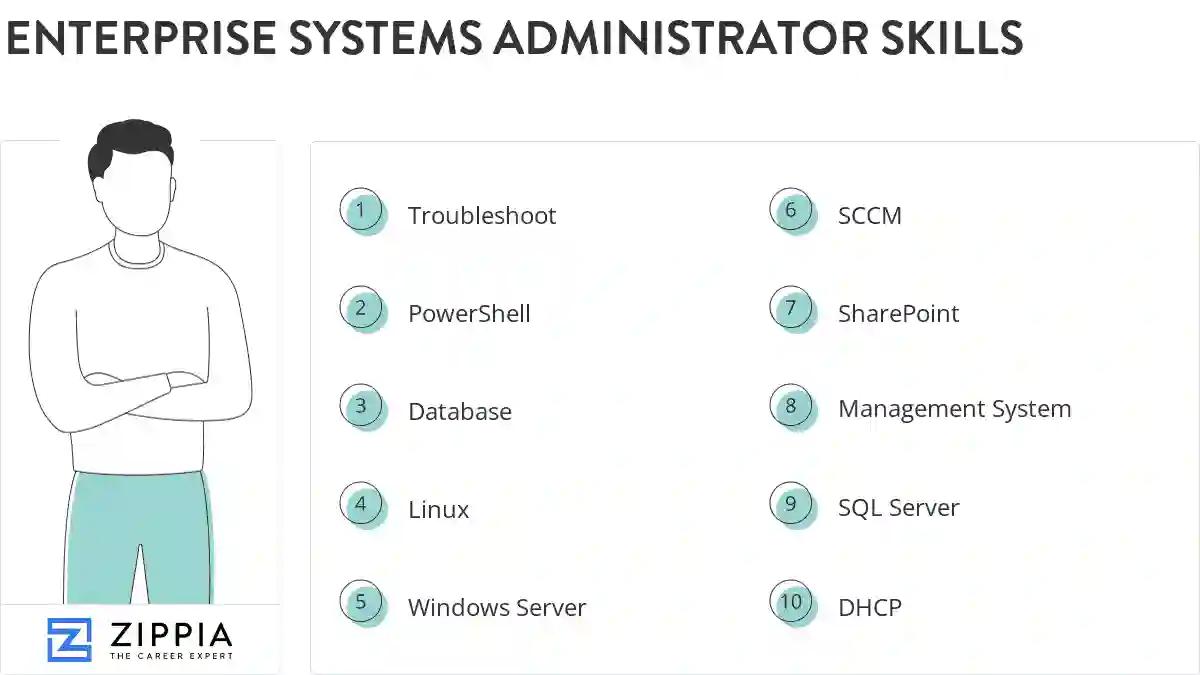
The most important skills for an enterprise systems administrator resume and required skills for an enterprise systems administrator to have include:
- Troubleshoot
- PowerShell
- Database
- Linux
- Windows Server
- SCCM
- SharePoint
- Management System
- SQL Server
- DHCP
- DNS
- SAN
- DOD
- Desktop
- IP
- Symantec
- Unix
- OS
- Technical Support
- SCOM
- Provisioning
- Tcp Ip
- NAS
- Network Infrastructure
- Virtualization
- Problem Resolution
- Switches
- PC
- Microsoft Exchange
- Azure
- Citrix
- User Accounts
- Microsoft Windows
- Microsoft System Center
- Disa
- Virtual Servers
- DR
- PKI
- Red Hat
- LDAP
- Security Policies
- Remedy
- Group Policies
- Microsoft Server
- Virtual Machines
- Lan Wan
- Remote Sites
- IIS
- Java
- R2
Updated January 8, 2025
