Explore jobs
Find specific jobs
Explore careers
Explore professions
Best companies
Explore companies
What is an environmental scientist/geologist and how to become one
While many students are interested in studying engineering, business, or computer science, geology may be of interest to some. These earth lovers can tell you what has happened to the earth in the past and what may happen in the future. Geologists are kind of like Earth detectives and, thanks to them, we can protect ourselves from natural disasters and save lives.
A geologist studies the composition and structure of the earth's crust and tries to understand the history of the planet. Based on their findings, they can foresee how past processes and events may influence the future. Geologists also monitor planetary changes like land formation and climate change.
Professional geologists possess excellent problem-solving skills, stamina, and communication skills. The job is highly paid at an average of $41.96 an hour and is expected to experience a 6% growth by 2028. Great employment opportunities can be found at universities, with the federal government, and with private energy industries.
What general advice would you give to an environmental scientist/geologist?
Nelson Ham Ph.D.
Professor of Geology and Environmental Science, St. Norbert College
Avg. Salary $63,344
Avg. Salary $59,228
Growth rate 5%
Growth rate 0.3%
American Indian and Alaska Native 0.77%
Asian 5.03%
Black or African American 3.09%
Hispanic or Latino 6.19%
Unknown 3.68%
White 81.24%
Genderfemale 24.73%
male 75.27%
Age - 37American Indian and Alaska Native 3.00%
Asian 7.00%
Black or African American 14.00%
Hispanic or Latino 19.00%
White 57.00%
Genderfemale 47.00%
male 53.00%
Age - 37Stress level is manageable
7.1 - high
Complexity level is challenging
7 - challenging
Work life balance is good
6.4 - fair
Key steps to become an environmental scientist/geologist
Explore environmental scientist/geologist education requirements
Start to develop specific environmental scientist/geologist skills
Skills Percentages OSHA 25.86% GIS 13.78% Surface Water 7.83% GPS 5.64% Data Management 5.58% Complete relevant environmental scientist/geologist training and internships
Accountants spend an average of 6-12 months on post-employment, on-the-job training. New environmental scientist/geologists learn the skills and techniques required for their job and employer during this time. The chart below shows how long it takes to gain competency as an environmental scientist/geologist based on U.S. Bureau of Labor Statistics data and data from real environmental scientist/geologist resumes.Research environmental scientist/geologist duties and responsibilities
- Develop and manage company EHS compliance processes in accordance with current and upcoming regulatory mandates.
- Review raw analytical data and compare to Illinois EPA guidelines.
- Experience with EPA Superfund projects.
- Perform asbestos abatement oversight for schools and other clients ensuring AHERA, NESHAP and OSHA compliance.
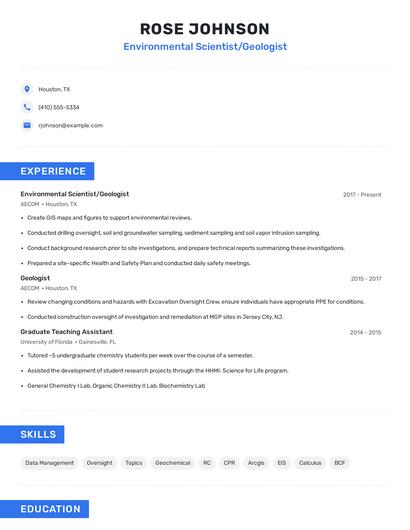
Prepare your environmental scientist/geologist resume
When your background is strong enough, you can start writing your environmental scientist/geologist resume.
You can use Zippia's AI resume builder to make the resume writing process easier while also making sure that you include key information that hiring managers expect to see on an environmental scientist/geologist resume. You'll find resume tips and examples of skills, responsibilities, and summaries, all provided by Zippi, your career sidekick.
Choose from 10+ customizable environmental scientist/geologist resume templates
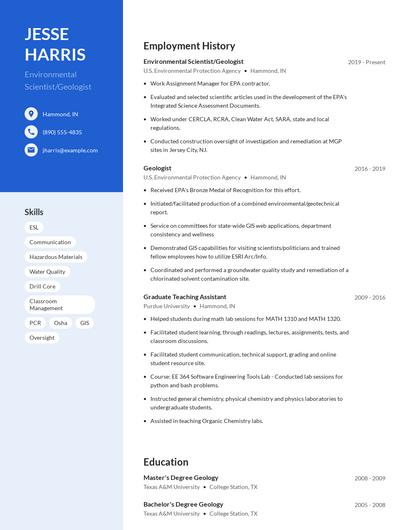
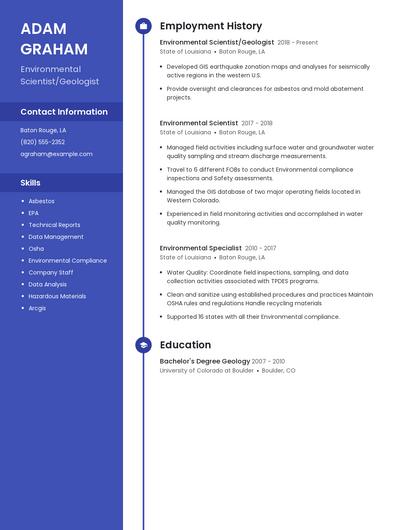
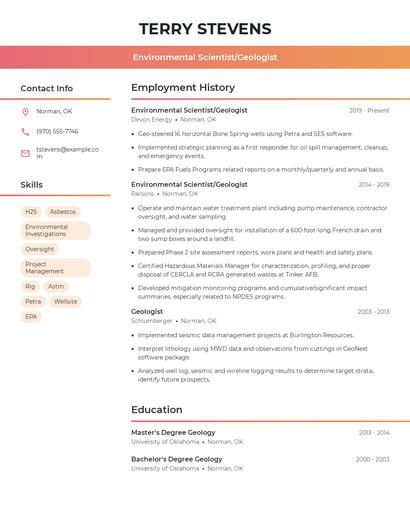
Build a professional environmental scientist/geologist resume in minutes. Browse through our resume examples to identify the best way to word your resume. Then choose from 10+ resume templates to create your environmental scientist/geologist resume.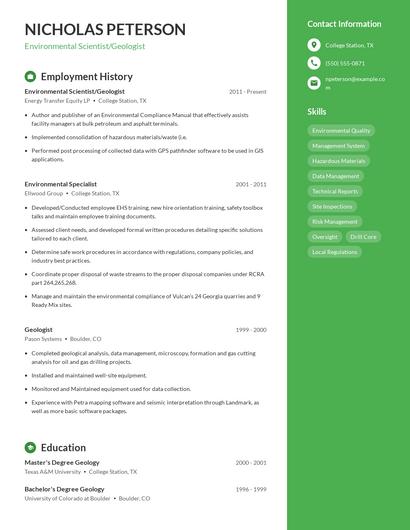
Apply for environmental scientist/geologist jobs
Now it's time to start searching for an environmental scientist/geologist job. Consider the tips below for a successful job search:
- Browse job boards for relevant postings
- Consult your professional network
- Reach out to companies you're interested in working for directly
- Watch out for job scams
How did you land your first environmental scientist/geologist job

Are you an environmental scientist/geologist?
Share your story for a free salary report.
Average environmental scientist/geologist salary
The average environmental scientist/geologist salary in the United States is $63,344 per year or $30 per hour. Environmental scientist/geologist salaries range between $48,000 and $82,000 per year.
What am I worth?

How do environmental scientist/geologists rate their job?
Environmental scientist/geologist reviews

I do the same job every day but I never get the same results twice. each minute, hour, day everything changes. we drill thru different formations all the time. But we drill the same stuff from well to well.
There is a constant chance of someone making a big mistake and causing a blow out that hurts or kills others.
Firstly, the most important is to protect our planet for us and the future generations. Secondly our planet is not going to support the pressure and negative impacts because of the big Increased human population . Finally our planet needs more and more environmental specialists to regulate and control all human activities, especially the ilegal ones.
I don’t like when big companies they know what’s wrong and what’s right, but still the destroy, like cutting trees in Brazil and the other side big companies even knowing those trees are ilegal, but still they continuing to porches. There for I can’t understand and I don’t like.
Understanding the earth and finding solution to problems caused by humans.
Hard to find a job.
Updated January 8, 2025
