
Automatically apply for jobs with Zippia
Upload your resume to get started.
Evidence custodian skills for your resume and career
11 evidence custodian skills for your resume and career
1. Patrol
- Shift Supervisor/Sergeant Bike Patrol Officer DARE Instructor Team Leader Tactical Response Team Patrolman Evidence Custodian
2. Laboratory Analysis
- Safeguarded evidence to prevent loss, destruction or alteration and requested laboratory analysis when required.
3. Law Enforcement Agencies
- Handled inquiries regarding the location of property sought by law enforcement agencies and citizens and assisted in locating and recovering property.
- Responded to telephone inquiries by the public and law enforcement agencies requiring information on property and evidence.
4. Evidence Room
- Reorganized and improved the overall productivity of the Evidence Room.
- Received the highest rating during all evidence room inspections.
5. Court Orders
- Release evidence to civilians-Fill out court orders-File paperwork-Scan in paperwork-Audit evidence-Answer phones-Respond to emails-Research cases
- Prepare court orders for disposition/destruction of property and evidence as necessary.
6. Crime Lab
- Prepared weapons, drugs, and other items for transportation to the Illinois State Police Crime Lab for destruction and analysis.
- Transported evidence to and from the State Crime Lab weekly for analysis.
7. Crime Scene Evidence
- Examine, record, analyze, and preserve crime scene evidence.
8. Physical Evidence
- Dusted all collected physical evidence for latent fingerprints.
- Processed, evaluated and secured physical evidence.
9. Court Proceedings
- Prepare any items that are ready for court proceedings.
10. DNA
Deoxyribonucleic acid, or only DNA, which is considered the king of molecules, is a macromolecule that contains the main component of chromosomes. Shaped like a double helix, DNA is usually found in the nucleus of a cell. It is a type of material that transports characteristics in many forms, developed in nucleotides around one another.
- Distributed all DNA reports and notified appropriate Office of the Armed Forces Medical Examiner (OAFME) personnel of DNA results.
- Distributed all DNA reports and notified appropriate personnel of DNA results in a timely manner.
11. Lims
A LIMS - Laboratory Information Management System is a software solution to improve laboratory productivity and efficiency with modern support of laboratory operations to address the challenges of data and sample management, automation, and regulation of laboratories from around the world and thus maintaining workflows and standardized testing and reporting procedures.
- Acted as main liaison with the software development team for new LIMS features, as well as a mobile mass-disaster LIMS.
- Use of LIMS to assign unique tracking case numbers to submitted specimens.

What skills help Evidence Custodians find jobs?
Tell us what job you are looking for, we’ll show you what skills employers want.
List of evidence custodian skills to add to your resume
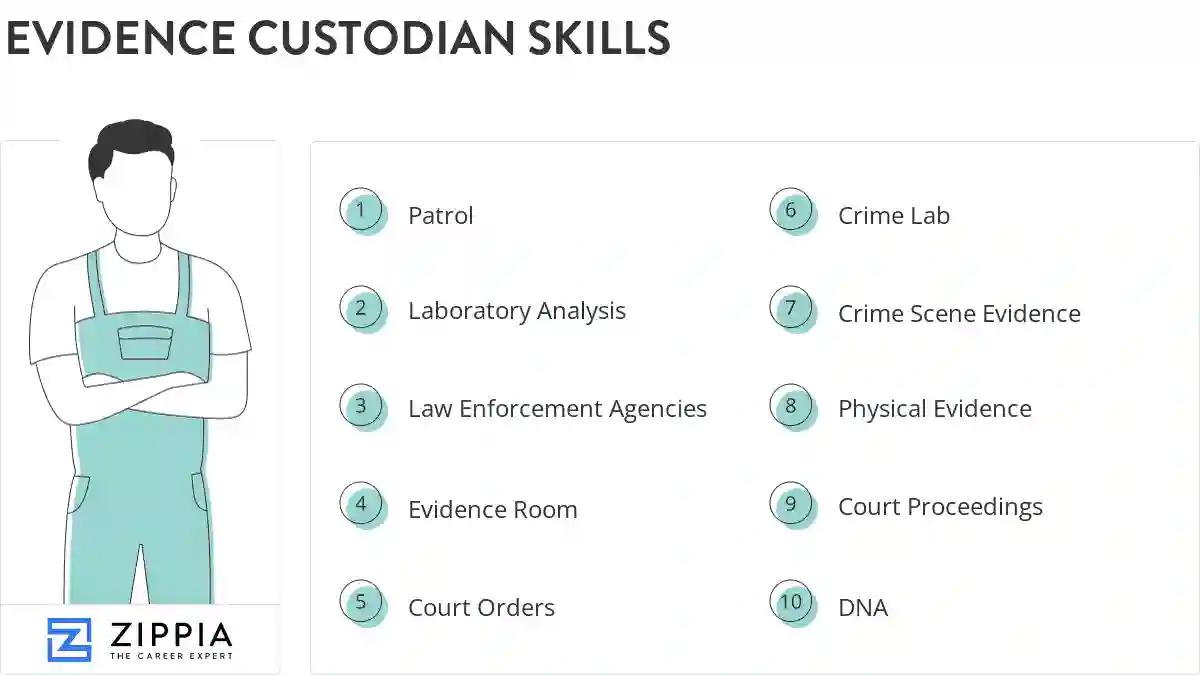
The most important skills for an evidence custodian resume and required skills for an evidence custodian to have include:
- Patrol
- Laboratory Analysis
- Law Enforcement Agencies
- Evidence Room
- Court Orders
- Crime Lab
- Crime Scene Evidence
- Physical Evidence
- Court Proceedings
- DNA
- Lims
Updated January 8, 2025
