What does an executive editor do?
An executive editor supervises the editorial content of magazines, newspapers, or other publications. In the corporate setting, an executive editor often arranges a book's publishing. In a newspaper setting, an executive editor is the newsroom leader, and in larger newspapers, they coordinate all aspects of the publication's production. They must have the ability to manage subordinates and assistant editors and be experienced with Associated Press style.
Executive editor responsibilities
Here are examples of responsibilities from real executive editor resumes:
- Lead effort to publish works of fiction (Alfaguara imprint).
- Manage content using CMS tools and ongoing social media campaign and reader engagement via social media networks and blog.
- Acquire established writers and introduce new voices in genre fiction.
- Leverage meticulous attention to detail in technical editing and proofreading all content from project inception to completion.
- Analyze FrameMaker source document and provide feedback to XML architects to improve accuracy of conversion.
Executive editor skills and personality traits
We calculated that 12% of Executive Editors are proficient in Editorial Content, Editorial Calendar, and Digital Content. They’re also known for soft skills such as Creativity, Detail oriented, and Good judgment.
We break down the percentage of Executive Editors that have these skills listed on their resume here:
- Editorial Content, 12%
Managed editorial content and supervised production on website for national magazine focusing on the media and journalism.
- Editorial Calendar, 8%
Solicited, scheduled and edited in-house and contributed articles to meet editorial calendar and daily deadlines.
- Digital Content, 6%
Crafted MarCom messaging and ensured digital content complied with branding and communications guidelines.
- SEO, 6%
Managed RIDES website and responsible for growth through social media engagement and SEO.
- Editor-In-Chief, 6%
Worked closely with the editor-in-chief on this quarterly spin-off of Travel+Leisure magazine.
- Content Strategy, 6%
Established robust video content strategy and launched original web series for brand, which were later sponsored by advertisers.
Common skills that an executive editor uses to do their job include "editorial content," "editorial calendar," and "digital content." You can find details on the most important executive editor responsibilities below.
Creativity. To carry out their duties, the most important skill for an executive editor to have is creativity. Their role and responsibilities require that "editors must be imaginative, curious, and knowledgeable in a broad range of topics." Executive editors often use creativity in their day-to-day job, as shown by this real resume: "serve as creative lead on special issues, cover stories and new digital products. "
Detail oriented. Many executive editor duties rely on detail oriented. "editors must be meticulous to ensure that material is error free and matches the style of a publication.," so an executive editor will need this skill often in their role. This resume example is just one of many ways executive editor responsibilities rely on detail oriented: "selected, oversaw, and edited 64 pages of editorial content launched brand toward more social justice-oriented content"
Good judgment. This is an important skill for executive editors to perform their duties. For an example of how executive editor responsibilities depend on this skill, consider that "editors decide whether certain stories are ethical and whether there is enough evidence to publish them." This excerpt from a resume also shows how vital it is to everyday roles and responsibilities of an executive editor: "directed strategy and editorial for national monthly magazine, analyzing trends and covering news affecting sporting goods retailers and manufacturers. ".
Interpersonal skills. For certain executive editor responsibilities to be completed, the job requires competence in "interpersonal skills." The day-to-day duties of an executive editor rely on this skill, as "in working with writers, editors must have tact and the ability to guide and encourage them in their work." For example, this snippet was taken directly from a resume about how this skill applies to what executive editors do: "coordinated interpersonal relations between editorial staff, artists, writers and judges. "
Writing skills. Another common skill required for executive editor responsibilities is "writing skills." This skill comes up in the duties of executive editors all the time, as "editors ensure that all written content has correct grammar, punctuation, and syntax." An excerpt from a real executive editor resume shows how this skill is central to what an executive editor does: "planned, directed and coordinated the conception, copywriting, design, production and distribution of the magazine. "
The three companies that hire the most executive editors are:
- Gannett2 executive editors jobs
- Newsmax Media, Inc.2 executive editors jobs
- Lee Enterprises1 executive editors jobs
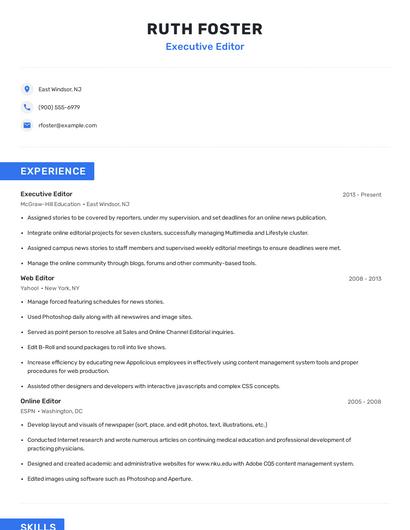
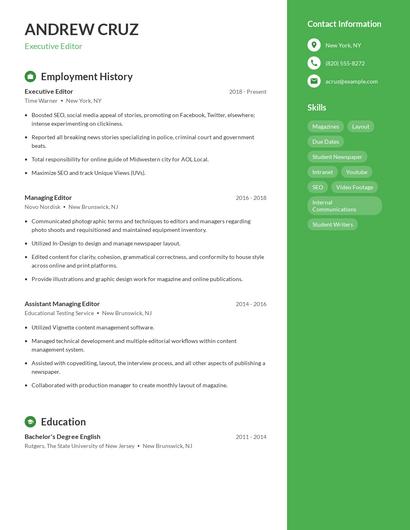
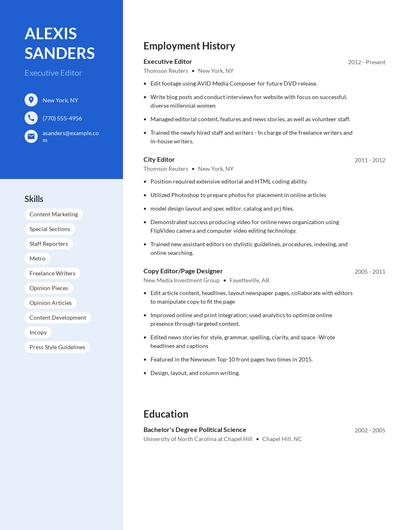
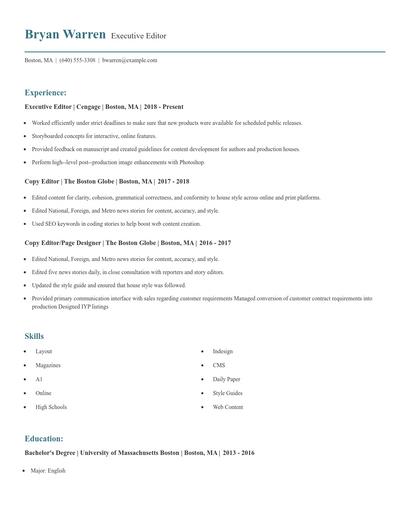
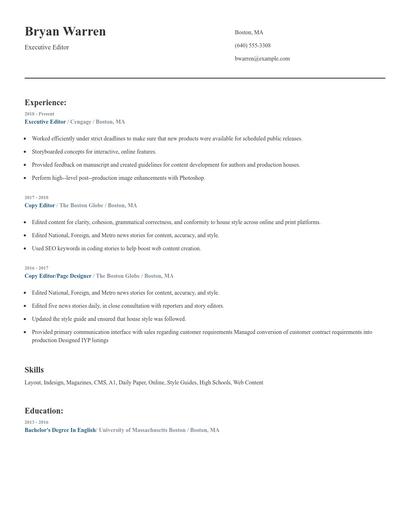
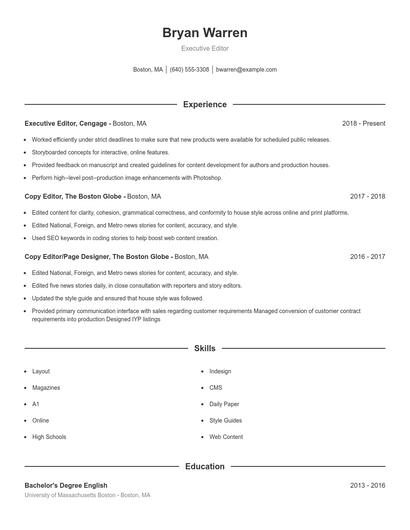
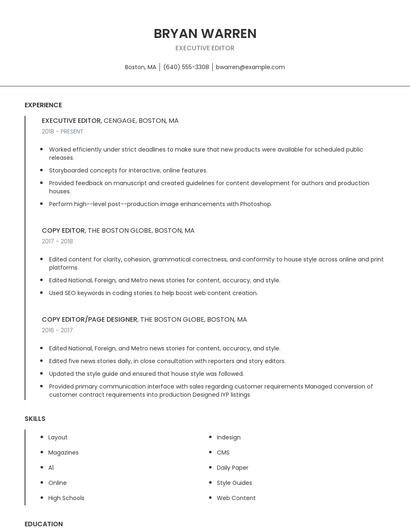
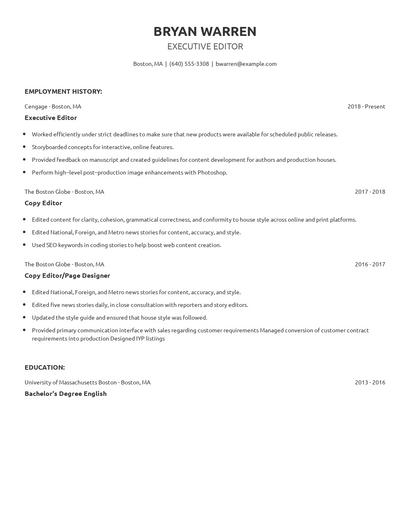
Choose from 10+ customizable executive editor resume templates
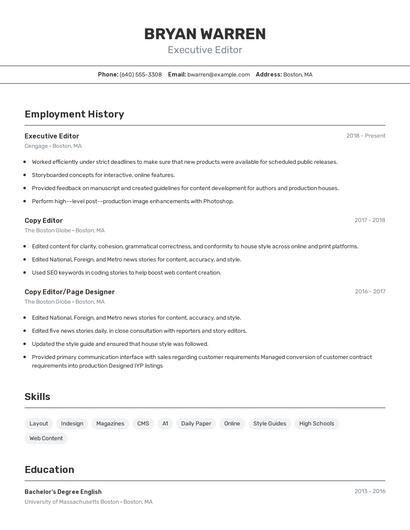
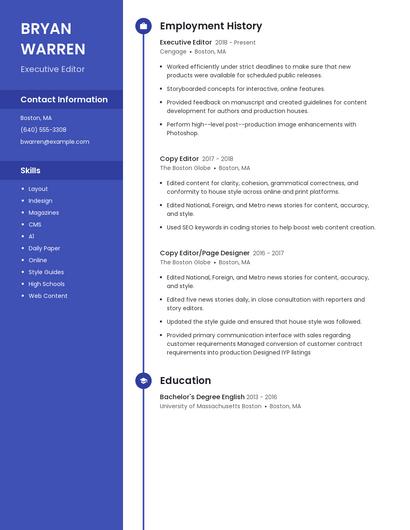
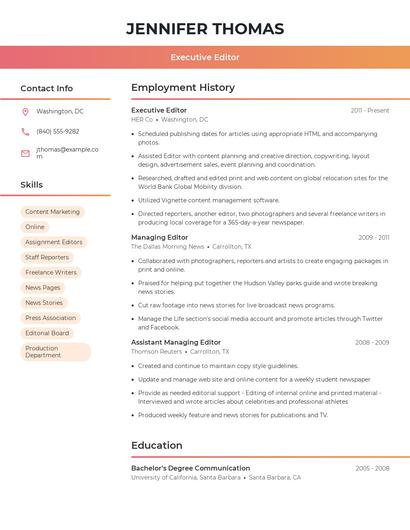
Build a professional executive editor resume in minutes. Our AI resume writing assistant will guide you through every step of the process, and you can choose from 10+ resume templates to create your executive editor resume.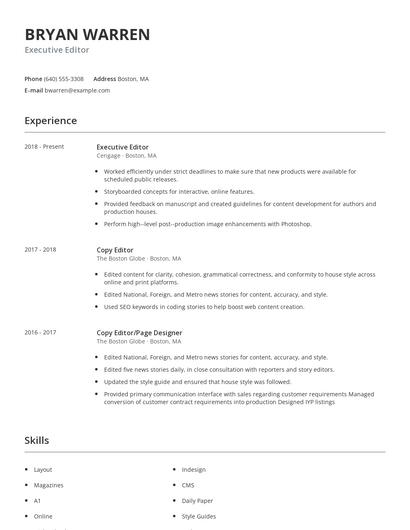
Compare different executive editors
Executive editor vs. Editing internship
An editorial intern is responsible for assisting the editorial department of an organization with publishing various media and digital content. Editorial interns shadow tenured editorial staff on researching stories, validating information, writing captivating articles, interviewing target audiences, and screening submitted manuscripts. They also assist in planning promotional strategies and marketing campaigns, such as monitoring press releases, posting on social media platforms, and developing marketing materials. An editorial intern must have excellent organizational skills, most importantly, a fast-learner to understand complex tasks and perform assigned duties under minimal supervision.
While similarities exist, there are also some differences between executive editors and editing internship. For instance, executive editor responsibilities require skills such as "editorial content," "editorial calendar," "digital content," and "seo." Whereas a editing internship is skilled in "video footage," "adobe photoshop," "photography," and "youtube." This is part of what separates the two careers.
Editing interns tend to reach similar levels of education than executive editors. In fact, editing interns are 4.7% less likely to graduate with a Master's Degree and 2.2% less likely to have a Doctoral Degree.Executive editor vs. Editorial internship
An editorial intern is responsible for assisting the editorial team in publishing digital and media content, writing articles, and managing readers' reviews. Editorial interns must have excellent knowledge of the industry they work for, suggesting the latest trends and featured topics, taking notes of the tenured employees' advice and observations, and actively joining brainstorming sessions. An editorial intern must be detail-oriented and take constructive feedback as an opportunity to learn. It is also crucial to have outstanding communication and proofreading skills and keep all the materials confidential until release.
While some skills are similar in these professions, other skills aren't so similar. For example, resumes show us that executive editor responsibilities requires skills like "editorial calendar," "digital content," "content strategy," and "content development." But an editorial internship might use other skills in their typical duties, such as, "fact-check," "editorial intern," "administrative tasks," and "content management system."
On average, editorial interns earn a lower salary than executive editors. Some industries support higher salaries in each profession. Interestingly enough, editorial interns earn the most pay in the media industry with an average salary of $33,508. Whereas executive editors have higher pay in the media industry, with an average salary of $112,912.In general, editorial interns achieve similar levels of education than executive editors. They're 4.5% less likely to obtain a Master's Degree while being 2.2% less likely to earn a Doctoral Degree.What technology do you think will become more important and prevalent for executive editors in the next 3-5 years?
Bradley Shreve
Editor, Tribal College Journal
Executive editor vs. Editor, freelance
An Editor, Freelance is responsible for reading content and correcting for errors in spelling, grammar, and punctuation. They work with writers to help their ideas and stories succeed.
There are many key differences between these two careers, including some of the skills required to perform responsibilities within each role. For example, an executive editor is likely to be skilled in "editorial content," "editorial calendar," "digital content," and "editor-in-chief," while a typical editor, freelance is skilled in "music videos," "track changes," "promotional videos," and "adobe photoshop."
Most editors, freelance achieve a similar degree level compared to executive editors. For example, they're 2.7% more likely to graduate with a Master's Degree, and 0.0% more likely to earn a Doctoral Degree.Executive editor vs. Editor in chief
Updated January 8, 2025
