What does a fabric machine operator do?
Fabric machine operator responsibilities
Here are examples of responsibilities from real fabric machine operator resumes:
- Use automate systems and RF units to pull, put away and load customer product, in addition to managing inventory
- Machine welder and TIG welding, bonding components together to fabricate metal products according to specifications and blueprints
- Operate various industrial machinery including robotic welder, slider, CNC wire bender, press brake, and parts oven.
- Complete daily checklist for forklift and clamp truck.
- Fasten metal materials using soldering, brazing, and welding equipment.
- Set up and operate centerless griding machines to grind OD metal.
- Use of GE Fanuc programs to help keep certain models within their require specifications.
- Use special machinery to align wood, steel or aluminum used for rigid supporting framework.
- Operate machinery and used grinders to make and smooth finish on stainless steel cutlery in manufacturing process.
- Operate fixtures to form, drill, see, and punch extrude aluminum rails prior to further processing.
- Read prints, create layout, cut material with oxygen/acetylene torch, opperate shear and press, weld using mig.
- Use overhead crane to load and operate CNC lathe and CNC sub-arc weld machine to build up rolls for blast furnaces.
- Maintain and operate several crankshaft main grinders.
- Control & troubleshoot automate extrusion line adjusting speed & feed, monitoring temperature, & finish material specification per customers order.
- Control & troubleshoot automate extrusion line adjusting speed & feed, monitoring temperature, & finish material specification per customers order.
Fabric machine operator skills and personality traits
We calculated that 10% of Fabric Machine Operators are proficient in Hand Tools, Math, and Tape Measure. They’re also known for soft skills such as Computer skills, Dexterity, and Mechanical skills.
We break down the percentage of Fabric Machine Operators that have these skills listed on their resume here:
- Hand Tools, 10%
Operate and repair as needed plasma table, drill presses, automatic band saws, to hand tools.
- Math, 10%
Produced and maintained accurate documentation for production reports using math and computer skills.
- Tape Measure, 10%
Use a wide variety of measuring tools (tape measure, caliper, protractor) to check quality of products.
- Basic Math, 9%
Followed production instructions and utilized a computer and calculator to aid in basic math calculations.
- Calipers, 8%
Utilized precision measuring instruments such as calipers and micrometers.
- Press Brake, 8%
Operated machines such as the Shear, Minister, Cincinnati, and accrue press, press brake operated machinery.
Common skills that a fabric machine operator uses to do their job include "hand tools," "math," and "tape measure." You can find details on the most important fabric machine operator responsibilities below.
Computer skills. The most essential soft skill for a fabric machine operator to carry out their responsibilities is computer skills. This skill is important for the role because "metal and plastic machine workers often must be able to use programmable devices, computers, and robots on the factory floor." Additionally, a fabric machine operator resume shows how their duties depend on computer skills: "operate cnc punch press and sub arc welder following sop for the computer system. "
Dexterity. Another soft skill that's essential for fulfilling fabric machine operator duties is dexterity. The role rewards competence in this skill because "metal and plastic machine workers who work in metal and plastic machined goods manufacturing use precise hand movements to make the necessary shapes, cuts, and edges that designs require." According to a fabric machine operator resume, here's how fabric machine operators can utilize dexterity in their job responsibilities: "operate fork lift and overhead cranes. "
Mechanical skills. This is an important skill for fabric machine operators to perform their duties. For an example of how fabric machine operator responsibilities depend on this skill, consider that "metal and plastic machine workers set up and operate machinery." This excerpt from a resume also shows how vital it is to everyday roles and responsibilities of a fabric machine operator: "performed minor mechanical work and routine maintenance. ".
Physical strength. A big part of what fabric machine operators do relies on "physical strength." You can see how essential it is to fabric machine operator responsibilities because "metal and plastic machine workers must be strong enough to guide and load heavy and bulky parts and materials into machines." Here's an example of how this skill is used from a resume that represents typical fabric machine operator tasks: "utilized variety of math skills and physical activity techniques to implement various job duties. "
The three companies that hire the most fabric machine operators are:
- Pharmaceutical10 fabric machine operators jobs
- Interior Specialists
9 fabric machine operators jobs
- Generac Holdings7 fabric machine operators jobs
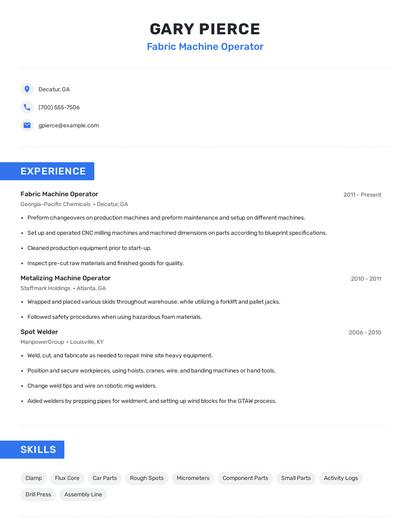
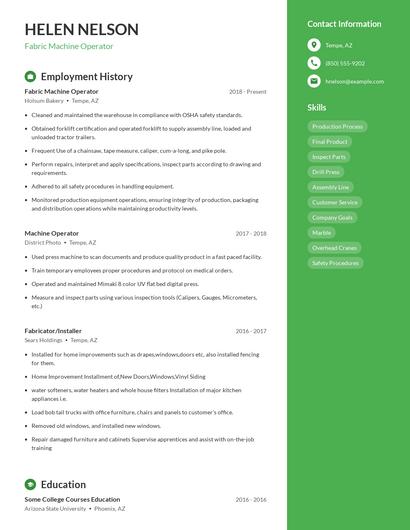
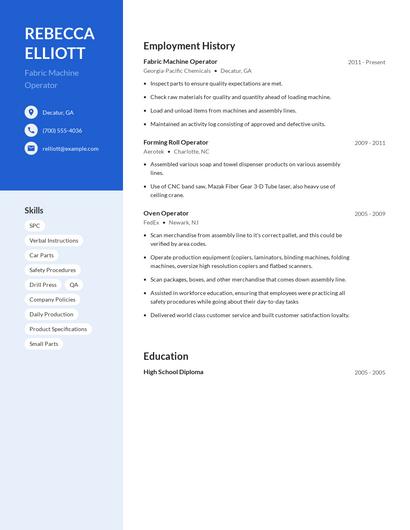
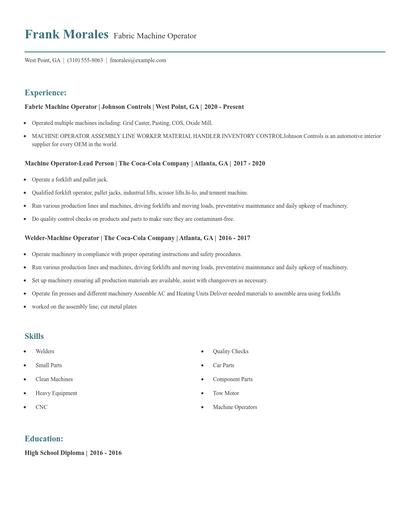
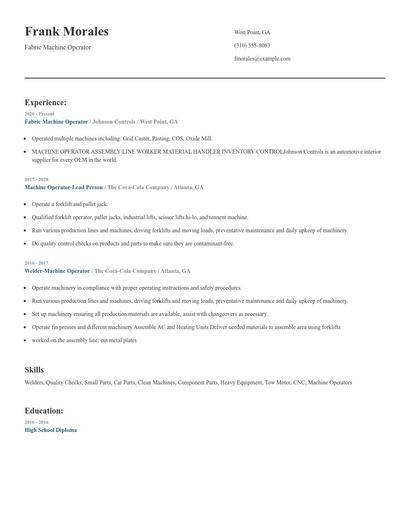
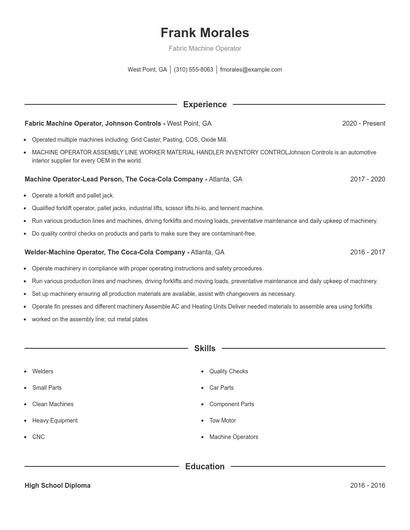
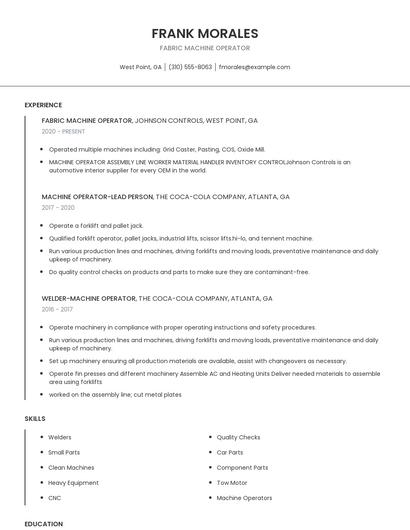
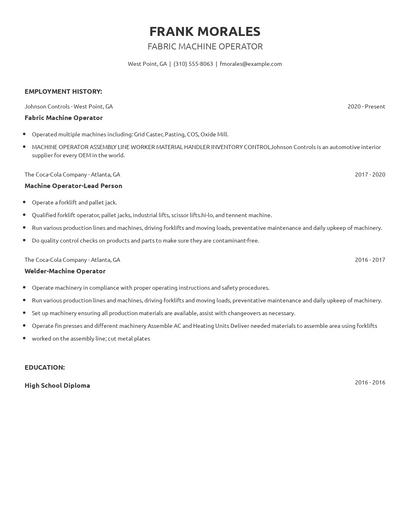
Choose from 10+ customizable fabric machine operator resume templates
Build a professional fabric machine operator resume in minutes. Our AI resume writing assistant will guide you through every step of the process, and you can choose from 10+ resume templates to create your fabric machine operator resume.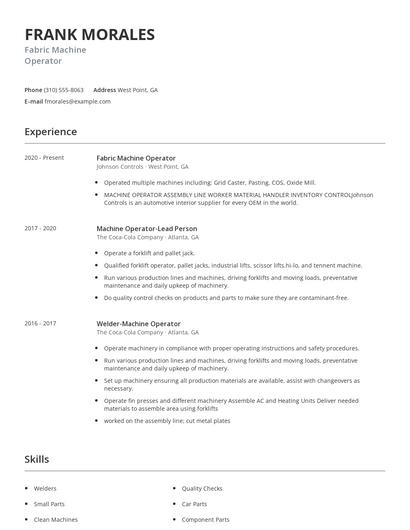
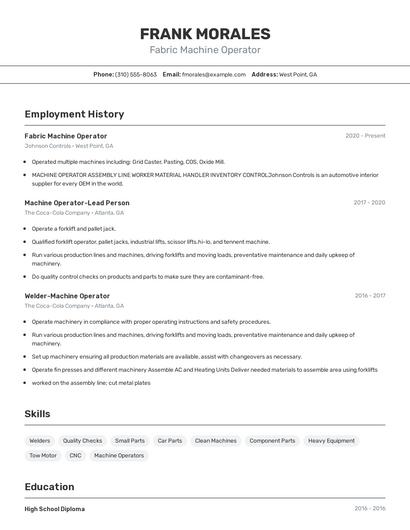
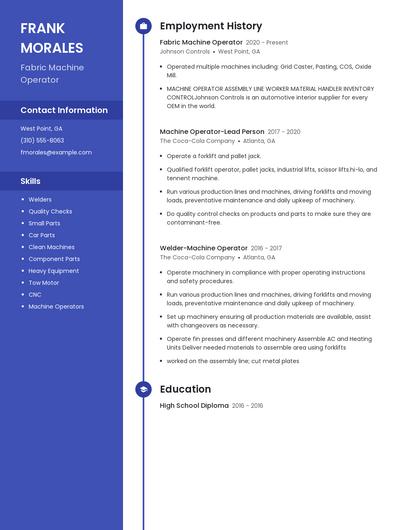
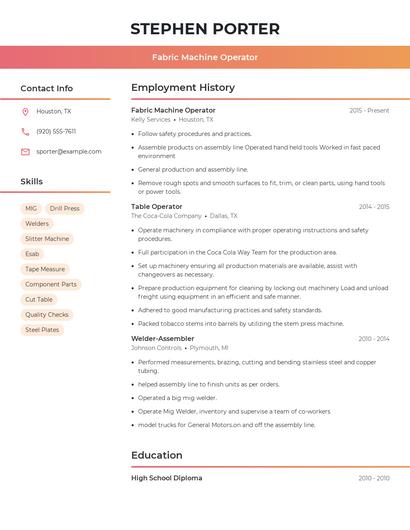
Compare different fabric machine operators
Fabric machine operator vs. Welder operator
A machine set-up operator operates machinery such as grinders, bores, and mills. They prepare machines to be used by organizing tools, setting valve directions, sharpening tools as needed, positioning tools, and conducting regular maintenance.
There are some key differences in the responsibilities of each position. For example, fabric machine operator responsibilities require skills like "math," "tape measure," "basic math," and "calipers." Meanwhile a typical welder operator has skills in areas such as "safety equipment," "safety procedures," "plasma arc," and "tack." This difference in skills reveals the differences in what each career does.
Welder operators really shine in the automotive industry with an average salary of $37,042. Comparatively, fabric machine operators tend to make the most money in the technology industry with an average salary of $40,125.welder operators tend to reach similar levels of education than fabric machine operators. In fact, welder operators are 0.8% more likely to graduate with a Master's Degree and 0.4% more likely to have a Doctoral Degree.Fabric machine operator vs. Set-up operator
A Cell Operator is someone who handles a production cell in a company or factory. This position ensures that a cell unit of the production functions properly and efficiently. The position also does other miscellaneous tasks related to production, such as inspection, sorting, and other assembly operations, depending on the type of company, business, or manufactured product. This person generally has strong organizational and problem-solving skills and has a knack for troubleshooting.
While some skills are similar in these professions, other skills aren't so similar. For example, resumes show us that fabric machine operator responsibilities requires skills like "tape measure," "press brake," "pallets," and "aluminum." But a set-up operator might use other skills in their typical duties, such as, "preventative maintenance," "safety procedures," "cnc lathes," and "quality standards."
Set-up operators earn a higher average salary than fabric machine operators. But set-up operators earn the highest pay in the automotive industry, with an average salary of $44,628. Additionally, fabric machine operators earn the highest salaries in the technology with average pay of $40,125 annually.Average education levels between the two professions vary. Set-up operators tend to reach similar levels of education than fabric machine operators. In fact, they're 0.1% more likely to graduate with a Master's Degree and 0.4% more likely to earn a Doctoral Degree.Fabric machine operator vs. Cell operator
A machine operator/forklift operator is responsible for operating industrial trucks to move merchandise around the warehouse facilities and other assigned areas. Machine operators/forklift operators also assist with inventory tasks by scanning orders and ensuring the correct merchandise for shipment. They manage the stability of the vehicles, ensuring its efficiency and optimization during operations, performing engine repairs for any inconsistencies to avoid delays on deliveries. A machine operator/forklift operator should strictly follow the safety protocols of the business, as well as have knowledge of the mechanical industry.
The required skills of the two careers differ considerably. For example, fabric machine operators are more likely to have skills like "tape measure," "basic math," "press brake," and "cnc machines." But a cell operator is more likely to have skills like "quality standards," "cnc," "safety procedures," and "lean manufacturing."
Cell operators make a very good living in the technology industry with an average annual salary of $41,770. On the other hand, fabric machine operators are paid the highest salary in the technology industry, with average annual pay of $40,125.When it comes to education, cell operators tend to earn similar degree levels compared to fabric machine operators. In fact, they're 1.5% more likely to earn a Master's Degree, and 0.3% more likely to graduate with a Doctoral Degree.Fabric machine operator vs. Machine operator/forklift operator
Types of fabric machine operator
Updated January 8, 2025
