Explore jobs
Find specific jobs
Explore careers
Explore professions
Best companies
Explore companies
Job outlook for facilities planners in the United States
Are facilities planner jobs in demand?
Facilities planner job and salary trends over time
Facilities planner jobs over time
Facilities planner job growth rate over time
| Year | # of jobs | % of population |
|---|---|---|
| 2021 | 1,634 | 0.00% |
| 2020 | 1,603 | 0.00% |
| 2019 | 1,618 | 0.00% |
| 2018 | 1,588 | 0.00% |
| 2017 | 1,482 | 0.00% |
Average facilities planner salary over time
Facilities planner salary by year
| Year | Avg. salary | Hourly rate | % Change |
|---|---|---|---|
| 2026 | $71,048 | $34.16 | +2.2% |
| 2025 | $69,551 | $33.44 | +1.8% |
| 2024 | $68,335 | $32.85 | +2.2% |
| 2023 | $66,875 | $32.15 | +2.1% |
| 2022 | $65,500 | $31.49 | +2.6% |
Facilities planner jobs by state
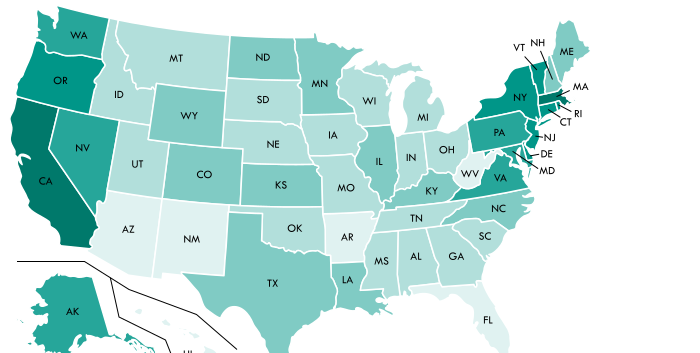
Most common states for facilities planners
| Rank | State | Population | # of jobs | Employment/ 1000ppl |
|---|---|---|---|---|
| 1 | District of Columbia | 693,972 | 75 | 11% |
| 2 | Virginia | 8,470,020 | 417 | 5% |
| 3 | Massachusetts | 6,859,819 | 355 | 5% |
| 4 | Washington | 7,405,743 | 263 | 4% |
| 5 | Maryland | 6,052,177 | 256 | 4% |
| 6 | Colorado | 5,607,154 | 243 | 4% |
| 7 | South Carolina | 5,024,369 | 181 | 4% |
| 8 | Connecticut | 3,588,184 | 132 | 4% |
| 9 | Utah | 3,101,833 | 114 | 4% |
| 10 | New Hampshire | 1,342,795 | 59 | 4% |
| 11 | Hawaii | 1,427,538 | 50 | 4% |
| 12 | North Dakota | 755,393 | 27 | 4% |
| 13 | California | 39,536,653 | 1,339 | 3% |
| 14 | New York | 19,849,399 | 614 | 3% |
| 15 | Pennsylvania | 12,805,537 | 412 | 3% |
| 16 | Minnesota | 5,576,606 | 180 | 3% |
| 17 | Oregon | 4,142,776 | 134 | 3% |
| 18 | Nevada | 2,998,039 | 93 | 3% |
| 19 | Delaware | 961,939 | 31 | 3% |
| 20 | Vermont | 623,657 | 17 | 3% |
Most common cities for facilities planners
| Rank | City | # of jobs | Employment/ 1000ppl | Avg. salary |
|---|---|---|---|---|
| 1 | Frankfort | 1 | 4% | $66,706 |
| 2 | Saint Cloud | 2 | 3% | $72,302 |
| 3 | Annapolis | 1 | 3% | $80,134 |
| 4 | Juneau | 1 | 3% | $80,939 |
| 5 | Cambridge | 2 | 2% | $94,103 |
| 6 | Idaho Falls | 1 | 2% | $58,959 |
| 7 | Huntsville | 1 | 1% | $61,237 |
| 8 | San Diego | 3 | 0% | $86,871 |
| 9 | Baltimore | 2 | 0% | $80,218 |
| 10 | Denver | 2 | 0% | $67,377 |
| 11 | Atlanta | 1 | 0% | $60,080 |
| 12 | Baton Rouge | 1 | 0% | $70,821 |
| 13 | Boston | 1 | 0% | $94,144 |
| 14 | Des Moines | 1 | 0% | $63,019 |
| 15 | Indianapolis | 1 | 0% | $61,507 |
| 16 | Kansas City | 1 | 0% | $62,146 |
Facilities Planner job outlook: Expert opinions
Our panel of facilities planner experts
Augsburg University
University of Utah

Solutions Development
De Paul College of Liberal Arts and Social Sciences
What will help Facilities Planners increase their earning potential?
Nancy Fischer: My general advice for people beginning careers in urban studies is to approach your first position in the field as a learning opportunity. Learn the norms of that particular urban sector and how things are done, and also learn about yourself and what you like to do, what you're good at doing, and where you need to build skills in order to get a sense of mastery. Talk with people all over the organization and learn about the different directions you can take your career over the long term.
Alessandro Rigolon
Assistant ProfessorUniversity of Utah
Department of City and Metropolitan Planning
What hard/technical skills are most important for Facilities Planners?
Alessandro Rigolon: - Geographic Information Systems
- Basic statistical skills
- Some graphic design expertise, including the use of Adobe InDesign, Illustrator, and/or Photoshop. Also, ArcGIS StoryMaps are increasingly used by planning agencies to share ongoing results of planning processes
- Some skills in platforms to collect online data for public engagement process, such as ArcGIS Survey123
- Some of the above skills related to applied fields (e.g., architecture), like reading site plans and building plans
- More rarely, AutoCAD and other similar Computer-Aided Design programs
- Good writing is really important but sometimes overlooked
- Capacity to design and manage complex public engagement processes, some of which might last more than one year
What technology do you think will become more important and prevalent for Facilities Planners in the next 3-5 years?
Irene Thomas Johnson: Integrating technology into the workplace will shift greatly in the next 3 to 5 years. Smart building technology is continuing to evolve, and I see this as important and prevalent in building management in the future. It will be more focused on the wellbeing of its occupants, focusing on the customer experience while continuing to drive efficiency and savings for building owners and occupiers.
Will there be an enduring impact of the coronavirus pandemic on Facilities Planners?
Alec Brownlow Ph.D.: So this is a bit of a different question than the enduring impact on the future of urban studies. This year's graduates find themselves in the grips of a downward spiraling economy and the reality of office closures and social distancing. The class of 2020 can be described as unprecedentedly 'remote.' Students/graduates should take this to heart, and do whatever they can to equip themselves (skills, training, technology, etc.) to be a competitor in a 'foreign' labor market. If working from home/remotely is the 'new normal,' at least for the foreseeable future, students who bemoan the situation will struggle when in competition with students who recognize and embrace it. GIS, for example, is a skill that does not require a physical location in an office. Familiarity with, and comfort in using, social interfaces (Zoom, WebX, etc.) is a must.