
Automatically apply for jobs with Zippia
Upload your resume to get started.
Family intervention specialist skills for your resume and career
15 family intervention specialist skills for your resume and career
2. Family Therapy
- Provided individual, marital and family therapy by assessment and treatment planning.
- Provided intensive in-home individual and family therapy to children and their families.
3. at-Risk Youth
A child who is unlikely to transition successfully into adulthood is considered an at-risk youth. Success can mean job readiness, academic success, or competence to be financially independent. It may also refer to the ability to avoid a life of crime by becoming a positive representative of society. At-risk students may show/have to show indifference for academics, low educational performance, absenteeism, disconnect from the school, emotional, and behavioral problems.
- Implemented structured anger management groups with at-risk youth identified by Juvenile Probation and Children & Youth of Montgomery County.
- Provide mental health counseling, family counseling, and substance abuse counseling for at-risk youth.
4. On-Call Availability
- Provide on-call availability to families.
- Provided on-call availability around the clock during week day hours and rotated weekend on call services.
5. Child Welfare
- Serve as an advocate for the client with human services agencies, courts, child welfare agencies and other systems.
- Partnered with state and federal leaders to bring about major reforms to child welfare and children s mental health systems.
6. Villages
- Produce weekly client specific treatment plans and utilizing appropriate interventions following the Youth Villages' treatment manual.
- Attend weekly treatment team and consultation on utilizing appropriate interventions following the Youth Villages treatment manual.
Choose from 10+ customizable family intervention specialist resume templates
Build a professional family intervention specialist resume in minutes. Our AI resume writing assistant will guide you through every step of the process, and you can choose from 10+ resume templates to create your family intervention specialist resume.7. Wide Array
- Drive up to 60-80 miles to provide treatment in individual families' homes in a wide array of settings and communities.
- Deliver treatment in individual families' homes, a wide array of settings and communities.
8. Behavioral Problems
- Serve children of any age (infant to age 18) who have serious emotional and behavioral problems.
- Provided in-home counseling to children with emotional and behavioral problems and their families.
9. Professional Development
Professional development means to have the essential training certification or education with the purpose of earning and having a successful career. Every job requires a different set of skills. However, new skills may be needed in the future. Professional development, in this regard, helps people to develop and polish the skills and become efficient workers.
- Attend weekly supervision and consultation meetings for professional development.
- Attend weekly meetings with supervisor and consultant to gain further insight and professional development.
10. Therapeutic Interventions
- Provided therapeutic intervention services to children and adolescents using individual and family treatment.
- Reviewed other counselors' treatment plans and provided feedback on therapeutic interventions.
11. Family Sessions
- Monitor the family's progress by conducting family sessions a minimum of three times a week while providing 24/7 on-call support.
- Hold family sessions with each case up to 3 times a week scheduled at the convenience of the families.
12. Crisis Intervention
- Provide professional crisis intervention, outreach and community education services.
- Provide crisis intervention and facilitate acute hospitalizations as needed.
13. Foster Children
- Developed a reunification plan for foster children and worked with the families on implementing this plan through each stage.
- Work with foster parents and foster children in a home setting.
14. In-Home Services
- Provided time limited in-home services to identify insufficient protective capacities.
- Conducted daily intensive in-home services to assist families by assessing and monitoring parent/child interaction.
15. Foster Care
- Case management with parents involved with the protective services and foster care system due to substance abuse and child neglect.
- Coordinate treatment team meetings for youth in residential or treatment foster care placements.
5 Family Intervention Specialist resume examples
Build a professional family intervention specialist resume in minutes. Browse through our resume examples to identify the best way to word your resume. Then choose from 5+ resume templates to create your family intervention specialist resume.

What skills help Family Intervention Specialists find jobs?
Tell us what job you are looking for, we’ll show you what skills employers want.
What skills stand out on family intervention specialist resumes?
Dr. Andrew Wiley Ph.D.
Associate Professor, Kent State University
What hard/technical skills are most important for family intervention specialists?
Dr. Dianna Cooper
Associate Professor, Campbellsville University
What soft skills should all family intervention specialists possess?
Sam Terrazas Ph.D.
Professor and Academic Chair Department of Social Work, The University of Texas Permian Basin
What family intervention specialist skills would you recommend for someone trying to advance their career?
Melissa Bell
Associate Professor/Social Work Program Director, Chatham University
What type of skills will young family intervention specialists need?
Elisha Blankson
Program Director NCCU, Assistant Professor, North Carolina Central University
List of family intervention specialist skills to add to your resume
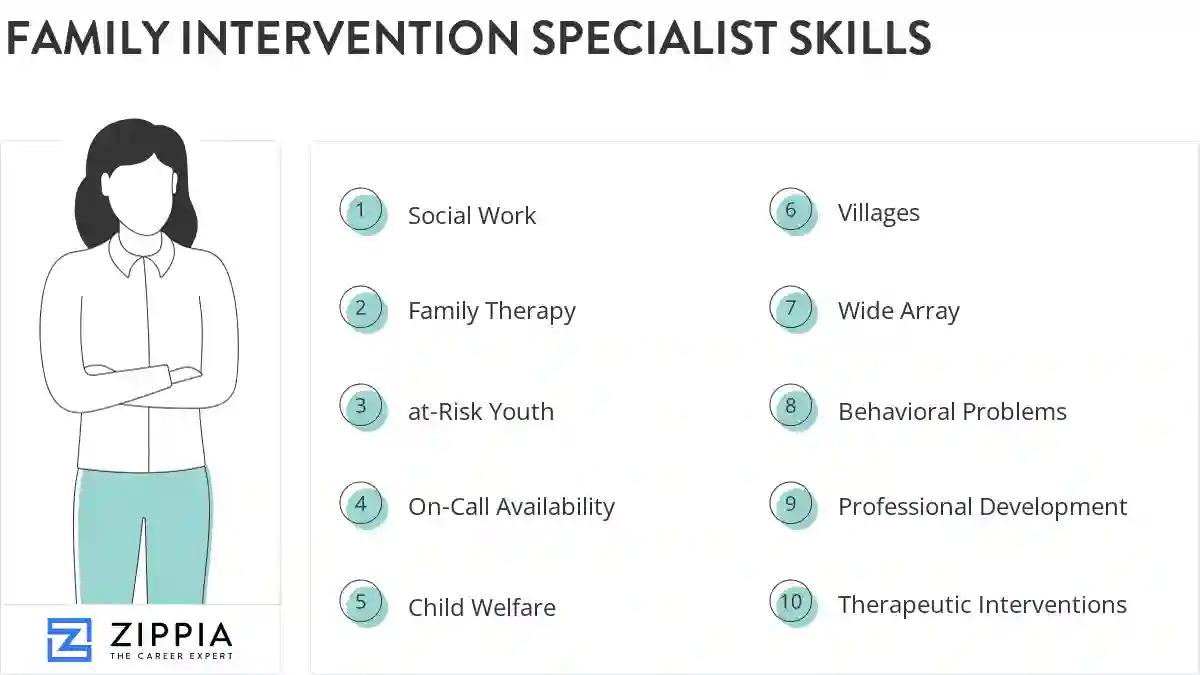
The most important skills for a family intervention specialist resume and required skills for a family intervention specialist to have include:
- Social Work
- Family Therapy
- at-Risk Youth
- On-Call Availability
- Child Welfare
- Villages
- Wide Array
- Behavioral Problems
- Professional Development
- Therapeutic Interventions
- Family Sessions
- Crisis Intervention
- Foster Children
- In-Home Services
- Foster Care
- Psychosocial Assessments
- Out-of-Home Placements
- Community Resources
- Collaborative Problem
- Crisis Support
- Substance Abuse Issues
- Family Intervention
- Voice Recognition Technology
- Support Services
- Group Therapy
- Family Services
- DCF
- Domestic Violence
- Child Abuse
- Team Supervision
- Cognitive Behavioral Therapy
- Community Agencies
- Community Services
- Therapeutic Services
- Anger Management
- Crisis Management
- Protective Services
- Court Hearings
- DCS
- Risk Assessments
- Medicaid
- Family Support
- On-Call Support
- Court Reports
- Court System
- IEP
- Mental Health Issues
Updated January 8, 2025

1. Social Work