Explore jobs
Find specific jobs
Explore careers
Explore professions
Best companies
Explore companies
Job outlook for field applications scientists in the United States
Are field applications scientist jobs in demand?
Field applications scientist job and salary trends over time
Field applications scientist jobs over time
Field applications scientist job growth rate over time
| Year | # of jobs | % of population |
|---|---|---|
| 2021 | 252 | 0.00% |
| 2020 | 293 | 0.00% |
| 2019 | 295 | 0.00% |
| 2018 | 280 | 0.00% |
| 2017 | 259 | 0.00% |
Average field applications scientist salary over time
Field applications scientist salary by year
| Year | Avg. salary | Hourly rate | % Change |
|---|---|---|---|
| 2026 | $101,706 | $48.90 | +3.1% |
| 2025 | $98,683 | $47.44 | +4.7% |
| 2024 | $94,259 | $45.32 | +3.3% |
| 2023 | $91,236 | $43.86 | +1.9% |
| 2022 | $89,502 | $43.03 | --2.1% |
Field applications scientist jobs by state
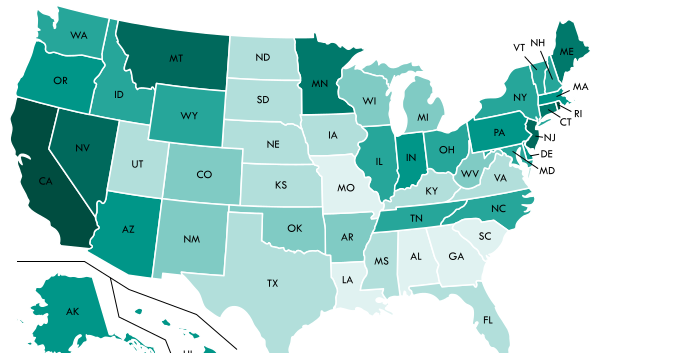
Most common states for field applications scientists
| Rank | State | Population | # of jobs | Employment/ 1000ppl |
|---|---|---|---|---|
| 1 | District of Columbia | 693,972 | 321 | 46% |
| 2 | Massachusetts | 6,859,819 | 2,735 | 40% |
| 3 | North Dakota | 755,393 | 226 | 30% |
| 4 | Delaware | 961,939 | 274 | 28% |
| 5 | Maryland | 6,052,177 | 1,521 | 25% |
| 6 | New Hampshire | 1,342,795 | 333 | 25% |
| 7 | Vermont | 623,657 | 158 | 25% |
| 8 | Montana | 1,050,493 | 254 | 24% |
| 9 | New Jersey | 9,005,644 | 1,966 | 22% |
| 10 | Virginia | 8,470,020 | 1,863 | 22% |
| 11 | Wyoming | 579,315 | 126 | 22% |
| 12 | Minnesota | 5,576,606 | 1,156 | 21% |
| 13 | Maine | 1,335,907 | 285 | 21% |
| 14 | Oregon | 4,142,776 | 813 | 20% |
| 15 | South Dakota | 869,666 | 175 | 20% |
| 16 | North Carolina | 10,273,419 | 1,982 | 19% |
| 17 | Washington | 7,405,743 | 1,394 | 19% |
| 18 | New Mexico | 2,088,070 | 377 | 18% |
| 19 | Alaska | 739,795 | 134 | 18% |
| 20 | Rhode Island | 1,059,639 | 177 | 17% |
Most common cities for field applications scientists
| Rank | City | # of jobs | Employment/ 1000ppl | Avg. salary |
|---|---|---|---|---|
| 1 | South San Francisco | 2 | 3% | $127,217 |
| 2 | Agawam Town | 1 | 3% | $90,283 |
| 3 | Annapolis | 1 | 3% | $85,078 |
| 4 | Hartford | 2 | 2% | $98,014 |
| 5 | Springfield | 2 | 2% | $74,429 |
| 6 | Bethesda | 1 | 2% | $84,504 |
| 7 | Billerica | 1 | 2% | $90,392 |
| 8 | Boston | 10 | 1% | $90,651 |
| 9 | Sacramento | 3 | 1% | $126,841 |
| 10 | Santa Ana | 3 | 1% | $116,272 |
| 11 | Carlsbad | 1 | 1% | $113,009 |
| 12 | Phoenix | 4 | 0% | $91,497 |
| 13 | San Diego | 3 | 0% | $111,373 |
| 14 | Baltimore | 2 | 0% | $85,441 |
| 15 | San Francisco | 2 | 0% | $127,343 |
| 16 | Atlanta | 1 | 0% | $52,186 |
Field Applications Scientist job outlook: Expert opinions
Our panel of field applications scientist experts
Northeastern State University
SUNY Stony Brook
Washburn University of Topeka
University of San Diego
Northwestern University
Southern Illinois University Carbondale
Washington State University
University of Pittsburgh
University of Nebraska - Omaha
University of Oklahoma
Western Washington University
Quinnipiac University

Doverspike Consulting/HR LItehouse
Robert Morris University

Brigham Young University – Idaho

Tiffin University
Washington State University
What general advice would you give to a Field Applications Scientist?
Dulanjani Wijayasekara Ph.D.: Having experience and a well highlighted skill set to match the job description. This can be obtained by pursuing advanced education and training, such as obtaining a master's or doctoral degree in the field you are interested in.
What will help Field Applications Scientists increase their earning potential?
Dr. Vitaly Citovsky: Multi-prong advice: try to get a higher degree, look for jobs that you enjoy (e.g., research, patient care) rather than chase the money.
Susan Bjerke
Associate Professor of BiologyWashburn University of Topeka
Biological And Physical Sciences
What will help Field Applications Scientists increase their earning potential?
Susan Bjerke: Some of the skills that will be important in the next 3-5 years will be general critical thinking skills and the ability to adapt to changing technology. Almost all science fields are increasingly dependent on technology, so being able to learn new skills and change the way you do things in your job will be important. Being an effective communicator, both in writing and orally, is an overlooked skill in the sciences and is always an important asset.
What will help Field Applications Scientists increase their earning potential?
Nicole Danos PhD: In addition to many sought after hard skills that our Biology program graduate have been trained in (cell and microbial culture, DNA sequencing and bioinformatics, antibody staining, data analysis and biostatistics), graduates should remember to leverage the other scientific skills they learned. This includes things like researching and summarizing the state of knowledge in a field, distilling relevant information for peers and supervisors, presenting experimental designs and results and all around thinking about problems from start to finish. All of our graduates should be able to leverage these soft science skills, since they all had to do an independent research project.
What general advice would you give to a Field Applications Scientist?
Nathaniel Stern: To answer this question we need to be clear what field the graduate intends to continue in. If they want to continue in Physics as a “field”, then they will most likely need to go to graduate school in Physics, Astronomy, or a related field. There are many opportunities for graduates with majors in Physics, but many of these are in different fields. Physics majors excel in these other opportunities, but in order to do “physics”, meaning studying the science of matter and energy, one generally goes to graduate school. If this is the graduate’s plan, then the advice is to be passionate about the research topic that you choose. One does not need to know ahead of time that a particular direction of research is the best possible direction for them, but they should have interest in it. Research often involves small academic questions, and if one doesn’t find these interesting then it can be a bit of a slog. More generally, advice matches other career paths, however: do something that you love, and also choose impactful problems. Even if your own work is a small part of the whole, if you can see the impact of the field it can be exciting all the time. If the graduate is not going to graduate school in Physics or a related subject, then they are likely entering a technical career such as engineering, finance, education, data science, or consulting. Physics is a great basic training for whatever direction someone takes since it trains you to think and problem solve, especially in reducing a problem to its core questions (as opposed to building encyclopedic knowledge of relevant facts). But, whatever specific career path a graduate takes will likely bring more specialized methods, knowledge, and applications. Physics is a great starting point, but future endeavors will broaden thinking to new challenges outside of the rigid rules of physical laws. So, graduates should be willing to, and excited to, adapt to new cultures.
What general advice would you give to a Field Applications Scientist?
Meghan McGee-Lawrence Ph.D.: Take full advantage of the education and training opportunities offered to you either while you are completing your degree or when you start your first post-degree position. Academic institutions and employers are invested in the success of their recruits and regularly provide professional development opportunities to help folks build up skillsets – so make time to seek out and capitalize on those opportunities when they are offered, and document them on your CV (curriculum vitae) / resumes.
What general advice would you give to a Field Applications Scientist?
Jacob Nordman: Salary potential in my field of neuroscience almost always involves publications, awards, and technical acumen. Therefore, as I mentioned, it is important to start early looking for opportunities that can strengthen these areas. Another important aspect of getting high-profile, and thus high-paying, positions, is being able to tell a story with your research and career. Employers want to see that you have thought deeply and strategically about your career and where it’s going. This will allow them to believe you are a safe bet and worthy of their investment.
What will help Field Applications Scientists increase their earning potential?
Lindsey du Toit: Take every opportunity you can to learn, network, and build an effective team of people that bring a greater breadth and depth of skills and expertise to the work on which you will be focusing. Cultivate a life-long sense of intellectual curiosity and learning. Don’t be afraid to ask questions. Treat ignorance as an opportunity to learn. Questions demonstrate you want to understand the situation/problem effectively and that you are paying attention. Always demonstrate integrity in your work. It is one of the most valuable traits you can bring to your career. Be kind and supportive of your colleagues.
What will help Field Applications Scientists increase their earning potential?
Arjumand Ghazi Ph. D: Having an advanced degree such as a PhD and even a few years postdoc is a good way to start at a higher level. It often allows one to make up for the reduced earnings during the training periods while increasing long-term earnings.
Andrew Riquier Ph.D.
InstructorUniversity of Nebraska - Omaha
Neurobiology And Neurosciences
What general advice would you give to a Field Applications Scientist?
Andrew Riquier Ph.D.: Apply for the positions you want, even if you feel underqualified. I know plenty of people who have applied for jobs they didn't quite meet the requirements for, and got hired for other reasons. In my experience, many recent graduates choose to take time to strengthen their resumes by retaking classes, working jobs they don't particularly want to get experience, etc. There is some value in that, particularly if you have been unsuccessful attaining the position you want, or if you want to see if you even enjoy that type of work. But if you are confident in what you want to do, go for it; in the worst-case scenario, you are in the same position you would be if you hadn't applied, but now you have experience applying and have potentially gained a contact in the field.
What general advice would you give to a Field Applications Scientist?
Sean Matt: As astronomy becomes more data-intensive, computing and data-handling skills only become more relevant. At the same time, since the ultimate goal of science is human understanding, it will be increasingly challenging to make *sense* of the analysis of large datasets and increasingly sophisticated numerical simulations. Therefore, the “classical” skills of having a firm understanding of physics, etc. will always be necessary. Another essential skill now and in the future is communication, both in written and verbal form, both in discussing with an expert audience and with the lay public, and all audiences in between. Finally, as the field becomes more competitive for jobs and funding, a critical skill is writing proposals (including job applications).
What Field Applications Scientist skills would you recommend for someone trying to advance their career?
Sean Matt: One needs a PhD to have a career in astronomy related research. And in the early career stages, research experience, outputs, and quality are the most important factors improving chances of employment. So I’d say getting research experience as soon as possible (as an undergraduate, ideally) is good. And during schooling (undergraduate and graduate), work to gain as many different kinds of research skills and fundamental knowledge (of physics, mathematics, and astronomy) as possible. For the research, it is good to work on different types of research projects in different research areas (and requiring you to pick up different skills)—not all at once but via successive projects that are unrelated to each other. As a PhD student, toward the last few years, it is most important to focus on a single area and develop a niche in the form of a novel research area or research tool that you have mastered. After the PhD, the usual path is to go into a postdoctoral research position. It is also important to further deepen and broaden research productivity and expertise, during this time. Furthermore, this is a stage where you want to develop your independence and show that you can find and follow and answer your own research questions. For a career path that will eventually involve teaching or leading research groups, it is also helpful to gain experience teaching and/or mentoring junior researchers and/or participating in outreach activities. This can be done during graduate school or as a postdoc. Similarly, the sooner you can get experience applying for funding and other competitive resources (like telescope and computing time), the better. Finally, be realistic and have a backup plan. Getting a long-term position in astronomy and astrophysics is one of the most competitive endeavors (statistically comparable to being a professional sports player or astronaut, that kind of level).
What will help Field Applications Scientists increase their earning potential?
Sean Matt: Frankly, if you are motivated by earning a high salary, astronomy and astrophysics is not a time-effective way to do that. Skills of an astrophysicist, particularly with regard to computing, scientific knowledge, and general problem-solving, are prized in other industries with competitive salaries, for example in data science. But professional astronomer salaries are not high compared to the level of schooling and temporary positions typically required before finding a long-term position. Generally speaking, if you focus on salary as a professional astronomer, you would probably do best to move jobs as frequently as you are able. Commonly, new hires make comparable or sometimes higher salaries than people who have stayed at an institution for a long time. Salaries in the US are typically higher than those in other countries. I’m not sure, but I believe jobs at government labs in the US are higher for early career positions than university posts, but the latter can for some people be higher than government labs (i.e., universities might have a wider range of salary possibilities). Private universities usually pay higher salaries than public, I think. This is widely varying.
What Field Applications Scientist skills would you recommend for someone trying to advance their career?
Josh Kaplan Ph.D.: Demonstrating a skill set that is unique, such as experience with a rare technical research approach, or demonstrating that you can save your employer money by utilizing free resources, can be used to negotiate a higher salary.
Lisa Cuchara Ph.D.
Professor of Biomedical SciencesQuinnipiac University
Microbiological Sciences And Immunology
What Field Applications Scientist skills would you recommend for someone trying to advance their career?
Lisa Cuchara Ph.D.: The first and foremost would be Critical Thinking. We live in a world where facts can be easily acquired, sometimes even by asking Siri/Alexa/ChatGPT/Google/etc. But critical thinking is timeless and priceless. I can ask anyone on the street what xyz is and they can look it up, but can they provide advice or interpret.
Also being a good steward towards science and being willing and able to communicate not just with peers as we are trained, but also with the public, the politicians, the board members. John Holdren*, stated that Scientists should be tithing at least 10 percent of their time to public service ... including activism. In the ever growing science denialism that is happening in our country being able to communicate science with the public is important. As Peter Hotaz states, "Anti-science propaganda is "killing Americans in unprecedented numbers,""
*Holdren is an American scientist who served as the senior advisor to President Barack Obama on science and technology issues through his roles as assistant to the president for science and technology, director of the White House Office of Science and Technology Policy, and co-chair of the President's Council of Advisors on Science and Technology and a Research Professor in Harvard University's Kennedy School of Government
What type of skills will young Field Applications Scientists need?
Dennis Doverspike Ph.D.: Seemingly a paradox, there will continue to be a need for very general, but highly fungible, skills and demand for too specialized skills, requiring advanced education. Coding, statistics, and data analysis related skills will remain a hot growth area. The aging of the baby boomers will create demand for medical and healthcare-related regions, especially nursing, nursing aides, and emergency services. Despite the automation of many people facing jobs, there will continue to be a demand for interpersonal and people skills, including various types of sales. The switch to remote work, due to COVID, will create a substantial future market to fill the leadership and managerial skills gap. In many areas of Technology and engineering, it is already challenging to find a combination of technical knowledge and people skills, and this demand will intensify.
Will there be an increase or decrease in demand for Field Applications Scientists in the next 5 years?
Paul Badger Ph.D.: The demand for skilled research scientists in the healthcare industry or related industries will almost certainly grow in the next five years. There is nearly always a need for entry-level positions, such as laboratory scientists or medical laboratory technicians. The recent increase in pressures placed on the health care sector will likely lead to more hiring as testing facilities, and analytical labs are expanded.
Nels Hansen Ph.D.
Department ChairBrigham Young University – Idaho
Department of Applied Plant Science
What experience really stands out on Field Applications Scientist resumes?
Nels Hansen Ph.D.: I think that the following areas stand out to employers when they review a resume. Students who acquire real-world experience in one or more (and hopefully more) of the following will likely have their resumes rise to the top.
-Irrigation planning and system management.
-Safe chemical handling and application.
-Pest identification and management.
-Soil and plant testing combined with plant nutrient recommendations.
-Data gathering, power, and analysis.
-Verbal fluency in Spanish.
Sami Mejri Ph.D.
Associate Professor of Science, Assistant Dean, Graduate ProgramsTiffin University
School of Arts & Sciences
Are there any particularly good places in the United States for Field Applications Scientists to find work opportunities?
Sami Mejri Ph.D.: With the rising cost of living, a college graduate's ideal first job may not be in their home state or favorite vacation town. According to Business Insider, MidWestern cities like Columbus-Ohio, Cincinnati-Ohio, Madison-Wisconsin, Milwaukee-Wisconsin, and Indianapolis-Indiana were some of the best geographical areas to live for college graduates. The cost of living in these Midwestern states remains relatively lower than coastal areas, making these locations ideal for college graduates entering the workforce. However, college graduates with degrees in healthcare, computer science, and data analytics may not be limited to these geographical areas, given employers' incentives to these in-demand jobs.
Joe Harrison
Animal Scientist and Extension SpecialistWashington State University
Department of Animal Sciences
How do you envision technology impacting Field Applications Scientists in the next 5 years?
Joe Harrison: Technology is and will continue to change how cows are managed; having data instantly at your fingertips will help make more informed decisions. Examples are activity monitors and robotic milkers.