
Automatically apply for jobs with Zippia
Upload your resume to get started.
Filler machine operator skills for your resume and career
15 filler machine operator skills for your resume and career
1. Hand Tools
- Monitor Correctly and safely used a variety of hand tools, saws and cutting equipment to carry out job duties
- Cleaned, oiled and made adjustments and repairs to machinery and equipment using hand tools.
2. HMI
A human-machine interface is a dashboard or user interface that connects an operator to a device, system, or machine.
- Used HMI system to operate/regulate machine parameters.
- Demonstrated knowledge of Human Machine Interface (HMI) to control the correct amount of product in filler.
3. Defective Products
- Operated manual pallet machinery; inspected and removed defective products and materials.
- Inspected and removed defective products and packaging materials.
4. Production Equipment
Production equipment in limited terms is used to define any type of machinery or equipment used in the production of a video or film. Basic production equipment includes a camera, tripod, lighting kit, camera light, short term microphone, light reflector, boom pole, shock mount, audio cables, wireless microphone, headphones, portable digital audio recorder, camera lenses, extra batteries, external hard drive, and DSLR shoulder mount rig.
- Cleaned and maintained production equipment, coordinated with team members on how to keep beetles out of cigarette-making process.
- Disassemble and assemble production equipment for proper cleaning.
5. Production Lines
- Monitor the production lines, watching for problems, pile-ups, and jams.
- Operated drills and production lines to ensure quality of products.
6. Quality Checks
Quality checks are a component of quality control aimed at ensuring that quality requirements are met. Internally, quality checks provide assurance to managers, and externally, it provides assurance to clients, federal departments, authorities, and certifiers.
- Perform Quality Checks to verify product meets specifications.
- Clean, set up, operate and monitor filling equipment while completing all required documentation and scheduled quality checks.
Choose from 10+ customizable filler machine operator resume templates
Build a professional filler machine operator resume in minutes. Our AI resume writing assistant will guide you through every step of the process, and you can choose from 10+ resume templates to create your filler machine operator resume.7. Package Goods
- Maintain consistent production quality and Package goods for shipment or storage
- Maintain consistent production quailty Package goods for shipment or storage Stock or organize goods Clear machine jams and ensure quailty and comformity
8. Product Weight
- Regulated machine flow, product weight, and speed.
- Operated equipment within validated parameters while verifying product weight and components.
9. Safety Procedures
Safety procedures are a set of standardized procedures, that ensures minimal to no risk to people, resources, and the work environment. A company follows the step-by-step safety procedures as it they not only keep the customers and the employees safe, but also help in avoiding legal claims.
- Comply and follow all general Health and safety procedures contained in the cGMP's.
- Warehouse machine operation; while demonstrating safety procedures, maintain general housekeeping and specific safety standards.
10. PPE
Personal protective equipment is an item of protective clothing such as goggles, helmets, or other garments meant to protect the body from injury.
- Provided PPE and supplied crew with any other equipment needed for their assigned job.
- Trained new hires in Daily CL Audits proper PPE, and JHA's.
11. Filling Machine Operation
- Stocked and sorted products for packaging or filling machine operation.
- Stock and sort product for packaging and filling machine operation.
12. Lot Numbers
- Attached identification labels to finished packaged items, such as lot numbers and shipping destinations.
- Checked lot numbers and explorations dates Notified operators or supervisor of equipment malfunctions.
13. Machine Components
- Adjust machine components and machine tension and pressure according to size or processing angle of product.
- Start machines and adjust controls to regulate tension on pressure rolls to synchronize speed of machine components.
14. CIP
A Capital Improvement Plan (CIP) is a planning tool used to coordinate the timing and financing of capital improvements over a period of several years. It helps organizations make good budget decisions for large projects and purchases based on objectives and resources. The purpose of a CIP is to identify capital improvement projects, identify and forecast funding sources, prioritize improvements based on available funds, and estimate a timeline for completing the improvements.
- Performed CIP procedures on machinery when changing yogurt brands.
- Operated all clean In place(CIP) and clean out of place (COP) systems as necessary.
15. Stencils
- Prepared silkscreen stencils and operated machines to label containers for various product-lines.
- Attached various stencils and labels using labeler machine.
5 Filler Machine Operator resume examples
Build a professional filler machine operator resume in minutes. Browse through our resume examples to identify the best way to word your resume. Then choose from 5+ resume templates to create your filler machine operator resume.

What skills help Filler Machine Operators find jobs?
Tell us what job you are looking for, we’ll show you what skills employers want.
List of filler machine operator skills to add to your resume
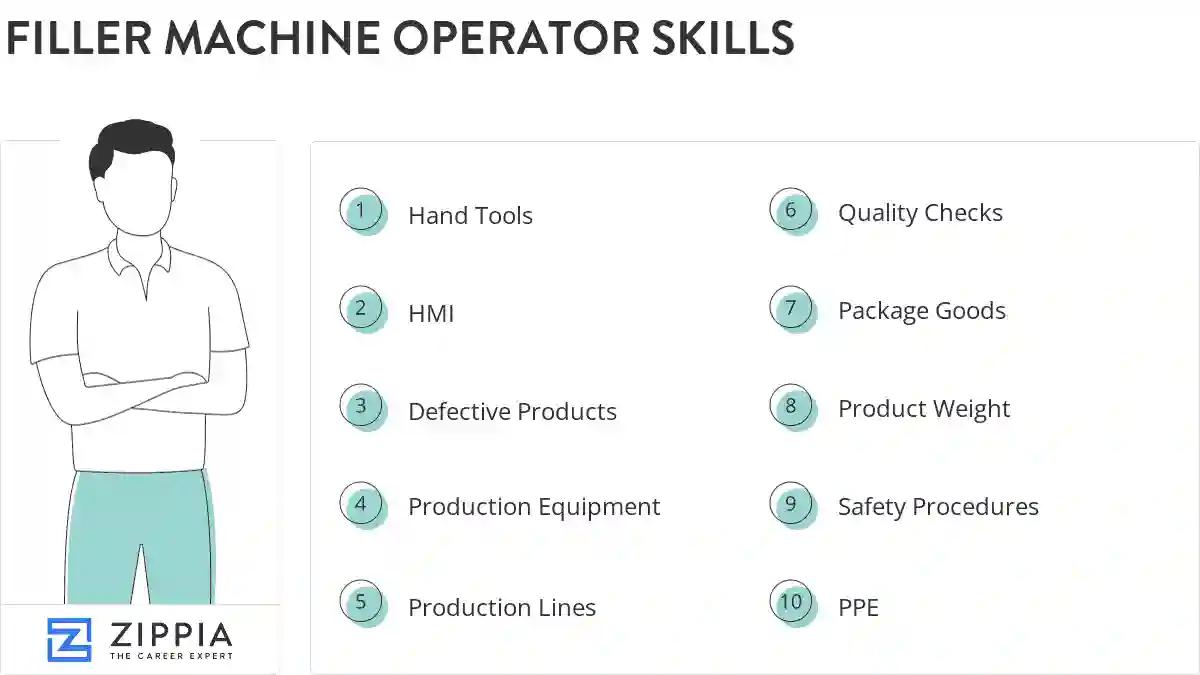
The most important skills for a filler machine operator resume and required skills for a filler machine operator to have include:
- Hand Tools
- HMI
- Defective Products
- Production Equipment
- Production Lines
- Quality Checks
- Package Goods
- Product Weight
- Safety Procedures
- PPE
- Filling Machine Operation
- Lot Numbers
- Machine Components
- CIP
- Stencils
- Sort Product
- Inspect Products
- Assembly Line
- GMP
- Identification Labels
- Troubleshoot
- Reset Machines
- Wrapping Paper
- Spindles
- RF
- Machine Flow
- Packages Product
- FDA
- Safety Regulations
- Protective Material
- Quality Standards
- Capper
- Production RUN
- Consumer Products
- FIX Problems
- HACCP
- Customer Orders
- Production Process
- SQF
- Production Quality
- Sops
- Inferior Materials
- QA
- Inventory Control
Updated January 8, 2025
