
Automatically apply for jobs with Zippi
Upload your resume to get started.
Finishing technician skills for your resume and career
15 finishing technician skills for your resume and career
1. Hand Tools
- Put final parts on a lot of different windshields but mostly military windshields using lots of hand tools.
- Build aerospace industry parts using various hand tools and calibrated measuring tools.
2. Grinders
- Conducted maintenance to material grinders.
- Perform machining, including but not limited to components using mills, lathes and surface grinders to accomplish repairs.
3. Pallets
- Down piled - Finished product is put onto pallets, wrapped, and sent out of factory.
- Maintained quality assurance on all assigned shipments to include piece by piece inspections and pallet weight checks.
4. Dexterity
- Possess excellent hand-eye coordination and wrist dexterity.
- Can demonstrate good manual dexterity.
5. Safety Procedures
Safety procedures are a set of standardized procedures, that ensures minimal to no risk to people, resources, and the work environment. A company follows the step-by-step safety procedures as it they not only keep the customers and the employees safe, but also help in avoiding legal claims.
- Maintain a safe work environment and exceptional housekeeping by following established safety procedures including wearing required Personal Protective Equipment.
- Conducted employee training on equipment operations and safety procedures and managed daily operations.
6. ISO
- Maintained the necessary qualifications to work in ISO 5-8 environments and regularly completed work to maintain the environments.
- Fill and finish liquid media products under ISO and cGMP requirements.
Choose from 10+ customizable finishing technician resume templates
Build a professional finishing technician resume in minutes. Our AI resume writing assistant will guide you through every step of the process, and you can choose from 10+ resume templates to create your finishing technician resume.7. Production Equipment
Production equipment in limited terms is used to define any type of machinery or equipment used in the production of a video or film. Basic production equipment includes a camera, tripod, lighting kit, camera light, short term microphone, light reflector, boom pole, shock mount, audio cables, wireless microphone, headphones, portable digital audio recorder, camera lenses, extra batteries, external hard drive, and DSLR shoulder mount rig.
- Utilized high precision electronic measuring/glass production equipment
- Perform changes/adjustments to production equipment and systems within the established capabilities of each operation, monitoring machine functionality and safe operation.
8. Safety Guidelines
Safety guidelines are regulations or rules governing procedures, actions, or devices with the aim of reducing the occurrence or risk of loss, injury, and danger to properties, individuals, or the environment. To adhere to the safety guidelines and be able to make the best possible decisions to ensure everyone at the workplace is safe, you should possess a wide range of skills.
- Work on binder to make magazines, follow safety guidelines as well as working as part of a team.
- Maintain a clean area and prepare for the next shift production following the company's standards and safety guidelines.
9. Clean Rooms
As the name suggests, clean rooms are scientifically cleansed from microbes, dirt particles, and many other pollutants. It has a shallow level of external particles and is useful in the manufacturing and engineering of products. Since chemical reactions and scientific procedures can be affected by outside factors, they provide dirt and an interaction-free environment where scientific manufacturing can occur. Clean rooms are beneficial in various industries, including the aerospace, optics, and nanotechnology industries.
- Experience in clean room, keeping product dust free during coating process.
- Operated labeler, crimper, and worked in clean room.
10. Quality Checks
Quality checks are a component of quality control aimed at ensuring that quality requirements are met. Internally, quality checks provide assurance to managers, and externally, it provides assurance to clients, federal departments, authorities, and certifiers.
- Prepared line, Loading Form logs to machine, Down piled finished product, quality checks.
- Performed own visual quality checks to then ship to next operation.
11. Troubleshoot
Troubleshooting is the process of analyzing and fixing any kind of problem in a system or a machine. Troubleshooting is the detailed yet quick search in the system for the main source of an issue and solving it.
- Finalize book design for production Troubleshoot machine problems
- Experience with Pigments and Slurry's * Troubleshoot all equipment prior to calling on mechanics.
12. Quality Standards
Quality standards are a specific level of standards of products that are set by the companies for the customers that have to be met and maintained throughout the process until the time of delivery. Quality standards are information that includes the customer's requirements, guidelines, and characteristics for the needed final product or service.
- Performed high end wood finishing for multi-millionaire customers, and ensured all work met strict quality standards.
- Developed/created processes to maintain quality standards and consistently worked to identify better and more efficient methods to increase productivity.
13. Safety Rules
Principles or regulations that ensure the protection of people, objects, or the environment are called safety rules. These rules can be governing actions, devices, or procedures that help in minimizing the risks of loss, injury, or damage.
- Meet company safety rules and standards.
- Followed and made sure others followed safety rules, used appropriated PPE and maintained proper safety practices at all times.
14. FDA
The Food and Drug Administration (FDA) is a division of the US Department of Health and Human Services that regulates the production and sale of food, pharmaceutical products, medical equipment, and other consumer goods, as well as veterinary medicine. The FDA is now in charge of overseeing the manufacture of products like vaccines, allergy treatments, and beauty products.
- Ensured Smith-Nephew operated within FDA requirements.
- 53404Used guidelines in accordance with FDA regulations to perform visual inspections of medical devices.
15. PPE
Personal protective equipment is an item of protective clothing such as goggles, helmets, or other garments meant to protect the body from injury.
- Wear all PPE while manually draining and cleaning of all dip tanks and stations after shift or when production quality lessened.
- Follow safety procedures, including but not limited to, wearing proper PPE, lock-out/tag-out, and HAZMAT.
5 Finishing Technician resume examples
Build a professional finishing technician resume in minutes. Browse through our resume examples to identify the best way to word your resume. Then choose from 5+ resume templates to create your finishing technician resume.

What skills help Finishing Technicians find jobs?
Tell us what job you are looking for, we’ll show you what skills employers want.
List of finishing technician skills to add to your resume

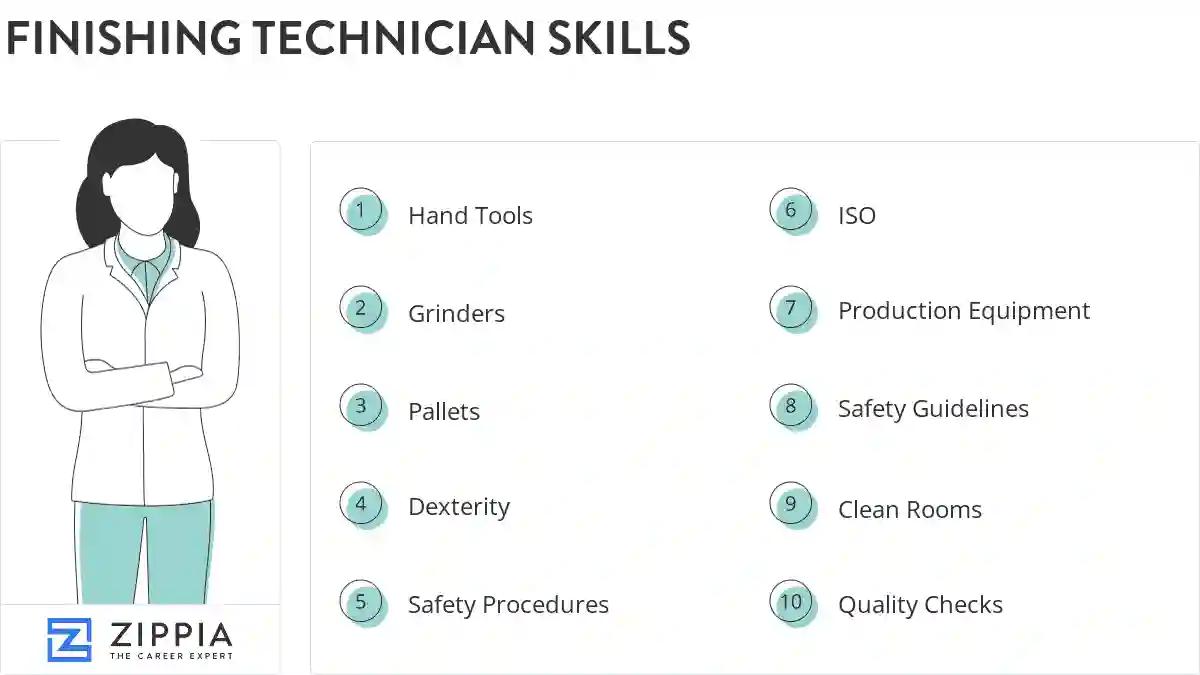
The most important skills for a finishing technician resume and required skills for a finishing technician to have include:
- Hand Tools
- Grinders
- Pallets
- Dexterity
- Safety Procedures
- ISO
- Production Equipment
- Safety Guidelines
- Clean Rooms
- Quality Checks
- Troubleshoot
- Quality Standards
- Safety Rules
- FDA
- PPE
- PC
- Coats
- Computer System
- Stitching
- GMP
- Caulking
- Hazardous Waste
- Quality Issues
- Machine Operation
- Assembly Line
- QA
- Tape Measure
- CNC
- Processing Equipment
- Production Process
- UV
- Spray Guns
- RAN
- Customer Specifications
- Production Schedules
- Visual Inspections
- Production Lines
- Hand Trucks
- ZIP Codes
- Hoists
- USPS
- Postal Regulations
Updated January 8, 2025
