What does a floor layer do?
Floor layer responsibilities
Here are examples of responsibilities from real floor layer resumes:
- Install pad, VCT, carpet tile, and cove base.
- Utilize interlocking installations for hardwood floors.
- Apply mortar to tile back, position the tile and press or tap with trowel handle to affix tile to base.
Floor layer skills and personality traits
We calculated that 45% of Floor Layers are proficient in VCT, Tape Measure, and Hardwood. They’re also known for soft skills such as Color vision, Customer-service skills, and Detail oriented.
We break down the percentage of Floor Layers that have these skills listed on their resume here:
- VCT, 45%
Measure floors for appropriate materials, cut and install, lay vinyl flooring and VCT where needed to complete job.
- Tape Measure, 29%
Read tape measure, use hand & power tools
- Hardwood, 27%
Utilized interlocking installations for hardwood floors.
Most floor layers use their skills in "vct," "tape measure," and "hardwood" to do their jobs. You can find more detail on essential floor layer responsibilities here:
Color vision. One of the key soft skills for a floor layer to have is color vision. You can see how this relates to what floor layers do because "flooring installers and tile and stone setters often determine small color variations and must be able to distinguish among colors in patterns for the best looking finish." Additionally, a floor layer resume shows how floor layers use color vision: "applied the appropriate tiling and carpets on client floors depending on texture, color and style preferred. "
Customer-service skills. Many floor layer duties rely on customer-service skills. "flooring installers and tile and stone setters must be courteous with and considerate of customers, especially while completing tasks in customers’ homes.," so a floor layer will need this skill often in their role. This resume example is just one of many ways floor layer responsibilities rely on customer-service skills: "install new hardwood floors including laying out new floor, sanding and finishing to customer specifications and industry standards. "
Detail oriented. floor layers are also known for detail oriented, which are critical to their duties. You can see how this skill relates to floor layer responsibilities, because "flooring installers and tile and stone setters need to be thorough and exacting to ensure that tile, wood, and carpet patterns are properly aligned." A floor layer resume example shows how detail oriented is used in the workplace: "install hardwood floors throughout lake country area physical labor requiring significant attention to detail"
Physical strength. A big part of what floor layers do relies on "physical strength." You can see how essential it is to floor layer responsibilities because "flooring installers and tile and stone setters must be able to lift, carry, and set heavy pieces of flooring material into position." Here's an example of how this skill is used from a resume that represents typical floor layer tasks: "perform tasks involving physical labor at construction sites. "
The three companies that hire the most floor layers are:
- University of Washington2 floor layers jobs
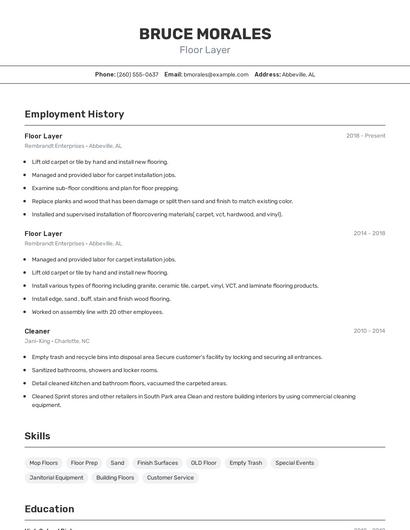
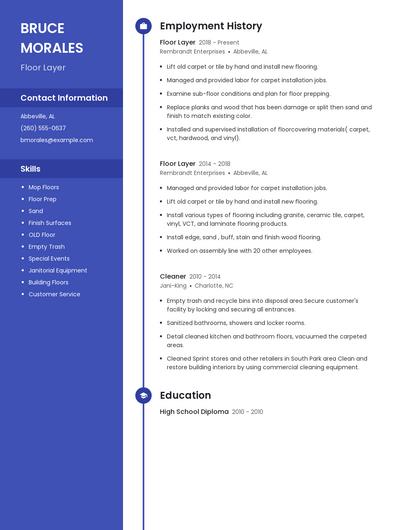
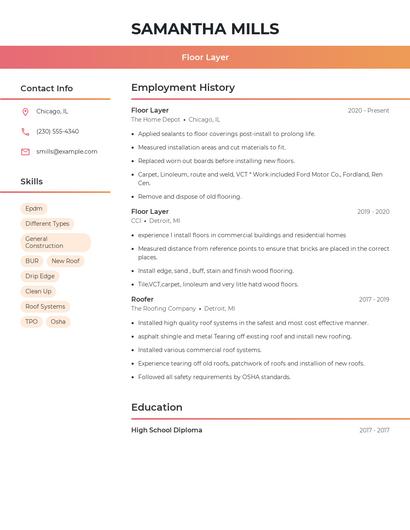
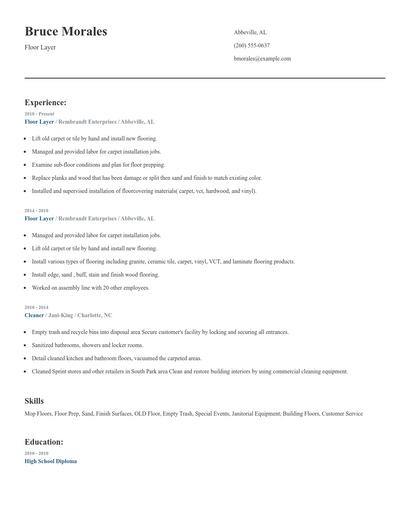
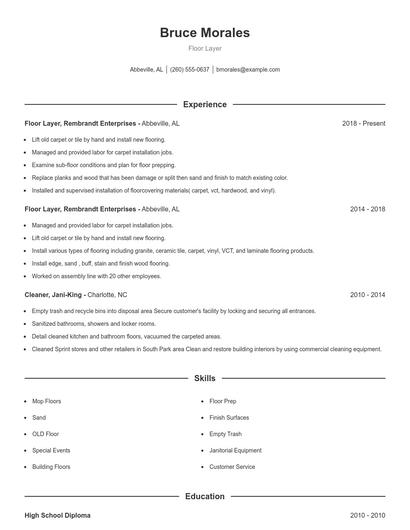
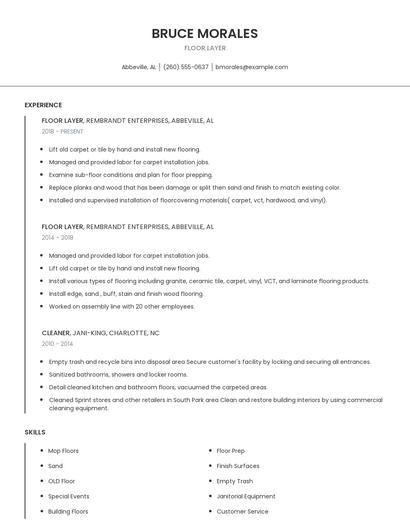
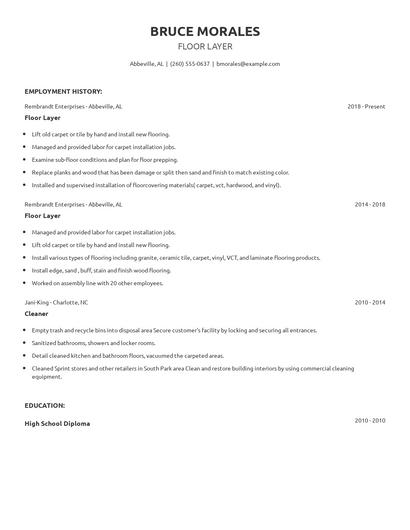
Choose from 10+ customizable floor layer resume templates
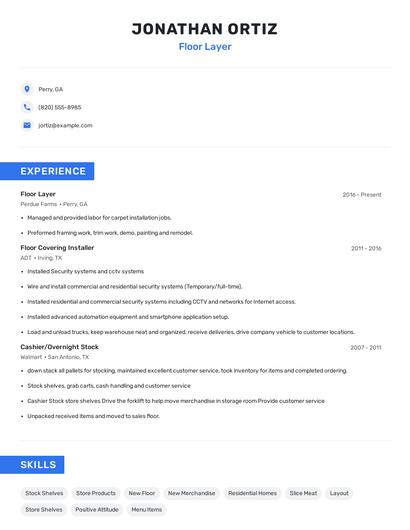
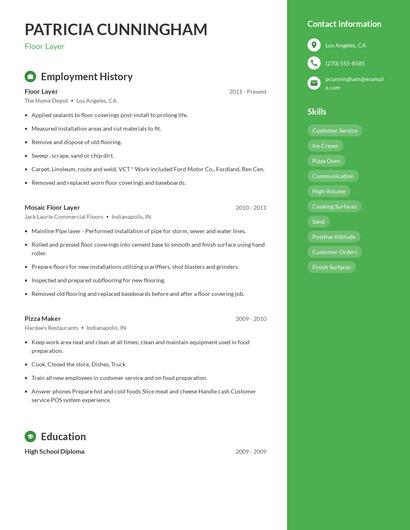
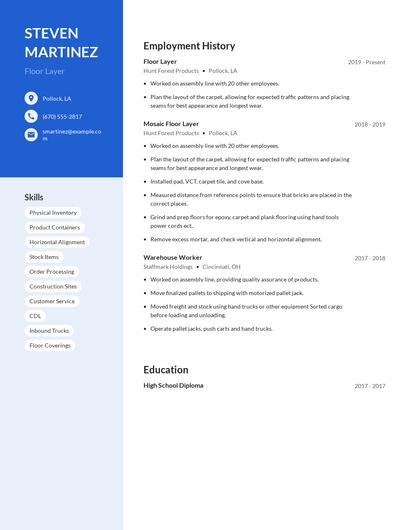
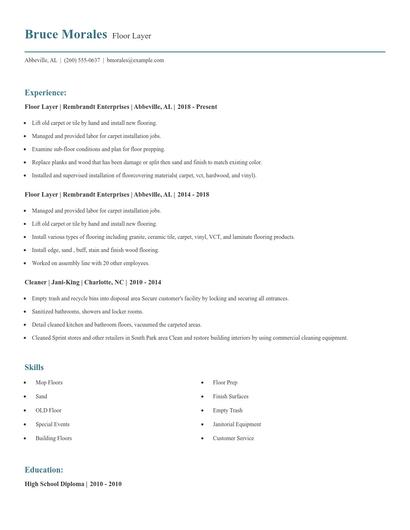
Build a professional floor layer resume in minutes. Our AI resume writing assistant will guide you through every step of the process, and you can choose from 10+ resume templates to create your floor layer resume.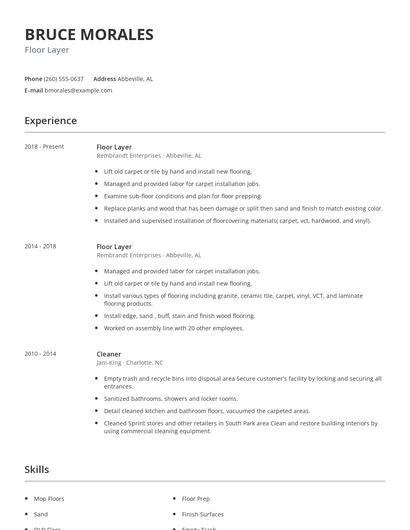
Compare different floor layers
Floor layer vs. Vinyl installer
There are some key differences in the responsibilities of each position. For example, floor layer responsibilities require skills like "vct," "tape measure," "hardwood," and "commercial buildings." Meanwhile a typical vinyl installer has skills in areas such as "vehicle wraps," "tack," "parts removal," and "customer vehicles." This difference in skills reveals the differences in what each career does.
Vinyl installers tend to reach similar levels of education than floor layers. In fact, vinyl installers are 0.7% more likely to graduate with a Master's Degree and 0.0% less likely to have a Doctoral Degree.Floor layer vs. Linoleum layer apprentice
Each career also uses different skills, according to real floor layer resumes. While floor layer responsibilities can utilize skills like "vct," "tape measure," "hardwood," and "commercial buildings," linoleum layer apprentices use skills like "manual labor," "building materials," "certifications," and "reference points."
Average education levels between the two professions vary. Linoleum layer apprentices tend to reach similar levels of education than floor layers. In fact, they're 0.0% less likely to graduate with a Master's Degree and 0.0% less likely to earn a Doctoral Degree.Floor layer vs. Floor covering contractor
There are many key differences between these two careers, including some of the skills required to perform responsibilities within each role. For example, a floor layer is likely to be skilled in "tape measure," "hardwood," "trowels," and "demo," while a typical floor covering contractor is skilled in "sheet vinyl," "carpet-vinyl," "jda," and "personnel administration."
Floor covering contractors typically earn similar educational levels compared to floor layers. Specifically, they're 0.0% less likely to graduate with a Master's Degree, and 0.0% less likely to earn a Doctoral Degree.Floor layer vs. Floor covering installer
Updated January 8, 2025
