
Automatically apply for jobs with Zippia
Upload your resume to get started.
Forensic materials engineer skills for your resume and career
11 forensic materials engineer skills for your resume and career
1. Litigation
- Provided definitive conclusion on cause and origin and prepared reports on findings for insurance claims and litigation.
- Write expert reports and declarations for attorney's use in litigation.
2. Failure Analysis
Failure Analysis is a step-by-step process of determining the reason for a particular machine or equipment failure by way of checking, identification, and examination. It means conducting a test within the system and perform a maintenance check that leads you to a conclusion. A failure analysis takes place to prevent further damages.
- Operated electrical failure analysis laboratory.
- Supervised a failure analysis lab to identify failure mode and to recommend failure solutions for manufacturing engineers and materials engineers
3. Encase
- Experience with EnCase for analysis, culling, recovery and reporting.
4. Technical Reports
Technical reports are a type of document that is used to indicate either the progress, result, or process of scientific research or the state of problems occurring within such research. A technical report may also showcase the report's overall conclusion and may also include recommendations. This kind of report does not require a peer review and isn't published officially but distributed within the organizations where it was formed.
- Generated technical reports for clients containing the results of the forensics engineering analysis
- Interview witnesses, research products, and write technical reports of my findings on a case-by-case basis.
5. Autocad
- Create drawings using AutoCAD 2009 and AutoCAD Land Development.
- Used AutoCAD and other software to create simple vehicle models to reconstruct possible accident scenarios.
6. Commercial Property
- Provided storm damage assessments and repair recommendations on residential and commercial property located along the East Coast.
- Provide consulting services to the insurance industry and to attorneys for residential and commercial property claims.
Choose from 10+ customizable forensic materials engineer resume templates
Build a professional forensic materials engineer resume in minutes. Our AI resume writing assistant will guide you through every step of the process, and you can choose from 10+ resume templates to create your forensic materials engineer resume.7. Security Incidents
- Logged incidents into the Information Security Incident Management System and assist in generating weekly reports based on security incidents.
8. IDS
An IDS (intrusion detection system) stands for a software application or device that monitors a network to identify policy violations or malicious activities.
- Monitor and analyze Intrusion Detection Systems (IDS) to identify security issues for remediation.
9. Destructive Testing
- Performed destructive testing inspection, retrofit design, and expert witness support for class action lawsuits.
- Perform nondestructive testing on evidence received to determine the cause of failure.
10. Structural Damage
Any kind of harm that damages a structure to its cores is called structural damage. Structural damage mainly includes the damage to load-bearing walls and roof. Walls are the most essential component of a building, as they carry the majority of the building's weight apart from carrying a roof. Without walls, the whole structure could fall apart and collapse. Structural damage includes; wood cracks, rusted doors and windows, damaged electricity wires, leaked gas and water pipes, wet insulations, rusty cracks, roof fissures, and foundation cracks.
- Inspected structural damage and provided repair recommendations for buildings damaged as a result of high winds and water from Hurricane Wilma.
- Inspect civil engineering works (runways, bridges, buildings) to detect structural damage to prevent failure and/or disaster.
11. Certifications
- Support FISMA audits and Certifications and Accreditations and all continuous monitoring activities.

What skills help Forensic Materials Engineers find jobs?
Tell us what job you are looking for, we’ll show you what skills employers want.
List of forensic materials engineer skills to add to your resume
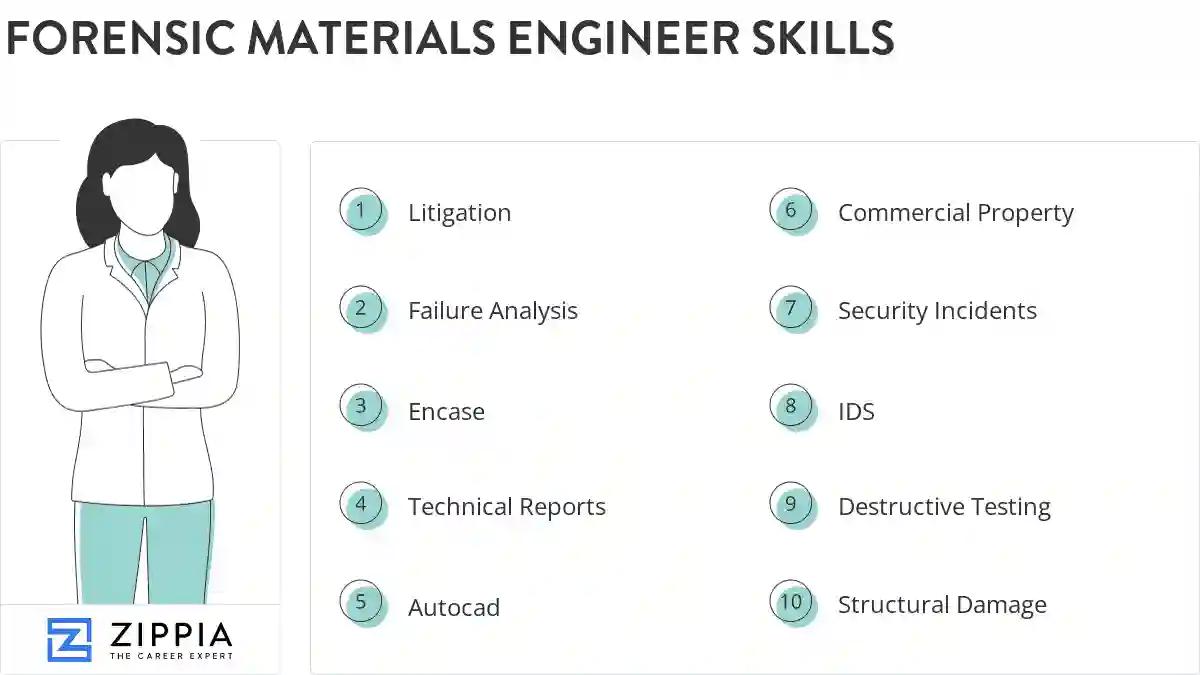
The most important skills for a forensic materials engineer resume and required skills for a forensic materials engineer to have include:
- Litigation
- Failure Analysis
- Encase
- Technical Reports
- Autocad
- Commercial Property
- Security Incidents
- IDS
- Destructive Testing
- Structural Damage
- Certifications
Updated January 8, 2025
