
Automatically apply for jobs with Zippia
Upload your resume to get started.
Formulation scientist skills for your resume and career
15 formulation scientist skills for your resume and career
1. Dosage Forms
- Performed physical characterization of pharmaceutical dosage forms and intermediates during development to improve manufacturing efficiency and formulation quality.
- Perform scanning electron microscopy or additional physical evaluation of raw material and dosage forms.
2. Scale-Up
Scale-Up refers to the act of making a product or model larger. Because all dimensions of the product must be increased, the scale of the model or rendering is increased as well. It may also refer to the act of increasing attention or force behind a certain idea or action, such as a scaled-up attempt to combat murder hornet infestations.
- Perform Reverse engineering of existing products, Pilot Phase development, Scale-up phase development and process of manufacturing.
- Performed scale-up studies and determined the parameters necessary for optimization of a laboratory scale batch.
3. GMP
GMP stands for Good Manufacturing Practice. It is a system that ensures that all products like food, beverages, and medicinal drugs that are produced comply with the quality standards. It helps in minimizing the risks and hazards that cannot be eliminated after the testing of final products.
- Travel to customer site to introduce, combine and verified GMP operating procedures into customer's existing manufacturing facilities.
- Team delivered GMP Clinical Supplies and VICH batches 6 months ahead of schedule and removed CMC activities from project critical path.
4. QC
Quality control is a set of instructions or procedures to ensure a manufactured product or a service is up to the highest quality standards. This set of quality control criteria are either defined by the clients or the company itself.
- Coordinate timelines with Analytical R & D, Manufacturing, QC and QA to ensure timely completion of projects.
- Developed and wrote QC Specifications, Manufacture Specifications, Bill of Materials, Standard Operating Procedure in a development/ manufacturing environment.
5. Drug Products
A drug product is a drug that has the finished dosage form which is the final product from a pharmaceutical company bearing an active ingredient. The active ingredient is tagged along with other inactive ingredients that make the product whole in the effect that it offer to users.
- Designed, wrote and implemented protocols for testing compatibility and stability of protein drug products with containers and delivery systems.
- Formulated scaled up nutrition supplements and generic drug products.
6. HPLC
- Develop crude HPLC methods to test raw drug solubility and drug content in finished research products.
- Implemented execution and HPLC analysis of development stability studies of lead parenteral product and authored technical summary report.
Choose from 10+ customizable formulation scientist resume templates
Build a professional formulation scientist resume in minutes. Our AI resume writing assistant will guide you through every step of the process, and you can choose from 10+ resume templates to create your formulation scientist resume.7. R
R is a free software environment and a language used by programmers for statistical computing. The R programming language is famously used for data analysis by data scientists.
- Created and validated R based automated analysis scripts for quality control release of manufactured materials.
- Led development of an R package collaboratively using version control.
8. FDA
The Food and Drug Administration (FDA) is a division of the US Department of Health and Human Services that regulates the production and sale of food, pharmaceutical products, medical equipment, and other consumer goods, as well as veterinary medicine. The FDA is now in charge of overseeing the manufacture of products like vaccines, allergy treatments, and beauty products.
- Co-designed and executed Drug Product solubility studies which demonstrated lot comparability and satisfied questions posed in an FDA Complete Response Letter.
- Aided in starting up a new microbiology laboratory and expanded clean room manufacturing facility with successful FDA approval.
9. CMC
CMC stands for "chemistry, manufacturing, and controls," which represents a standard procedure when producing new pharmaceutical drugs. First the drug is developed through chemical tests and analysis, then the drug is manufactured. Before the pharmaceutical can be offered to the public, it must be tested on individuals, often animal test subjects first and then human beings. This allows pharmacists to determine whether the drug must be reconsidered, reproduced, or whether any side effects accompany the drug.
- Prepared regulatory submission package (CMC section) including reference standard, drug substance characterization and impurity characterization.
- Contributed technical and regulatory expertise to CMC development project teams, specification review and stability committees.
10. Technical Reports
Technical reports are a type of document that is used to indicate either the progress, result, or process of scientific research or the state of problems occurring within such research. A technical report may also showcase the report's overall conclusion and may also include recommendations. This kind of report does not require a peer review and isn't published officially but distributed within the organizations where it was formed.
- Supervised protocol execution and summarized successful results in technical reports.
- Prepared technical reports for CMC preparation of IL-2 and beta interferon.
11. Stability Studies
- Trained and supervised Formulation Technicians to assist in the testing and development of protein formulations and related compatibility/stability studies.
- Performed routine and non-routine sample analysis in support of stability studies for the development of monoclonal antibody formulations.
12. Project Management
- Provided technical and documentation support to the project management team.
- General knowledge of AtTask project management software
13. DSC
DSC - Differential Scanning Calorimetry is a thermo-analytical technique used to measure how much energy a sample absorbs or releases while heating or cooling. Thus, DSC measures the amount of heat required to increase the temperature of a sample as a function of temperature or time.
- Well versed in operation of lyophilizers as well as in analytical instrumentation such as ITC, DSC, and Freeze-Dry Microscope.
- Conceptualized and developed an analytical method for evaluating onset of melting point as a fast and potential orthogonal method to DSC.
14. Analytical Methods
An analytical method is a method used to determine the chemical or physical property of a substance. It is a procedure to determine the relationship between different variables. This method can be conducted by combining scientific methods with any kind of formal process to solve a problem or prove a fact.
- Identified problems between the 9th and 10th Editions of the ACS Chemical Reagents Analytical Methods.
- Research and develop qualitative and quantitative analytical methodologies for testing in-vitro drug release from drug delivery systems.
15. QbD
- Develop pharmaceutical formulation utilizing Quality by Design (QbD) and Risk Assessment concept.
- Applied QbD and PAT to formulation/process development.
5 Formulation Scientist resume examples
Build a professional formulation scientist resume in minutes. Browse through our resume examples to identify the best way to word your resume. Then choose from 5+ resume templates to create your formulation scientist resume.

What skills help Formulation Scientists find jobs?
Tell us what job you are looking for, we’ll show you what skills employers want.
What skills stand out on formulation scientist resumes?
Tedley Pihl
Assistant Professor of Practice, University of Arizona
What formulation scientist skills would you recommend for someone trying to advance their career?
Dr. Kelly Giovanello Ph.D.
Professor, Director of Neuroscience Curricula, The University of North Carolina at Chapel Hill
What type of skills will young formulation scientists need?
David Cool Ph.D.
Professor, Pharmacology & Toxicology; Professor, Obstetrics & Gynecology, Wright State University
Some were even given a test to see if they understood the concept. This then leads to mass spectrometry, LCMS, MALDI-TOF, and even GCMS, and everything that has been developed around those basic techniques is now commonplace in most core facilities and Pharma. New methods for flow cytometry, FACS, are necessary for the higher throughput drug discovery types of labs. Molecular biology has evolved from simple PCR machines that could run 24 samples, just 25 years ago, to digital PCR machines that can run 384 pieces today and email the final data to you at home, while you sleep. Knowing how to calculate the PCR data is extremely critical, as it isn't intuitive, and people tend to take short cuts. Knowing how to do that will be vital. Cell culture and working with animals are still common ways to generate data in any lab, and people who have those skills will always have a job. What do all these techniques have in common? They all have evolved to the point that no one is an expert in every one of them. Labs focus and concentrate on the ones they need the most and make use of them over a long period. What a student should develop is what I call a big toolbox. Learn as many of these techniques as you can, and then use them. Understanding that these are all cyclic and that you may get rusty, or the technology will change. It doesn't matter. By being trained in any of these, it will mean that you can be prepared for other things, that you can catch up and learn and update your techniques in your toolbox. This is what any PI running a lab will be looking for, someone who can be trained, and can evolve and adapt to different technologies, know how they work and how they can be used, what the data looks like when it is working well, and what it looks like when it isn't. The people who have these skills will always be employable.
There is a greater need than ever for workers to analyze data and synthesize a reasonable idea about what it means. This means that they must understand their experiments at a deeper level than just pipetting buffers and timing reactions. They must know what is happening, and if there is a problem, first, they have a problem and then how to solve it. Bioinformatics has become one of the fastest-growing fields. The increased amount of data, whether from standard assays run in an ordinary lab or high throughput data, needs more crunching. The future researcher will not be able to get by just knowing how to use a computer stats program but will be required to understand how to run data in R or Python or whatever new data analysis package is coming next. This becomes even more critical as the data becomes more complex, i.e., 27 cytokines analyzed in 3 different tissues over three other times, from 14 different groups, 6 of which are controls, with the rest being toxin and then treatment groups and authorities. A simple two way ANOVA just doesn't cut it. For this, machine learning tools, pattern recognition, neural networks, topological data analysis (TDA), Deep Learning, etc., are becoming the norm and are being advanced and changed to give more and more substance to what the data means. Students who can operate instruments to generate data and run more complex types of analysis on this 'big data' are in great demand. Likewise, learning the computer-generated design of drugs 'in silico' is a growing field that is now required to screen tens of thousands of compounds before generating them in the lab. This will need someone who can think three-dimensionally; even though the software and advanced computers can do that, it helps if your brain is wired that way, at least a little.
Aside from instruments and complex data analysis, consider where the clinical research is headed. With COVID19, the need to quickly advance drugs from potential use to clinical application has undergone an exponential increase. Lives are being lost daily to the lack of a vaccine or medication that can attenuate to any level the impact the virus has on the human body. The future clinical researcher will need to understand how the instruments work and how tests are run, how a vaccine works, how the virus or disease manifests itself, and how to get it under control. This will only be possible if the researcher is familiar with much of what I wrote above. You won't need to be an expert on virtually everything, but you'll need to understand it so you can use it to synthesize new ideas that may be applicable in the clinical environment. COVID19 is a perfect example. One of the early struggles with this virus was how to test for it. Antibodies weren't developed for it in the very beginning, so an ELISA was out.
In contrast, PCR is one of the most sensitive methods to identify genetic material, such as viruses. So, early on, PCR primers were created that could be used to run a PCR to determine if a person had a live virus. However, the first such PCRs had high false negatives and positives. Further refinement led to the creation of PCR primer sets and protocols that allowed for a more accurate and faster test. An advantage that anyone who has been trained in biotechnology will know the basics of developing a test. If it is a PCR, then what goes into that. Suppose it is an ELISA, how it works, and what you need to set it up. Imagine a test strip similar to the one used for at-home pregnancy tests. This came about in much the same way, through experimentation and developing a way to lower the false negatives and positives, to allow a quick, 5-minute test that could determine if a particular hormone was in your urine at a stage of pregnancy when many women may not have realized there was a possibility they could be pregnant. The person entering the workforce that can think in these ways will be employable and will be able to move between jobs and continue with a very successful and enriching career.
What soft skills should all formulation scientists possess?
Janet Alder Ph.D.
Associate Professor, Assistant Dean for Graduate Academic and Student Affairs, SGS, School of Graduate Studies, Rutgers University
List of formulation scientist skills to add to your resume
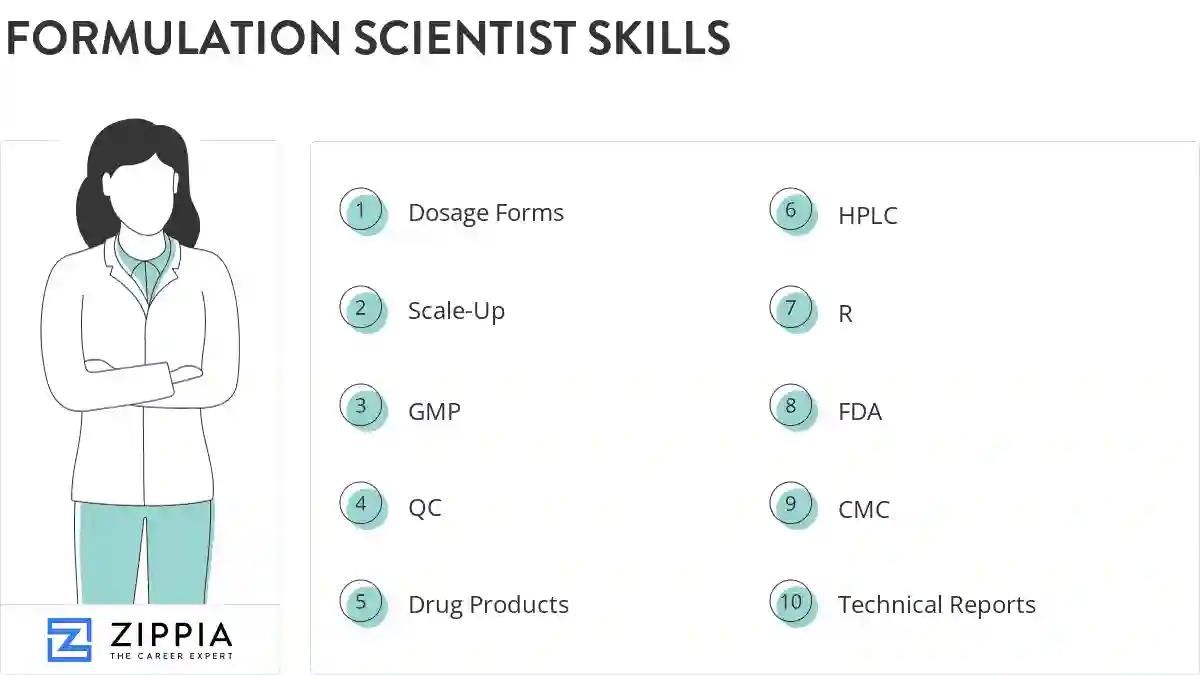
The most important skills for a formulation scientist resume and required skills for a formulation scientist to have include:
- Dosage Forms
- Scale-Up
- GMP
- QC
- Drug Products
- HPLC
- R
- FDA
- CMC
- Technical Reports
- Stability Studies
- Project Management
- DSC
- Analytical Methods
- QbD
- Capsules
- NDA
- Technical Support
- Oligonucleotides
- Method Development
- GLP
- Laboratory Equipment
- Analytical Data
- Lab Scale
- Experimental Design
- ICH
- API
- Electrophoresis
- Clinical Studies
- Particle Size
- Formulation Development
- Process Optimization
- DOE
- Regulatory Submissions
- Pharmacokinetics
- Pharmaceutical Products
- CMO
- IV
- IND
- Laboratory Experiments
- QA
- USP
- Product Development
- TGA
- Nanoparticles
- Pilot Scale
- Preformulation
- Immunotherapy
- Extrusion
Updated January 8, 2025
