
Automatically apply for jobs with Zippia
Upload your resume to get started.
Functional test engineer skills for your resume and career
15 functional test engineer skills for your resume and career
1. Test Cases
- Documented specific test cases and scenarios for automation purposes.
- Prepared test cases based on functional Requirement specifications.
2. Test Equipment
Test equipment is a mechanical tool or a device which is used create signals and gather response from an electronic device under test. It helps in detecting any faults in the device and it also proves the proper operation of the electronic device.
- Designed test equipment to support system test, audit test and final system audit of completed systems prior to shipment.
- Monitor test equipment capacity; work with customer and manufacturing to increase / decrease capacity as product demand changes.
3. Test Results
- Analyzed test results and recommended corrective action.
- Created test scripts using Quick Test Professional QTP, and executed test scenarios and analysis of test results.
4. Front End
- Managed creation of test suites and tools for front end efforts.
- Design and Develop the SQL queries for the Front end screens.
5. Test Data
- Prepared UAT test scripts and test data and coordinated with business users in executing the test scripts throughout the UAT cycle.
- Generated yield data, analyzed and interpreted test data and prepared technical reports for the test engineering team.
6. QA
QA, or Quality Assurance is a procedure that entails all of the steps taken to avoid any errors in the manufacturing process or in the production of the goods that a company produces. It can also include ensuring the consistency of the services rendered. Quality assurance ensures that the quality of the service delivered to consumers meets or exceeds the promised expectations. This greatly aids in the prevention of any complications that might arise after the goods or services have been distributed. It makes sure that customers are satisfied.
- Lead testing effort with Development teams, Business Analysts, Customers and offshore QA Testers.
- Supported Reliability, QA and FA engineers with all related functional test issues.
Choose from 10+ customizable functional test engineer resume templates
Build a professional functional test engineer resume in minutes. Our AI resume writing assistant will guide you through every step of the process, and you can choose from 10+ resume templates to create your functional test engineer resume.7. Test Scripts
Test scripts validate the quality of the software or app being tested. An effective test script has all the steps to be taken to use a software program as well as the ending result of each step.
- Tested application manually before developing automation test scripts.
- Escalated and raised any issues and risks encountered during the creation of the automated test scripts then documented it.
8. Regression
- Supported Regression testing in staging and Post-Production verification testing in Production environment for major and minor releases of the Iteration.
- Completed router infrastructure and software upgrades while performing testing and regression testing.
9. Test Scenarios
- Prepare the positive and negative test scenarios.
- Work on data preparation for different test scenarios including negative testing to provide accurate delivery of overall functionality of the product.
10. Test Execution
- Captured test execution results and logged defects in JIRA after investigating the issues.
- Identify critical bugs in the product early in the test execution cycle.
11. Cycle Management
- Used Quality Center/ Application Life Cycle Management and Jira bug tracking tools to report and track defects till closure.
12. Test Software
- Developed C# functions that communicated with the Therapy Module on defibrillator to ensure easy automation of test software.
- Defined test plans, test hardware, test software.
13. Debugging
- Implemented a development program including machine performance validations, legal certifications, and software debugging for completely new Off Highway Truck.
- Test includes debugging generated log files to isolate equipment fail points and modify test configurations to specific semiconductor tools as necessary.
14. Automation Scripts
- Created many re-usable components in VB script which can be used across the automation scripts
- Involved in Preparation of Automation scripts for LSE-UnaVista application using RFT-7.0.
15. System Integration
System integration refers to connecting distinct subsystems into a sole bigger system that tasks as one in very extensive terms. In engineering, the principal system integrator integrates separate systems using various techniques such as enterprise application integration, computer networking, business process management or manual programming.
- Implement system engineering throughout the product development cycle, including requirements analysis, requirement tracking, system integration and verification.
- Directed system integration and test activities including formal design certification on developmental systems and factory/site acceptance testing on production systems.
5 Functional Test Engineer resume examples
Build a professional functional test engineer resume in minutes. Browse through our resume examples to identify the best way to word your resume. Then choose from 5+ resume templates to create your functional test engineer resume.

What skills help Functional Test Engineers find jobs?
Tell us what job you are looking for, we’ll show you what skills employers want.
List of functional test engineer skills to add to your resume
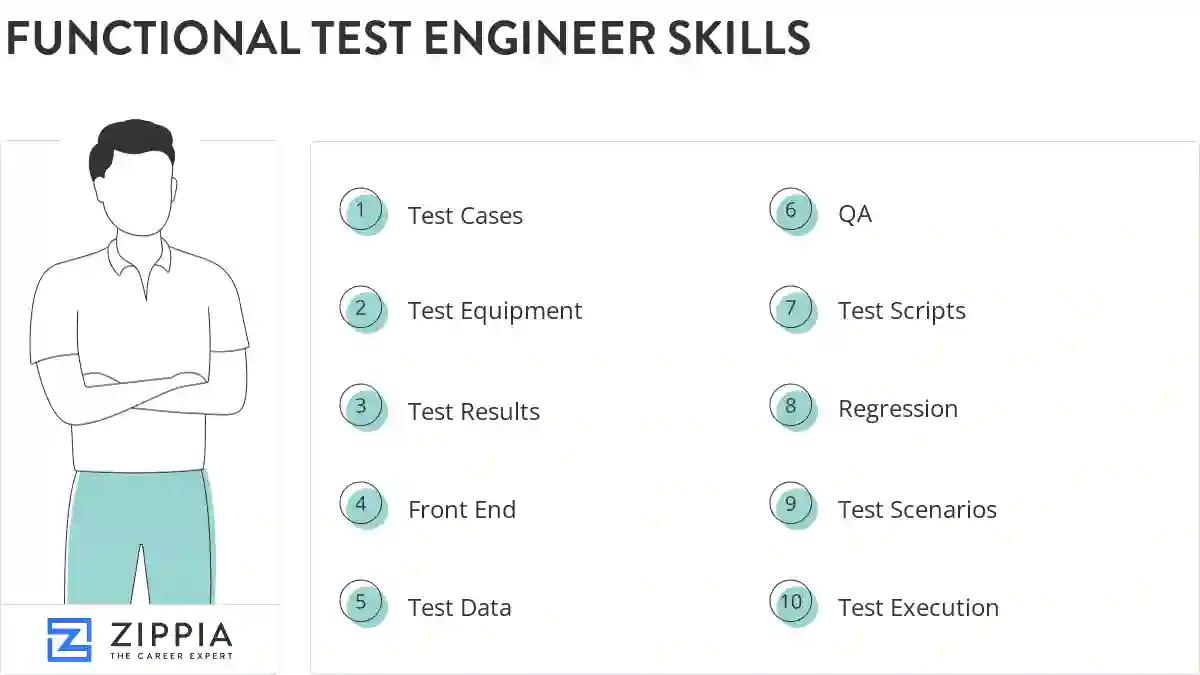
The most important skills for a functional test engineer resume and required skills for a functional test engineer to have include:
- Test Cases
- Test Equipment
- Test Results
- Front End
- Test Data
- QA
- Test Scripts
- Regression
- Test Scenarios
- Test Execution
- Cycle Management
- Test Software
- Debugging
- Automation Scripts
- System Integration
- API
- Java
- Linux
- Python
- DOD
- ISO
- Test Strategy
- Verification Testing
- Test Environment
- Business Processes
- UAT
- User Acceptance
- Switches
- End Testing
- SQL Server
- Test Programs
- UI
- Api Testing
- Unix
- C++
- C #
- XML
- JavaScript
- Browser Testing
- PL/SQL
- Windows XP
- C Net
- GUI
- QTP
- HP QC
Updated January 8, 2025
