What does a gatherer do?
Gatherer responsibilities
Here are examples of responsibilities from real gatherer resumes:
- Distribute insulating materials into small spaces within ceilings or walls using blowers.
- Complete all necessary safety inspection documentation in accordance with OSHA standards and followed-up as required in a timely manner.
- Position or align components for assembly, manually or using hoists.Rework, repair, or replace damage parts or assemblies.
Gatherer skills and personality traits
We break down the percentage of Gatherers that have these skills listed on their resume here:
- Customer Service, 100%
Maintained high standards of customer service during high-volume, fast-paced operations.
Dexterity. The most essential soft skill for a gatherer to carry out their responsibilities is dexterity. This skill is important for the role because "agricultural workers need excellent hand-eye coordination to harvest crops and operate farm machinery." Additionally, a gatherer resume shows how their duties depend on dexterity: "load pallets & move products, operate small hand tools & fork lift as required. "
Listening skills. Another soft skill that's essential for fulfilling gatherer duties is listening skills. The role rewards competence in this skill because "agricultural workers must listen carefully to ensure that they understand instructions from farmers and other agricultural managers and supervisors." According to a gatherer resume, here's how gatherers can utilize listening skills in their job responsibilities: "prepared sandwiches listened to customer orders and handled money answered phone calls provided customer service"
Physical strength. This is an important skill for gatherers to perform their duties. For an example of how gatherer responsibilities depend on this skill, consider that "agricultural workers must be strong enough to lift heavy objects, including tools and crops." This excerpt from a resume also shows how vital it is to everyday roles and responsibilities of a gatherer: "pick up eggs, care for live birds, physical labor, construction work".
Mechanical skills. For certain gatherer responsibilities to be completed, the job requires competence in "mechanical skills." The day-to-day duties of a gatherer rely on this skill, as "agricultural workers must be able to operate complex farm machinery." For example, this snippet was taken directly from a resume about how this skill applies to what gatherers do: "clean shop, organize tools and equipment, sand cars, fix body work and mechanical problems with cars. "
The three companies that hire the most gatherers are:
- S&S Activewear1 gatherers jobs
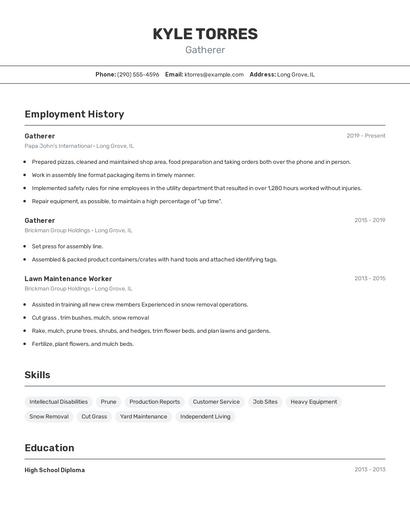
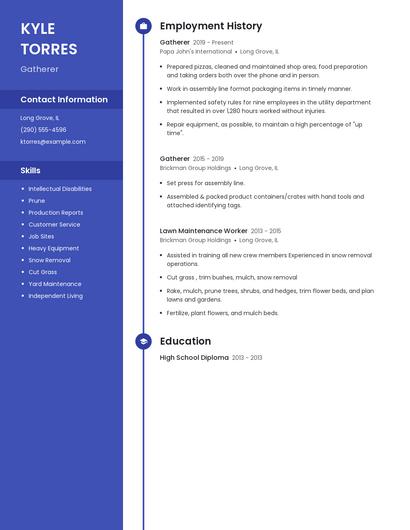
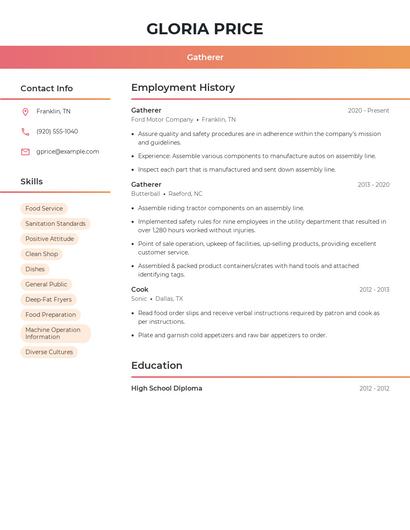
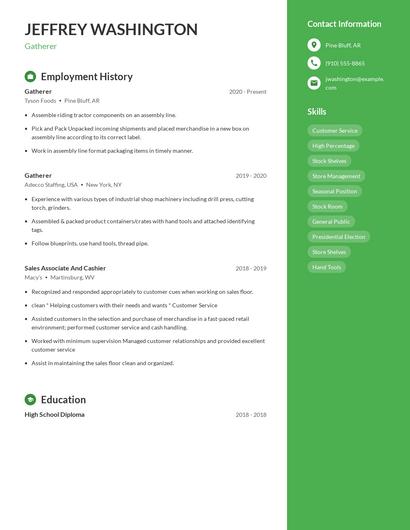
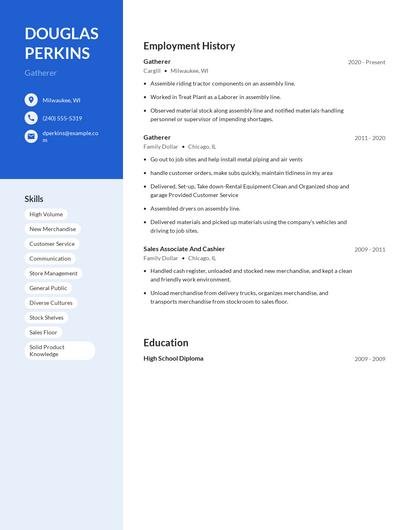
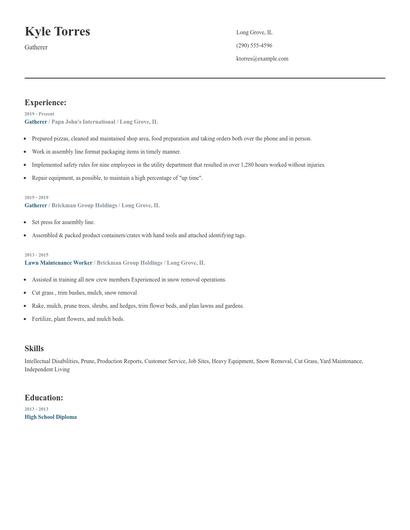
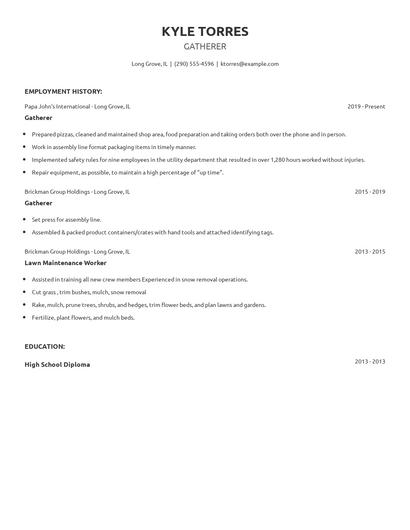
Choose from 10+ customizable gatherer resume templates
Build a professional gatherer resume in minutes. Our AI resume writing assistant will guide you through every step of the process, and you can choose from 10+ resume templates to create your gatherer resume.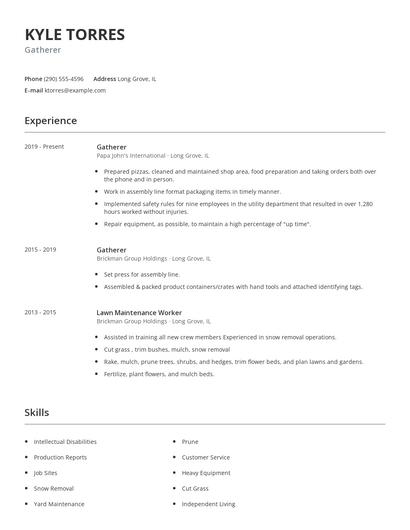




Compare different gatherers
Gatherer vs. Mill work
Professional utility workers have skills in customer service, safety procedures, and safety standards. Those in this career work to maintain a perpetually clean work area, comply with safety standards, inspect finished projects, repair and replace any broken equipment. A professional utility worker will also locate parts and tools to help improve workflows.
While similarities exist, there are also some differences between gatherers and mill work. For instance, gatherer responsibilities require skills such as "customer service," "quality checks," "door sales," and "service provision." Whereas a mill work is skilled in "production process," "safety procedures," "load trucks," and "augers." This is part of what separates the two careers.
The education levels that mill works earn slightly differ from gatherers. In particular, mill works are 2.3% less likely to graduate with a Master's Degree than a gatherer. Additionally, they're 0.3% more likely to earn a Doctoral Degree.Gatherer vs. Ammunition assembly labour
Production line operators must have strong reading skills and a knowledge base for loading and unloading, quality control, and starting and stopping of production lines. Those who choose this career will be expected to assist in assembling and manufacturing machines, foodstuffs, and products. Production line operators most often work in a factory setting for a manufacturer.
While some skills are similar in these professions, other skills aren't so similar. For example, resumes show us that gatherer responsibilities requires skills like "customer service," "door sales," "service provision," and "computer programs." But an ammunition assembly labour might use other skills in their typical duties, such as, "hand tools," "assembly line," "blueprint specifications," and "work ethic."
Average education levels between the two professions vary. Ammunition assembly labours tend to reach similar levels of education than gatherers. In fact, they're 2.2% less likely to graduate with a Master's Degree and 0.3% less likely to earn a Doctoral Degree.Gatherer vs. Production utility worker
The required skills of the two careers differ considerably. For example, gatherers are more likely to have skills like "customer service," "door sales," "service provision," and "computer programs." But a production utility worker is more likely to have skills like "production process," "pallets," "safety rules," and "basic math."
Most production utility workers achieve a similar degree level compared to gatherers. For example, they're 2.8% less likely to graduate with a Master's Degree, and 0.0% less likely to earn a Doctoral Degree.Gatherer vs. Production line operator
Types of gatherer
Updated January 8, 2025
