
Automatically apply for jobs with Zippia
Upload your resume to get started.
General assembler-installer skills for your resume and career
15 general assembler-installer skills for your resume and career
1. Hand Tools
- Fabricate and install parts and systems, using hand tools, power tools, and test instruments.
- Can easily operate an extensive array of hand tools and or small machinery.
2. Dollies
- Load and unload items from machine, carts, and dollies.
3. Plumbing
- General construction including electrical repairs and installation, plumbing repair and installation, drywall and basic carpentry.
- Skilled in refrigeration, plumbing, basic electrical and facility maintenance.
4. Roofing
- Installed free floating and ballast membrane roofing and removed and repaired existing roofing.
- Performed exterior remodeling; roofing, siding, installed windows and doors, gutters.General Laborer/Installer
5. HVAC
- Performed preventative maintenance, troubleshot breakdowns and repaired malfunctioning HVAC systems and components; utilized measuring and testing instruments.
- Installed complete HVAC systems per customers' specific requirements and in alignment with standard safety/regulatory practices.
6. General Construction
General construction is a fundamental term that is used to describe the various kinds of construction projects like building, remodelling, and designing. While each of these requires some form of construction the difference arises based on the equipment and skill required for each. General construction may cover variables like estimation, project management, client communication, and sourcing materials or equipment.
- General construction for new and existing commercial buildings and residential reconstructions and renovations.
- Performed other general construction duties as assigned by immediate supervisor.
Choose from 10+ customizable general assembler-installer resume templates
Build a professional general assembler-installer resume in minutes. Our AI resume writing assistant will guide you through every step of the process, and you can choose from 10+ resume templates to create your general assembler-installer resume.7. FOD
FOD is the safety and quality control process followed in environments where loose objects, wildlife and small debris make cause damage to equipment, employees, visitors, or passengers. In worse cases, it will also lead to production delays and violation of safety regulations.
- Followed aviation/company Tool Control and FOD procedures.
- Trained in FOD, which included how to detect and remove unwanted debris before causing damage to the product.
8. Landing Gear
- Installed and rigged Flap/ Vane assembly, Main & Alternate Landing Gear and rigged flight control cables for the Rudder.
- Joined structural assemblies such as landing gear parts.
9. Engineering Drawings
Engineering drawings are technical drawings that tell about the requirements for engineering components or equipment. Such drawings have standardized languages and symbols. There are multiple types of engineering drawings such as isometric drawing, orthographic or multiview drawing, schematic drawings, one view, and two view drawings, etc.
- Interpreted engineering drawings and technical specifications for assembly.
- Interpret engineering drawings and technical documents.
10. PVC
PVC - Polyvinyl chloride is the third most widely produced synthetic plastic polymer in the world. It is made up of carbon atoms from ethylene, which is made from natural gas or oil, and chlorine from salt.
- Installed pumps/filters/chlorine feeders and automated systems by installing interior/exterior PVC and metal.
- Installed Refrigerant piping and condensation lines using PVC piping
11. Hazardous Materials
Any substance or good that is harmful to human health as well as the environment are called hazardous materials. Such materials must be handled carefully to avoid any mishaps. Harmful gases. chemicals, strong medicines or drugs, radioactive elements required for radiation purposes, a human blood sample that carries germs, all of these are considered hazardous materials.
- Apply sealants, primers and adhesives, handling and disposing of hazardous materials according to guidelines.
- Haul off of destroyed or hazardous materials from slabs or other structures.
12. Construction Sites
A piece of land where constructional activities are to be conducted is termed as a construction site.
- Determine labor requirements for dispatching workers to construction sites.
- Installed fiberglass insulation in residential construction sites
13. Jigs
- Excelled in interpreting detailed aligning units using jigs and fixtures, and inspecting completed components to ensure conformance to specifications.
- Aligned units using jigs and fixtures also inspecting completed components to ensure satisfaction.
14. Bobcat
A bobcat is a utility vehicle that can be used at farms to facilitate transportation and help perform different tasks.
- Use various types of industrial equipment (bobcat, concrete saw, compacter) to fill and compact dirt.
- Installed and assembled pools, utilizing a Bobcat and forklift.
15. Assembly Line
Assembly line is a process used in industries to ensure the production of products in a cost effective manner by dividing up the responsibilities of each labor. Assembly lines enabled industries to hire more workers, therefore providing more employment opportunities to labors. This is possible because in this process the burden of all the tasks related to production are not laid on a single person, they are divided into small baby steps for each labor.
- Inspected and installed various components on a 737 Boeing plane on an assembly line.
- Worked on assembly line manufacturing starter motors for the automotive industry where I received great performance evaluation results.
5 General Assembler-Installer resume examples
Build a professional general assembler-installer resume in minutes. Browse through our resume examples to identify the best way to word your resume. Then choose from 5+ resume templates to create your general assembler-installer resume.

What skills help General Assembler-Installers find jobs?
Tell us what job you are looking for, we’ll show you what skills employers want.
List of general assembler-installer skills to add to your resume
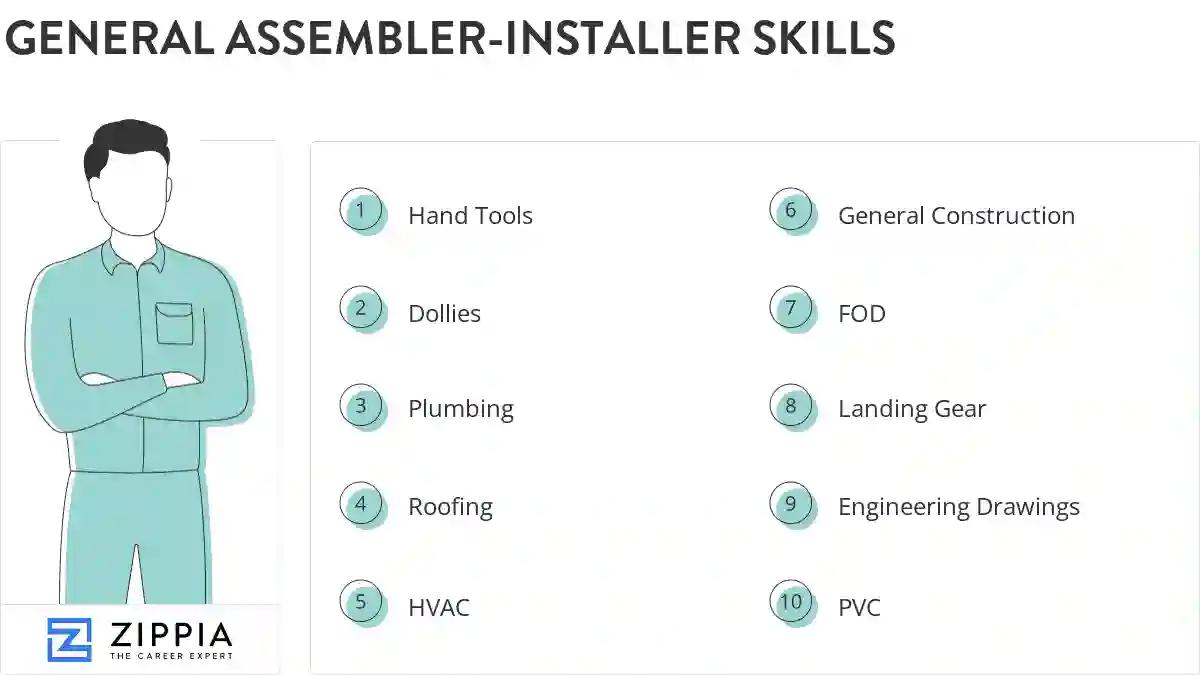
The most important skills for a general assembler-installer resume and required skills for a general assembler-installer to have include:
- Hand Tools
- Dollies
- Plumbing
- Roofing
- HVAC
- General Construction
- FOD
- Landing Gear
- Engineering Drawings
- PVC
- Hazardous Materials
- Construction Sites
- Jigs
- Bobcat
- Assembly Line
- Hoists
- Caulking
Updated January 8, 2025
