
Automatically apply for jobs with Zippia
Upload your resume to get started.
Genomics scientist skills for your resume and career
14 genomics scientist skills for your resume and career
1. Data Analysis
- Establish data analysis best practices to interpret molecular patient data and prioritize clinically-actionable genetic variants.
- Implemented an improved scheduling and analysis management effort between government contracting team and their government customers to foster rapid data analysis.
2. NGS
- Bench work Next generation sequencing (NGS) library preparation for Illumina Hiseq4000 and HiseqX10 and PacBio platforms.
- Paired with bioinformatics colleagues to develop and improve mutation detection algorithms in NGS and non-NGS data.
3. QC
Quality control is a set of instructions or procedures to ensure a manufactured product or a service is up to the highest quality standards. This set of quality control criteria are either defined by the clients or the company itself.
- Provided scientific QC for algorithmic methods of EST-derived gene prediction.
- Adhere to laboratory quality control policies, document all QC activities, instrument and procedural calibration and instrument maintenance.
4. PCR
PCR stands for Polymerase Chain Reaction, a tool to make millions of copies of a target part of DNA. Polymerase chain reaction involves the process of heating and cooling. The process takes place using a machine, which helps in heating and cooling off the substances. The purpose of heating exists to separate the DNA into two single strands.
- Research included optimization of emulsion PCR, sequencing by ligation, and development of novel mate-paired library construction methods.
- Collaborated with automation engineers to automate creation of sequencing templates and to automate emulsion PCR reaction setup.
5. Scientific Literature
- Annotated new genes and researched scientific literature to support their predicted structure and functions.
6. Assay Development
Assay development is a process in molecular biology to test or measure the activity of a drug or biochemical substance in an organic sample or organism and to screen putative compounds to determine the interaction and/or modification of the target. The aim is to standardize the assay and to be able to use it repeatedly and reproducibly.
- Performed assay development for medium throughput screens.
- Assisted in assay development/evaluation of potential small molecule drug targets and in the assessment of potential oncology therapeutics.
7. DNA
Deoxyribonucleic acid, or only DNA, which is considered the king of molecules, is a macromolecule that contains the main component of chromosomes. Shaped like a double helix, DNA is usually found in the nucleus of a cell. It is a type of material that transports characteristics in many forms, developed in nucleotides around one another.
- Develop protocols for producing random adaptor-ligated DNA library.
- Supervised, scheduled and executed laboratory experiments to evaluate the performance of developmental and competitor's DNA sequencing reaction purification systems.
8. Drug Development
- Develop and implement personalized / translational medicine-based approaches to drug development.
9. Clinical Trials
- Design genomic genomic tests for Biotech and and Pharma sponsored clinical trials.
- Managed project with outside company to properly select and develop critical research tools necessary to accelerate program progression toward clinical trials.
10. Cell Lines
- Propagated, handled and banked cell lines for cell based assays.
- Generated monoclonal stable cell lines to evaluate the construct.
11. Drug Targets
- Helped in the search for drug targets with 2 publications and 4 internal publications (no over-lapping materials).
- Analyzed resulting genes signature for potential drug targets.
12. GLP
GLP stands for "good laboratory practice." This refers to the integrity and quality measures that non-clinical laboratories have in place to ensure accurate research and market testing. GLP is most often used in pharmaceutical companies where new drugs must be tested before being approved for sale, but the practice can also be used in food packaging and preparation test centers.
- Developed protocol for Mass Spec based protein identification of Membrane proteins and successfully performed GLP validation required for Regulatory safety studies.
- Performed routine laboratory assignments in accordance with company SOP's and any other applicable guidelines and regulations including GLP if applicable.
13. Genotyping
- Implemented state of the art Genotyping facility for large-scale Human Familial Genetics.
- Generate sequence and genotyping data for SFP genetic map construction.
14. SNP
- Develop genome reduction method for 454 technology for SNP discovery.
- Amplify sequence, develop SNP markers and generate mapping data in QTL population.

What skills help Genomics Scientists find jobs?
Tell us what job you are looking for, we’ll show you what skills employers want.
What genomics scientist skills would you recommend for someone trying to advance their career?
Lisa Cuchara Ph.D.
Professor of Biomedical Sciences, Quinnipiac University
Also being a good steward towards science and being willing and able to communicate not just with peers as we are trained, but also with the public, the politicians, the board members. John Holdren*, stated that Scientists should be tithing at least 10 percent of their time to public service ... including activism. In the ever growing science denialism that is happening in our country being able to communicate science with the public is important. As Peter Hotaz states, "Anti-science propaganda is "killing Americans in unprecedented numbers,""
*Holdren is an American scientist who served as the senior advisor to President Barack Obama on science and technology issues through his roles as assistant to the president for science and technology, director of the White House Office of Science and Technology Policy, and co-chair of the President's Council of Advisors on Science and Technology and a Research Professor in Harvard University's Kennedy School of Government
What type of skills will young genomics scientists need?
Dennis Doverspike Ph.D.
Chief People Scientist, Doverspike Consulting/HR LItehouse
List of genomics scientist skills to add to your resume
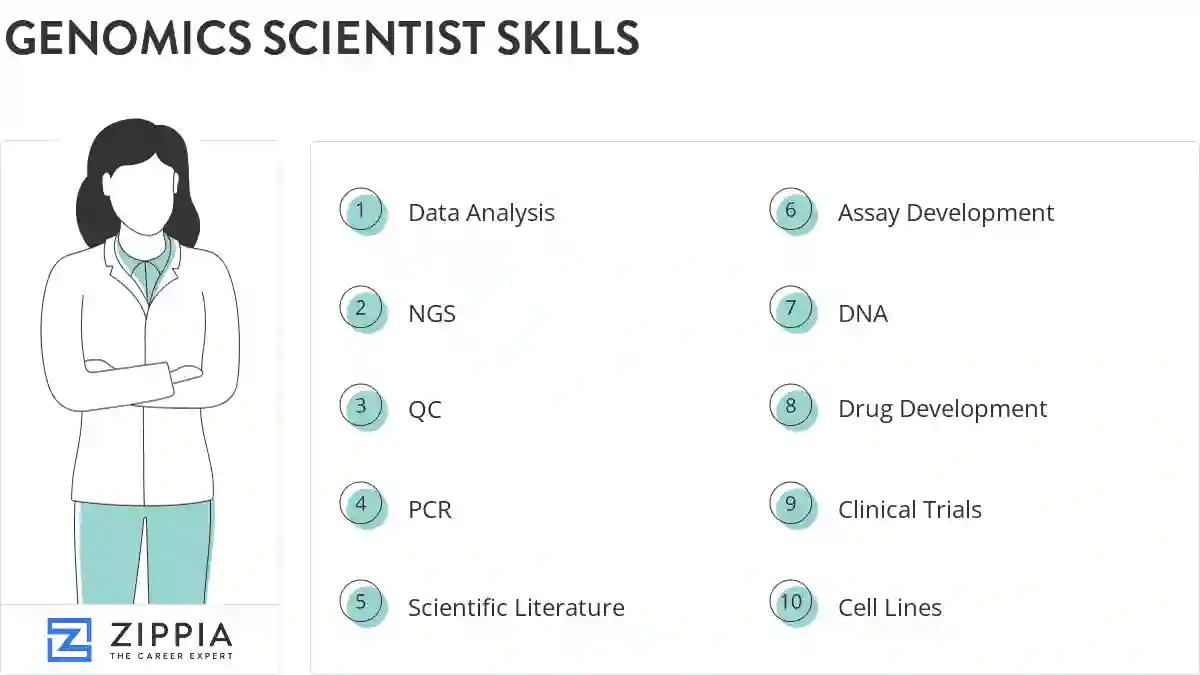
The most important skills for a genomics scientist resume and required skills for a genomics scientist to have include:
- Data Analysis
- NGS
- QC
- PCR
- Scientific Literature
- Assay Development
- DNA
- Drug Development
- Clinical Trials
- Cell Lines
- Drug Targets
- GLP
- Genotyping
- SNP
Updated January 8, 2025
