
Automatically apply for jobs with Zippia
Upload your resume to get started.
Geophysicist skills for your resume and career
15 geophysicist skills for your resume and career
1. Data Collection
Data collection means to analyze and collect all the necessary information. It helps in carrying out research and in storing important and necessary information. The most important goal of data collection is to gather the information that is rich and accurate for statistical analysis.
- Supervised vendor during network deployment, ensured data collection QC, interacted with data analysis team, and delivered interpretation.
- Procured seismic data from subcontractors and designed seismic data collection programs.
2. Geophysical Data
- Conditioned geophysical data and built advanced high level models, which improved correlations between geophysical data and control point models.
- Performed wavelet extraction and AVO analysis on geophysical data to determine likelihood of encountering oil and gas.
3. C++
C++ is a general-purpose programming language that is used to create high-performing applications. It was invented as an extension to the C language. C++ lets the programmer have a high level of domination over memory and system resources. C++ is an object-oriented language that helps you implement real-time issues based on different data functions
- Studied building custom software modules and tools for programs in C++, ProMax, and LISP.
- Improved the usability of a C++ program that performs adaptive data filtering using ridge regression.
4. MATLAB
- Developed SRV algorithm and program in Matlab: later ported to C#.
- Intern Developed novel statistical algorithm with Matlab to estimate uncertainty in volumetric estimation of the subsurface oil reservoirs
5. Data Analysis
- Developed seismic processing best practices in data analysis and processing to heighten level of processing expertise within company.
- Designed and delivered PowerPoint data analysis presentations to clients, in person and by teleconference.
6. Reservoir Characterization
Reservoir characterization is the process mining engineers and geophysicists use to determine how underground reservoirs hold and produce oil. The process helps relevant players to determine the best way to drill.
- Standardized divisional best practices for reservoir characterization and enhanced production through reduced technical error.
- Proposed new prospects based on interpretation, mapping, AVO analysis and reservoir characterization.
Choose from 10+ customizable geophysicist resume templates
Build a professional geophysicist resume in minutes. Our AI resume writing assistant will guide you through every step of the process, and you can choose from 10+ resume templates to create your geophysicist resume.7. Fortran
Fortran is a programming language used for numeric and scientific computing. The general-purpose language was originally developed by IBM for scientific and engineering applications.
- Developed and implemented interactive graphical software with aid of X-Window/Motif and binding between C/C++ and FORTRAN
- Developed Refraction Statics program in FORTRAN language using ABC and Gardenar's methods.
8. Petrel
Petrel is a software program used for the exploration and production processes of the petroleum sector. Petrel was released on 26th July 2015 by Schlumberger. It allows the user to build various reservoir models, calculate the capacity, produce maps, and design development strategies so the reservoir can function at its maximum potential. The software's additional advantage is that it allows managing risk and uncertainty throughout the reservoir's life.
- Surface Seismic Interpretation using petrel.
- Gathered deviation surveys, completion plans, formation top surfaces, and well logs for project generation in Petrel.
9. GPS
GPS stands from Global Positioning System. It is a navigation system comprising of satellites that helps in determining the location, velocity, and synchronize time data for different modes of travel like air, sea, or land.
- Conducted land gravity survey for oil exploration using traditional gravity equipment combined with total station GPS equipment.
- Produced field grade and final quality maps utilizing GPS data and integrated geophysical survey data in GIS.
10. Seismic Data Processing
- Work includes: -Data management, testing and assessment -Data quality assurance -Seismic data processing and interpretation.
- Utilize Landmark ProMax and ProManager software to process seismic data processing within Linux environment.
11. Geotechnical
- Conducted ground penetrating radar surveys in support of geotechnical investigations.
- Received the California Department of Water Resources Levee Evaluations Program Team Award for Geotechnical Excellence in 2015.
12. AVO
- Utilized AVO work experience in Gulf Coast Regions of Texas and Louisiana, and the deep water of Gulf of Mexico.
- Participated in a rock physics project for understanding the reservoir properties and its AVO response by using the Paradigm package.
13. Promax
- Trained and mentored staff to use internally developed methodologies by effective utilization of ProMAX and ProManager software to achieve optimum results.
- Tested field data using ProMax software (F_K and spectral analysis) and processing parameters and applied working solutions.
14. Linux
Linux is a Unix-like operating system. Just like Windows, Mac OS, and IOS, Linux is an operating system used by millions across the globe. Android itself is powered by the Linux operating system. Linux manages all the hardware resources that are associated with your computer. The software is famous because of the protection it grants from viruses, malware, and crashes. The Linux operating system is entirely free and is an open-source software meaning it can be altered by those equipped with the knowledge to code.
- Developed numerical algorithms and then implemented them to run on company Linux cluster.
- Resolved computing problems in Linux environment.
15. VSP
- Processed near and far offset, walkaway, vertical incidence, and 3D land and marine VSP surveys.
- Close follow up for the 3-D seismic acquisition and processing and VSP appropriate design for each well case.
5 Geophysicist resume examples
Build a professional geophysicist resume in minutes. Browse through our resume examples to identify the best way to word your resume. Then choose from 5+ resume templates to create your geophysicist resume.

What skills help Geophysicists find jobs?
Tell us what job you are looking for, we’ll show you what skills employers want.
What type of skills will young geophysicists need?
Dr. Kraig Derstler
Associate Professor, University of New Orleans
What technical skills for a geophysicist stand out to employers?
Dr. Camelia Knapp Ph.D.
Professor and Head, Oklahoma State University
List of geophysicist skills to add to your resume
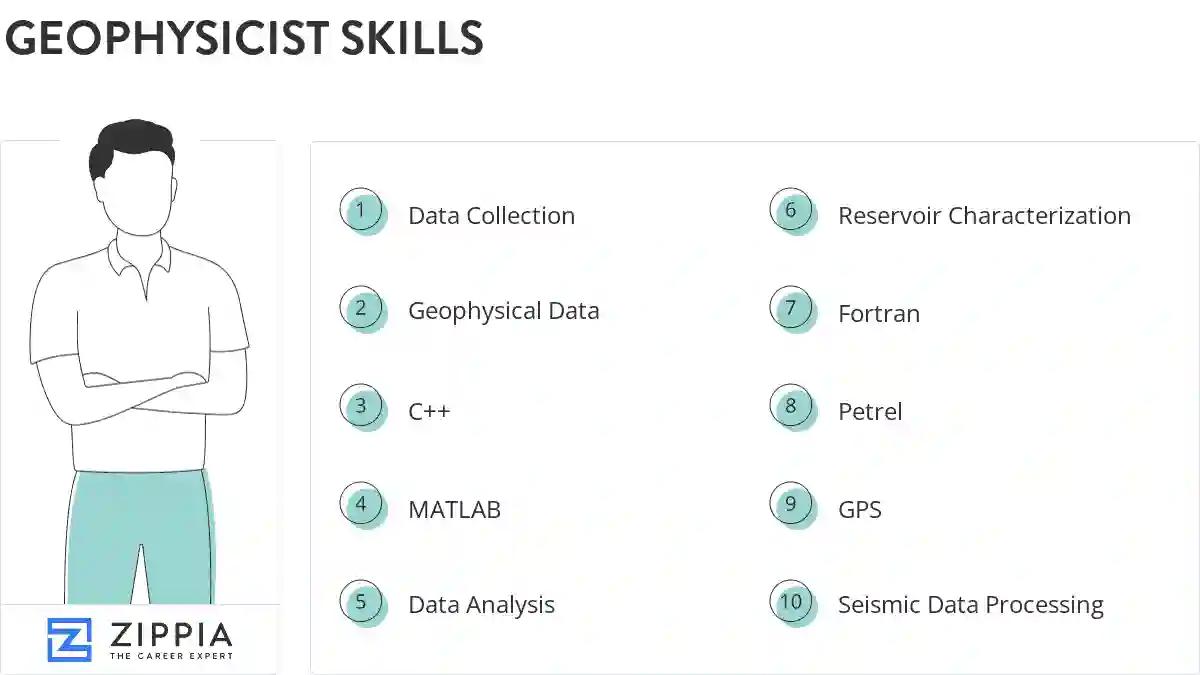
The most important skills for a geophysicist resume and required skills for a geophysicist to have include:
- Data Collection
- Geophysical Data
- C++
- MATLAB
- Data Analysis
- Reservoir Characterization
- Fortran
- Petrel
- GPS
- Seismic Data Processing
- Geotechnical
- AVO
- Promax
- Linux
- VSP
- Unix
- Velocity Analysis
- ArcGIS
- GIS
- Data Quality
- Data Management
- Field Development
- Remote Sensing
- Log Data
- GPR
- BP
- Velocity Model Building
- GOM
- OBC
- Depth Conversion
- SMT
- Petrophysics
- RTM
- Proprietary Software
- Post Processing
- Lease Sale
- Production Data
- HSE
- Geosteering
- Well Completion
- SEG
- Well Control
- UK
- BCF
- Ihs Kingdom
Updated January 8, 2025
