Explore jobs
Find specific jobs
Explore careers
Explore professions
Best companies
Explore companies
What is a geospatial analyst and how to become one
Geospatial analysts analyze data from geological systems and record them. They use GPS systems, cartographic records, aerial photographs, and even soil samples to compile their data. From this, they create databases used by private companies or governmental organizations. The work of geospatial analysis is essential to the military, NASA, and the FBI.
The job may involve producing data layers and maps, studying photographs and samples of the environment, and staying updated on current industry literature. Geospatial analysts may also meet with clients to discuss their findings and their impact on projects.
Most geospatial analysts have at least a master's degree in civil engineering, cartographic science, geographic information systems, or related fields. They may also have a cumulative educational background that compiles all of these areas.
What general advice would you give to a geospatial analyst?
B.L. Turner
Arizona State University
Avg. Salary $62,823
Avg. Salary $59,228
Growth rate 3%
Growth rate 0.3%
American Indian and Alaska Native 0.67%
Asian 2.87%
Black or African American 12.94%
Hispanic or Latino 14.62%
Unknown 5.03%
White 63.87%
Genderfemale 27.01%
male 72.99%
Age - 44American Indian and Alaska Native 3.00%
Asian 7.00%
Black or African American 14.00%
Hispanic or Latino 19.00%
White 57.00%
Genderfemale 47.00%
male 53.00%
Age - 44Stress level is manageable
7.1 - high
Complexity level is advanced
7 - challenging
Work life balance is fair
6.4 - fair
Geospatial analyst career paths
Key steps to become a geospatial analyst
Explore geospatial analyst education requirements
Start to develop specific geospatial analyst skills
Skills Percentages Geospatial Data 8.99% Geospatial Analysis 8.64% Remote Sensing 5.73% Visualization 5.48% Python 5.17% Complete relevant geospatial analyst training and internships
Accountants spend an average of 6-12 months on post-employment, on-the-job training. New geospatial analysts learn the skills and techniques required for their job and employer during this time. The chart below shows how long it takes to gain competency as a geospatial analyst based on U.S. Bureau of Labor Statistics data and data from real geospatial analyst resumes.Research geospatial analyst duties and responsibilities
- Manage and analyze large amounts of LiDAR data for design and construction of transmission lines and substations.
- Implement and run python scripts and SQL queries to automate complex GIS processes and to extract specific information from data sets.
- Consider expert level user in ESRI ArcGIS 9.3 and 10.0 and all ESRI desktop extensions.
- Provide on-going reach back capability to NGA headquarters and the intelligence community (IC) at large.
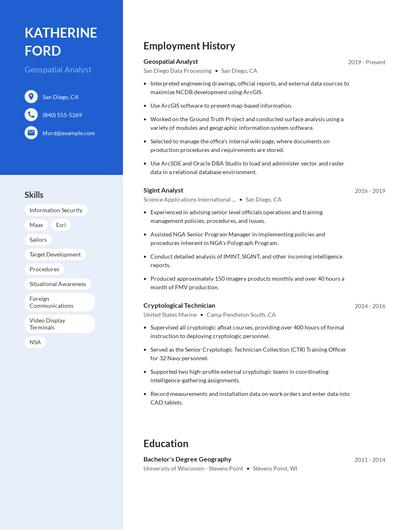
Prepare your geospatial analyst resume
When your background is strong enough, you can start writing your geospatial analyst resume.
You can use Zippia's AI resume builder to make the resume writing process easier while also making sure that you include key information that hiring managers expect to see on a geospatial analyst resume. You'll find resume tips and examples of skills, responsibilities, and summaries, all provided by Zippi, your career sidekick.
Choose from 10+ customizable geospatial analyst resume templates
Build a professional geospatial analyst resume in minutes. Browse through our resume examples to identify the best way to word your resume. Then choose from 10+ resume templates to create your geospatial analyst resume.


Apply for geospatial analyst jobs
Now it's time to start searching for a geospatial analyst job. Consider the tips below for a successful job search:
- Browse job boards for relevant postings
- Consult your professional network
- Reach out to companies you're interested in working for directly
- Watch out for job scams
How did you land your first geospatial analyst job

Are you a geospatial analyst?
Share your story for a free salary report.
Average geospatial analyst salary
The average geospatial analyst salary in the United States is $62,823 per year or $30 per hour. Geospatial analyst salaries range between $48,000 and $81,000 per year.
What am I worth?

How do geospatial analysts rate their job?
Updated January 8, 2025
