
Automatically apply for jobs with Zippia
Upload your resume to get started.
Geospatial engineer skills for your resume and career
15 geospatial engineer skills for your resume and career
1. Disaster Relief
- Maintained geographic information systems that support both military and civilian operations for domestic security as well as disaster relief 6.
- Utilized geographic data to support military and civilian operations for disaster relief and homeland security.
2. Intelligence Data
- Assimilated, integrated and managed Geospatial-Intelligence data and products used in over 90 named operations.
3. Digital Data
- Extracted terrain data from remote-sensed imagery, field reconnaissance, digital data, and existing topographic products.
- Performed digital manipulation of topographic information by querying, evaluating, and downloading digital data.
4. Military Operations
A military operation refers to the coordinated military actions of a government, or a non-state actor, in response to an emerging situation. These measures are devised as a military plan to best resolve the situation in the favor of the state or actor. Corresponding and reflecting similar framework for operations any organized components within the armed forces which prepare, prevent, or fight the war are also called military operations.
- Expanded methodology for proprietary software to solve unique problem sets dealing with statistical pattern recognition techniques in support of military operations.
- Detailed analysis and products preparing military operations, federal investigations, and providing safety of navigation.
5. Combat
Combat is a violent conflict between two parties. Combat can be held by using weapons or unarmed. The fighting between the armed forces of different countries can also be called combat and the main purpose of the combat is to eliminate and stop your opponent from achieving their goal.
- Completed over 800 products as a team while assigned to 2nd Combat Aviation Brigade.
- Gained experience in combat operations during deployment to Afghanistan [ ].
6. Python
Python is a widely-known programming language. It is an object-oriented and all-purpose, coding language that can be used for software development as well as web development.
- Automated the marine route positioning line (RPL) process using python 2.7.
- Use code, such as Python, and HTML5, to query Manage data and metadata.
Choose from 10+ customizable geospatial engineer resume templates
Build a professional geospatial engineer resume in minutes. Our AI resume writing assistant will guide you through every step of the process, and you can choose from 10+ resume templates to create your geospatial engineer resume.7. Geospatial Products
- Created maps, geospatial products, visualization products and reports for both face-to-face customers and customers around the globe.
- Collect, manipulate, analyze and distribute Geospatial Products, in support of Military & Civil Operations.
8. SQL
- Develop Reports with SSRS (reporting services) with SQL Server 2005 and VS 2005.
- Develop demo application with ASP.NET, C#, Sharpmap API, Virtual Earth and SQL Server 2008 spatial.
9. Windows
Windows is a chain of operating systems that controls a computer and is developed by Microsoft. Every version of Windows consists of GUI (graphical user interface), with a desktop that allows the user to open their files.
- Trained soldiers in Windows as well as in fundamental computing and networking concepts.
10. Esri
The ESRI (Environmental Systems Research Institute) is a worldwide provider of geographic data framework (GIS) programming, web GIS and geodatabase the board applications.
- Managed developing products, presentation and analysis supporting events, personnel and critical missions using ESRI software i.e.
- Trained and experience using ESRI, ERDAS Imagine, ArcGIS, ArcMap, ArcCatalog,.
11. Visualization
- Created visualization maps and figures to show regional inequality in China.
- Created visualization maps to show regional inequality.
12. Satellite Imagery
Satellite imagery refers to the images of the earth and/or other planets captured using artificial satellites and operated by businesses and governments around the world. These images are used to forecast the behavior of the planet and draw out clear and accurate information about how events on a particular planet unfold.
- Worked with satellite imagery and assembled many terrain-based maps with Arc GIS software.
- Satellite imagery analysis and interpretation Create imagery products to aid military decision-making for commanders on the battlefield.
13. DOD
Definition of Done (DoD) is a set of deliverables that are needed to devise software. These deliverables are valuable to the system and can be exemplified by writing code, coding comments, unit testing, integration testing, design documents, release notes, and so on.
- Coordinated with and advised DoD civilian and military supervisors concerning product quality control, personnel training, and upgrading.
- Collaborated and interacted with analysts within military components and DoD and national intelligence agencies.
14. Remote Sensing
- Performed remote sensing utilizing ERDAS imagine software.
- Supervised the production of digital imagery and remote sensing products from multiple high resolution satellite data sources.
15. NGA
- Worked as a subcontractor for Google supporting a project for the National Geospatial-Intelligence Agency (NGA).
- Project experience on JPEG2000, NGA Enterprise Engineering, U.S. Forest Service tree health project.
5 Geospatial Engineer resume examples
Build a professional geospatial engineer resume in minutes. Browse through our resume examples to identify the best way to word your resume. Then choose from 5+ resume templates to create your geospatial engineer resume.

What skills help Geospatial Engineers find jobs?
Tell us what job you are looking for, we’ll show you what skills employers want.
What geospatial engineer skills would you recommend for someone trying to advance their career?
B.L. Turner
Arizona State University
List of geospatial engineer skills to add to your resume
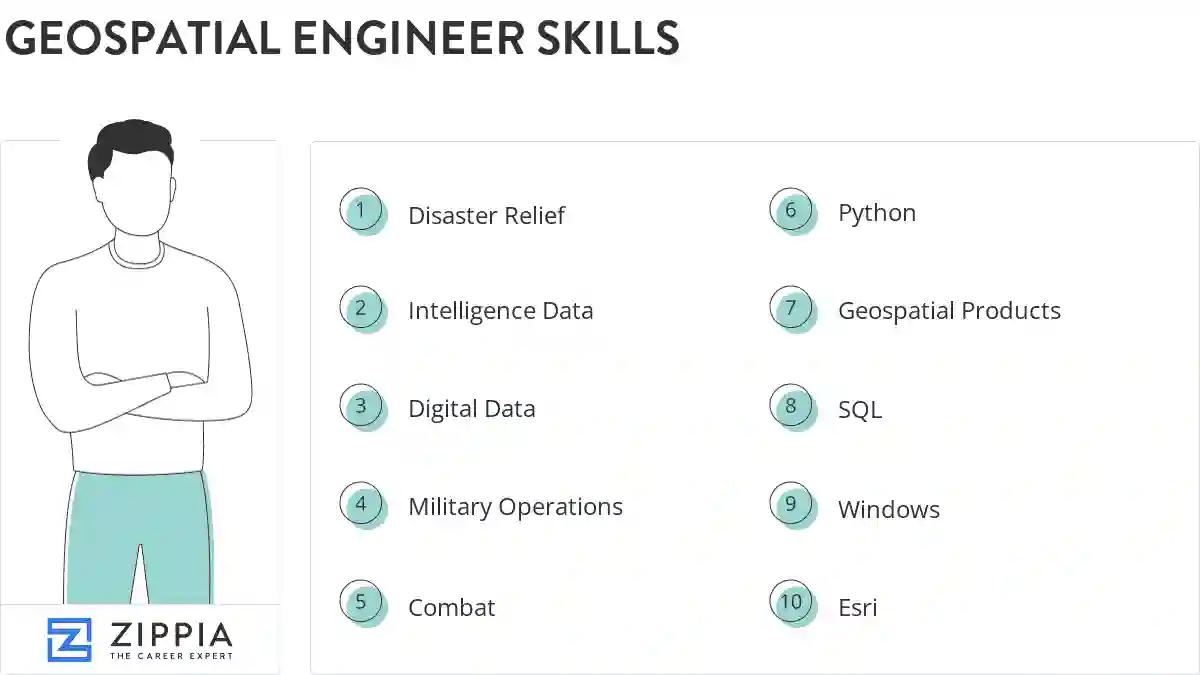
The most important skills for a geospatial engineer resume and required skills for a geospatial engineer to have include:
- Disaster Relief
- Intelligence Data
- Digital Data
- Military Operations
- Combat
- Python
- Geospatial Products
- SQL
- Windows
- Esri
- Visualization
- Satellite Imagery
- DOD
- Remote Sensing
- NGA
- Extraction
- Java
- Google Earth
- Technical Support
- LiDAR
- Vector Data
- Aerial Photographs
- Analysis Results
- DCGS-A
- GPS
- Mission Planning
- Erdas Imagine
- Technical Guidance
- Envi
- Digital Format
- Digitizing
- Data Collection
- Data Analysis
- Computer System
- Source Material
- Helicopter
- PowerPoint
- Terrain Data
- Source Data
- CAD
- Professional Development
Updated January 8, 2025
