
Automatically apply for jobs with Zippia
Upload your resume to get started.
Geospatial image analyst skills for your resume and career
15 geospatial image analyst skills for your resume and career
1. MRI
Magnetic Resonance Imaging (MRI) is a non-invasive and painless procedure that uses strong magnetic fields, radio waves, and computers to create detailed and cross images of the body's inner parts. MRI scanner can detect anomalies inside the brain and spinal cord, find tumors or cysts, detect heart, liver, and other abdominal organ problems, and many more. MRIs are very useful in studying soft tissues and the nervous system. Aside from diagnosing diseases, doctors also use MRI to check how well you have recovered from a particular treatment.
- contract only position) Utilized an image-guided beta software program to delineate nuclei areas on MRI scans of human brains.
- Assisted in administering brain MRI scans and smooth pursuit eye tracking tasks.
2. Photoshop
- Worked in a team to develop and expand on Photoshop actions to increase overall productivity of projects.
- Handled and edited airborne aerial digital photographs, Utilized Photoshop to edit images to be geospatially accurate for state infrastructure jobs.
3. Visualization
- Created visualization maps and figures to show regional inequality in China.
- Created visualization maps to show regional inequality.
4. Data Analysis
- Image processing algorithm development and image analysis using matlab, embedded system development, data analysis and much more.
- Create and implement data analysis and reporting for management that is used for maintaining controls, creating objectives and enhancing productivity.
5. Image Analysis
- Accepted casework in video, audio, and image analysis.
- Performed image analysis and analytical quantification on behalf of, and in cooperation with, Central Core Lab radiologists and physicists.
6. Python
Python is a widely-known programming language. It is an object-oriented and all-purpose, coding language that can be used for software development as well as web development.
- Program watershed characterization and system management tools using the Python programming language and ESRI ArcMap Add-in functionality.
- Implement and run python scripts and SQL queries to automate complex GIS processes and to extract specific information from data sets.
Choose from 10+ customizable geospatial image analyst resume templates
Build a professional geospatial image analyst resume in minutes. Our AI resume writing assistant will guide you through every step of the process, and you can choose from 10+ resume templates to create your geospatial image analyst resume.7. Linux
Linux is a Unix-like operating system. Just like Windows, Mac OS, and IOS, Linux is an operating system used by millions across the globe. Android itself is powered by the Linux operating system. Linux manages all the hardware resources that are associated with your computer. The software is famous because of the protection it grants from viruses, malware, and crashes. The Linux operating system is entirely free and is an open-source software meaning it can be altered by those equipped with the knowledge to code.
- Provided application and operational support in a high volume Linux environment for real time credit card transactions.
- Build and Deploy packages in Linux for a Java application built in house.
8. MATLAB
- Utilized MATLAB computer program to discover higher resolution images of arterial blood flow in heart patients.
- Build a reliable MATLAB GUI to analyze genotyping experiments and find positive DNA drops on slides.
9. Data Processing
Data processing refers to the manipulation and collection of data to generate meaningful information by a computer. It may include the transfer of raw data to a machine-legible form, managing the flow of data through the CPU or any memory to an output device, and conversion of output. Any utilization of computers to perform specific functions on data can be incorporated under data processing.
- Experienced several key modules to understand the procedures of fundamental seismic data processing with well understanding of methodologies.
- Applied geophysical software modules for seismic data processing.
10. SQL
- Performed Enterprise level database base administration with MS SQL 2005 Standard SDE.
- Created and ran SQL queries against access database for breeding reports.
11. Remote Sensing
- Designed, built, and commercialized imaging systems for project based research in multiple fields of remote sensing.
- Gained experience with LiDAR and other remote sensing technology in relation to contour mapping.
12. Proprietary Software
- Utilized proprietary software for image analyzing and other tasks.
- Generated digital terrain models using off the shelf and proprietary software packages.
13. GIS
A geographic information system (GIS) is a tool for capturing, storing, manipulating, analyzing, managing and presenting various forms of geographic data.
- Evaluated GIS data such as tie and ground control and ground truth points for compliance and accuracy.
- Educate and coordinate personnel on use of GIS products delivered at project end.
14. NGA
- Provided imagery analysis based on worldwide NGA requirements.
- Served as the primary point of contact for NGA at the National Center for Medical Intelligence (NCMI).
15. Aperture
- Analyze real time Synthetic Aperture Radar Imagery on various CIED/intel projects AFGHANISTAN/IRAQ Clearance: TS
5 Geospatial Image Analyst resume examples
Build a professional geospatial image analyst resume in minutes. Browse through our resume examples to identify the best way to word your resume. Then choose from 5+ resume templates to create your geospatial image analyst resume.

What skills help Geospatial Image Analysts find jobs?
Tell us what job you are looking for, we’ll show you what skills employers want.
List of geospatial image analyst skills to add to your resume
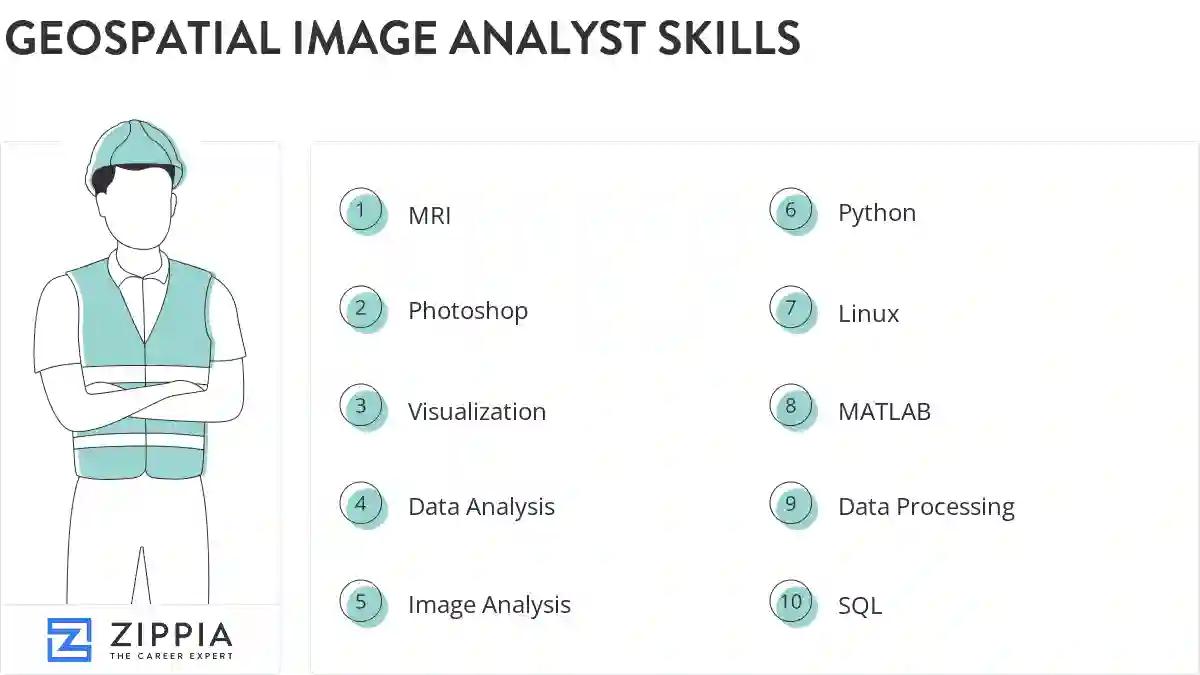
The most important skills for a geospatial image analyst resume and required skills for a geospatial image analyst to have include:
- MRI
- Photoshop
- Visualization
- Data Analysis
- Image Analysis
- Python
- Linux
- MATLAB
- Data Processing
- SQL
- Remote Sensing
- Proprietary Software
- GIS
- NGA
- Aperture
- QC
- Quality Data Integrity
- Flexibility
Updated January 8, 2025
