
Automatically apply for jobs with Zippia
Upload your resume to get started.
Geotechnical engineering technician skills for your resume and career
15 geotechnical engineering technician skills for your resume and career
1. Geotechnical
- Work as a Geotechnical Technician evaluating soil for viability.
- Ensured that the results obtained from the geotechnical investigations were accurate and with ASTM specifications.
2. ACI
American Concrete Institute (ACI) is an institution known for its consensus-based standards, educational, technical, and training programs, certification programs, and adept individuals involved in construction in choosing quality materials to pursue the best use of concrete. ACI publishes more than 400 standards that can be used in the manufacturing, maintenance of concrete in different usage. These standards also determine systems or methods for inspection, test, and building code requirements. With ACI, the standards ensure the product reliability, adoption of new uses, and improved up keeping.
- Tested cast-in-place concrete, structural concrete, and unit masonry assemblies in compliance with ACI standards.
- Complete concrete testing for contractors based on ACI specifications.
3. Asphalt
- Tested soil, asphalt, concrete, water tables, monitored excavations, worked in field, office and lab
- Performed field observations and collected samples of soil and asphalt to monitor compliance with construction specifications.
4. Construction Materials
Construction materials are equipment and objects that are used to construct buildings. Naturally occurring elements like clay, wood, and sand also come under construction materials. Man-made construction materials include concrete, bricks, tiles, etc. Using good quality construction materials helps in reducing maintenance costs and reduces the chances of frequent maintenance. The properties of artificial and natural elements determine the quality of construction material.
- Shoulder the responsibility of inspecting and testing construction materials as defined in the testing guidelines and specifications.
- Performed field and laboratory construction materials testing services.
5. Field Testing
- Supervised contractors' field testing ensuring testing were performed according to standard procedures and specifications.
- Perform laboratory and field testing for various projects in accordance to project specifications.
6. Laboratory Tests
- Collected and transported samples for laboratory testing and analysis.
- Perform laboratory testing on concrete, masonry and soil specimens.
Choose from 10+ customizable geotechnical engineering technician resume templates
Build a professional geotechnical engineering technician resume in minutes. Our AI resume writing assistant will guide you through every step of the process, and you can choose from 10+ resume templates to create your geotechnical engineering technician resume.7. Nuclear Density
- Obtained Nuclear Density Gauge Certification.
- Clean fill testing and certification with use of nuclear density gauge or probe.
8. GINT
- Prepared soil boring logs and created soil profiles using gINT to assist structural engineers to prepare bridge plans.
- Created boring logs using gINT based on visual classification and lab test results.
9. Soil Samples
- Performed fieldwork including drilling for soil samples, percolation tests, and moisture/density tests.
- Have experience with logging California method driven soil samples with CME-75 and Winkie-3000.
10. Test Results
- Summarized and presented test results in a clear, concise format utilizing Microsoft Office software and accepted laboratory reporting standards.
- Demonstrated the ability to communicate test results effectively with engineering staff, and other technical personnel.
11. Construction Sites
A piece of land where constructional activities are to be conducted is termed as a construction site.
- Accompanied civil engineer to construction sites to monitor progress and ensure conformance to engineering plans, specifications and construction safety standards.
- Performed research of construction sites using historic topographic maps and aerial photographs.
12. ASTM
- Sampled and tested concrete cylinders and soil proctor density sampling and testing to meet ASTM requirements were being met.
- Field soil and aggregate compaction testing in accordance to ASTM and ODOT test methods and practices.
13. Landfill
- Certified for several AEP Landfills, City of Cincinnati storm water projects, and EPA projects and landfills.
- Certified for several storm water EPA projects and landfills.
14. Air Content
- Provided field quality control for concrete pours on various projects including slump, air content, and temperature.
- Performed air content in concrete; slump testing; temperature testing of concrete used to construct new roadways.
15. Inspection Results
Inspection Results are provided after inspecting and analyzing a structure for various defects, including whether a home is ready to be occupied or sold. There may also be inspection results during construction to ensure the structure abides by local zoning, electrical, and plumbing regulations. Without satisfactory inspection results, the structure may need additional work before continuing construction or becoming occupied.
- Document and report inspection results.
5 Geotechnical Engineering Technician resume examples
Build a professional geotechnical engineering technician resume in minutes. Browse through our resume examples to identify the best way to word your resume. Then choose from 5+ resume templates to create your geotechnical engineering technician resume.

What skills help Geotechnical Engineering Technicians find jobs?
Tell us what job you are looking for, we’ll show you what skills employers want.
What geotechnical engineering technician skills would you recommend for someone trying to advance their career?
Jeff Moore
University of Utah
List of geotechnical engineering technician skills to add to your resume
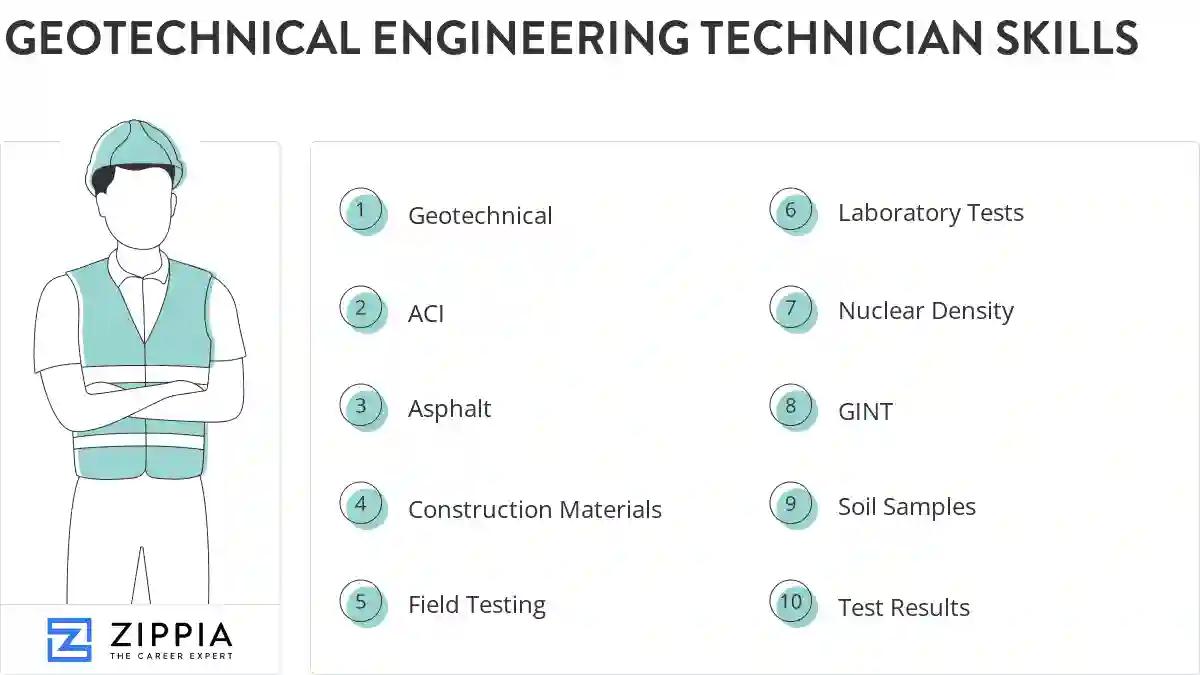
The most important skills for a geotechnical engineering technician resume and required skills for a geotechnical engineering technician to have include:
- Geotechnical
- ACI
- Asphalt
- Construction Materials
- Field Testing
- Laboratory Tests
- Nuclear Density
- GINT
- Soil Samples
- Test Results
- Construction Sites
- ASTM
- Landfill
- Air Content
- Inspection Results
- GPS
- Autocad
- Project Site
- Excavations
- Project Specifications
Updated January 8, 2025
