
Automatically apply for jobs with Zippia
Upload your resume to get started.
Ground school instructor skills for your resume and career
15 ground school instructor skills for your resume and career
1. FAA
FAA (Federal Aviation Administration) is an aviation regulatory body in the USA.
- Develop ESL course and Teach Private, Instrument, and Commercial FAA Ground school
- Served as Chief Inspector for the FAA Part 145 Repair Station Maintenance Department.
2. Training Courses
- Design and administer emergency or disaster preparedness training courses that teach people how to effectively respond to major emergencies and disasters.
- Conducted customer relations, and educational-motivational theory staff training courses.
3. CFI
- Conduct stage checks and evaluate students at various levels of the private, instrument, commercial, and CFI courses.
- Instructed Private, Instrument, CFI, CFII, Flight Review, and IPC Candidates Conducted Phase Checks and Aircraft Checkouts
4. Flight Operations
Flight operations refer to the activities within an airport that entails dispatching, flight planning, flight watch, weather data provision, and facilitating ground-to-air communication. They ensure proper integration of the airport crew, making appropriate schedules, and planning maintenance activities.
- Selected to represent the company in the Flight Operations Aviation Safety Action Program (ASAP).
- Identify system deficiencies and coordinate corrective action with flight operations manager and contractor Standardization pilot advising of conflicts and possible resolutions.
5. Flight Training
- Teach classroom and Flight Training Device (FTD) for B747-400 passenger aircraft system integration with checklist operation.
- Contract Systems Instructor and Flight Training Device B 747- 400.
6. Ground Training
- Managed student academic and ground training software, testing, and academic scheduling.
- Conduct ground training in classroom environment with flight crews.
Choose from 10+ customizable ground school instructor resume templates
Build a professional ground school instructor resume in minutes. Our AI resume writing assistant will guide you through every step of the process, and you can choose from 10+ resume templates to create your ground school instructor resume.7. ATP
ATP stands for "available to promise." This phrase is often used in inventory management to determine the quantity of a product available for purchase and the approximate date the product can be delivered by. Using this thought process, a company can keep stock of an item low, freeing up space in warehouses for additional merchandise.
- Performed duties as a Computer Assisted Training Services (CATS) supervisor through the ATP flight school.
- Specialize in teaching instrument skills to experienced clients seeking additional certification such as ATP.
8. Aircraft Systems
Aircraft systems refer to the subsystems necessary for the efficient and safe operation of an aircraft, including flight controls, landing gear, electrical systems, hydraulics, avionics, navigation, communications, and instrumentation. All aircraft require essential systems such as engine, propeller, induction, ignition systems, as well as fuel, lubrication, cooling, electrical, landing gear, and environmental control systems to aid flight. Understanding aircraft systems in flight is essential for safe operation and proper maintenance.
- Evaluated pilots providing thorough knowledge of aircraft systems, normal and emergency procedures and operational techniques.
- Reviewed numerous technical and soldier manuals and materials related to aircraft systems management and related subjects.
9. Classroom Environment
- Ground Instructor teaching international students in a classroom environment as part of a FAR Part 141 Ab-Initio flight school.
10. Crew Resource
- Designated Section/Division Leader, Crew Resource Management Instructor.
- Crew Resource Management (CRM) & Naval Air Training and Operations Procedures Standardization (NATOPS) instructor.
11. SME
The term ‘small and medium-sized enterprises' is meant to describe businesses of varied sizes who fall below certain limits and targets set by various organizations, such as the World Bank and the UN. SMEs, as they are commonly known, are an important part of any economy and generally, in healthy economies, should vastly outnumber other forms of business, such as multi-level corporations, because they collectively employ more people, pay better, and produce more money.
- Subject Matter Expert (SME) for the M1 Abrams series tank wrote and edited lesson and training plans.
- Provided instruction on the full spectrum of intelligence operations and was the SME for COIN, ISR Synchronization.
12. FTD
- Conducted training using, CBT, stand-up lectures, PowerPoint, Wicat 2D FMS, and FTD trainers.
13. Recurrent Training
- Provided Part 135 basic indoc and recurrent training for company charter pilots.
- Worked closely with pilot groups, station managers, and customers to schedule new hire and recurrent training for locations worldwide.
14. Training Programs
- Designed and implemented training programs to include classroom presentations, tests, on-line training, and take home CD training.
- Managed and administered Emergency Management Training Programs to advance Emergency Management personnel in all phases of Emergency Management.
15. Emergency Procedures
- Conduct simulator training and evaluate performance for normal procedures and emergency procedures.
- Allowed students to practice emergency procedures in a controlled (and safe) environment to prepare them for Solo Flight.
5 Ground School Instructor resume examples
Build a professional ground school instructor resume in minutes. Browse through our resume examples to identify the best way to word your resume. Then choose from 5+ resume templates to create your ground school instructor resume.

What skills help Ground School Instructors find jobs?
Tell us what job you are looking for, we’ll show you what skills employers want.
List of ground school instructor skills to add to your resume
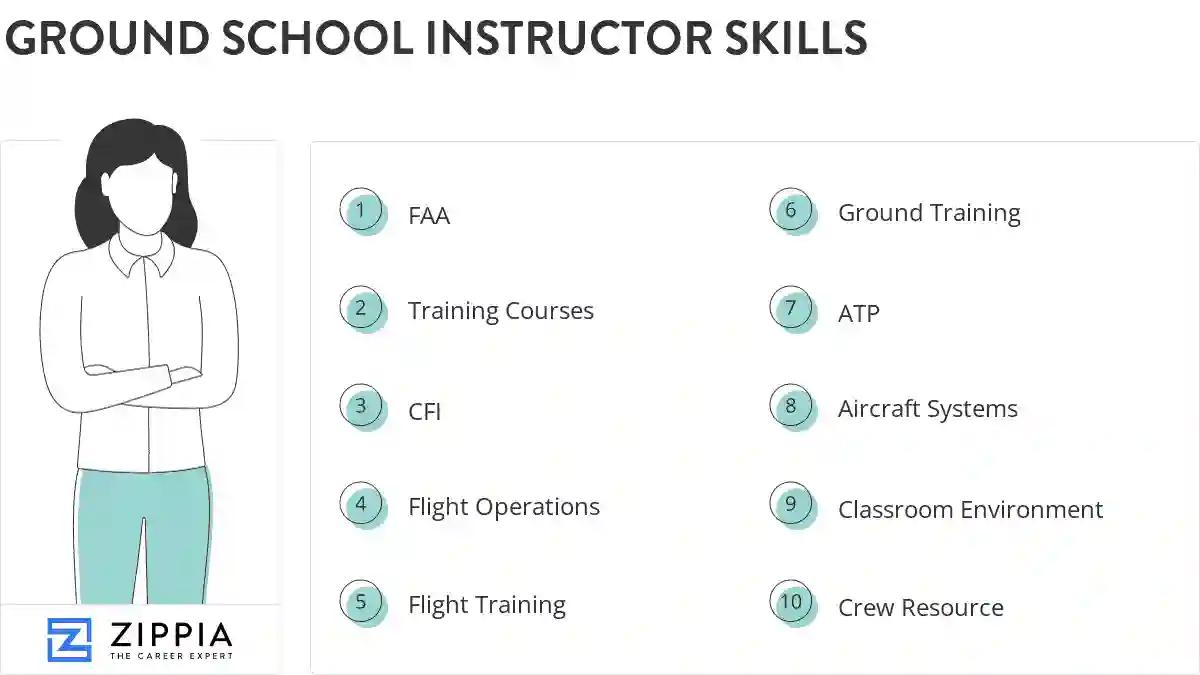
The most important skills for a ground school instructor resume and required skills for a ground school instructor to have include:
- FAA
- Training Courses
- CFI
- Flight Operations
- Flight Training
- Ground Training
- ATP
- Aircraft Systems
- Classroom Environment
- Crew Resource
- SME
- FTD
- Recurrent Training
- Training Programs
- Emergency Procedures
- PowerPoint
Updated January 8, 2025
