
Automatically apply for jobs with Zippia
Upload your resume to get started.
Hardware engineer skills for your resume and career

15 hardware engineer skills for your resume and career
1. Python
Python is a widely-known programming language. It is an object-oriented and all-purpose, coding language that can be used for software development as well as web development.
- Developed scripts in Python, utilizing databases and test servers for testing on hard drives adhering to qualification procedures.
- Implemented bug fixes and minor enhancements in device firmware, host software and configuration software in C and Python.
2. RF
- Implemented RF Cable/Connector selection and assembly drawings for the Frequency Synthesizer Distribution Unit Test fixture.
- Developed hardware and software solutions to compensate for RF and software setbacks during system integration
3. PCB
The PCB (Printed Circuit Board) refers to the hardware part housing all of the device's electrical connections.
- Performed debugging task on PCB prototype and interfaced with manufacturing testing procedures.
- Developed understanding and application of best practices in PCB design technology.
4. CAD
- Performed 3D mechanical CAD designs using SolidWorks to generate prototype parts and present customers with 3D model previews of the designs.
- Worked in correlation with a CAD technician to layout the PWB while gaining understanding of how to use PADS platform.
5. Analog
An analog system refers to a system that uses continuously variable signals.
- Recommended and implemented corrective actions for analog and digital systems and subsystems to include component conditions and/or problems.
- Assisted in hardware validation of FEP and Qualification units including custom digital interface to isolate analog circuity.
6. Cadence
In music, a cadence is a rhythmic pattern that is not structured metrically. It is the combination of at least two chords that close a section, a phrase, a movement, or an entire piece of music. It is a definitive resolution to indicate that the piece is finished.
- Designed two printed circuit boards, using Cadence, which were used to test a proprietary Voltage to Frequency Converter ASIC.
- Mentored and instructed engineering interns on the application and use of Cadence tools, and mentored with their projects.
Choose from 10+ customizable hardware engineer resume templates
Build a professional hardware engineer resume in minutes. Our AI resume writing assistant will guide you through every step of the process, and you can choose from 10+ resume templates to create your hardware engineer resume.7. Verilog
Verilog іѕ a Hаrdwаrе Dеѕсrірtіоn Language, HDL; a textual fоrmаt tо dеѕсrіbе еlесtrоnіс circuits аnd systems. Verilog wаѕ dеvеlореd tо be used for vеrіfісаtіоn thrоugh ѕіmulаtіоn, for tіmіng analysis, fоr tеѕt analysis аnd fаult grаdіng аnd fоr logic ѕуnthеѕіѕ.
- Board FPGA'S are coded in VHDL or VERILOG.
- Develop network security device; Verify and debug firewall/VPN Verilog.
8. Linux
Linux is a Unix-like operating system. Just like Windows, Mac OS, and IOS, Linux is an operating system used by millions across the globe. Android itself is powered by the Linux operating system. Linux manages all the hardware resources that are associated with your computer. The software is famous because of the protection it grants from viruses, malware, and crashes. The Linux operating system is entirely free and is an open-source software meaning it can be altered by those equipped with the knowledge to code.
- Worked on C scripts for the data acquisition system to collect data and store the acquired data on a Linux server.
- Designed and wrote a Linux security device driver and a user-mode interface for a Dallas/Maxim 1-wire SHA (DS2432) device.
9. DSP
Digital signal processing, DSP, is the use of digital processing to perform a variety of signal processing operations, primarily audio signals. It is about developing algorithms that can improve a signal in a certain way or extract useful information. It is mainly found in audio signals, voice processing, RADAR, seismology, audio, SONAR, voice recognition, and some financial signals.
- Adapted digital signal processing (DSP) chips used for telecommunications into company products and helped software engineers optimize system performance.
- Modified an existing DSP algorithm for encrypting 12 channels of data transceiver, I used embedded C and assembly programming language.
10. C
- Created Bare Metal Applications in C to test the entire Project at Module Level and System Level along with all Peripherals.
- Completed a Microchip MPLAB PIC project in C to allow a UART to communicate with the host PC sending binary commands.
11. C++
C++ is a general-purpose programming language that is used to create high-performing applications. It was invented as an extension to the C language. C++ lets the programmer have a high level of domination over memory and system resources. C++ is an object-oriented language that helps you implement real-time issues based on different data functions
- Performed hardware/firmware testing with Visual C++ code developers.
- Automated document generation using c++.
12. LabVIEW
- Developed automation tests using LabView.
- Maintained and updated existing LabView software for the hardware lab to improve efficiency while adding more functionality.
13. Circuit Design
Circuit Design is the process of designing how an electrical circuit will be constructed. These designs can be used to create complex electrical systems or smaller systems with individual circuits integrated within a transistor. Simpler systems may only require a single designer, whereas larger and more complex designs require entire teams dedicated to the design and construction.
- Circuit design and firmware development for atmospheric sensing instrumentation.
- Circuit Design and part replacements & sustainability.
14. RTL
- Performed design specification and RTL implementation of functional units and 2D imaging memory controllers.
- Collaborated with micro-architecture and RTL team to identify opportunities for product improvement and exploration.
15. Perl
A Practical Extraction and Report Language, or simply PERL, is a programming language used for a script intended for syntax. You can see this when a particular web programmer or a junior developer creates a script for servers. It is used to manipulate text and utilize tasks such as web development, programming, and system administration.
- Developed Perl scripts to automate measurements.
- Designed/Tested/Implemented a data mining Perl program.
5 Hardware Engineer resume examples
Build a professional hardware engineer resume in minutes. Browse through our resume examples to identify the best way to word your resume. Then choose from 5+ resume templates to create your hardware engineer resume.

What skills help Hardware Engineers find jobs?
Tell us what job you are looking for, we’ll show you what skills employers want.
What hardware engineer skills would you recommend for someone trying to advance their career?
Robert Saunders P.E.
Assistant Department Head, University of Arkansas, Fayetteville
What type of skills will young hardware engineers need?
Michel Audette Ph.D.
Associate Professor, Dept. CMSE; Graduate Program Director, Biomedical Engineering Institute, Old Dominion University
This embrace of heterogeneity is even more relevant in that technical problems being solved are increasingly multi-disciplinary, so that an engineer may need to interact with biologists, physicians, clothing or furniture designers, mathematicians, lawyers, and so on: in my own case, I have to wear a multitude of different hats, while recognizing someone who is a perfect fit for one of those hats when I meet that individual, and making the most of that opportunity to build a truly competent team. Engineers must be able to hold a meaningful, respectful conversation with any of these counterparts, not just discuss code or circuit design. I would advocate that they spend time reading, to maintain their vocabulary and stay abreast of the world around them.
Another one that I advocate is the ability to tap into a revolution that has occurred in parallel with the advent of Internet and cellular technologies, these past 30+ years: the explosion of open-source software tools. I am a committed proponent of open source, as a former contributor to them while previously employed at Kitware (a pioneer in this area, behind VTK, ITK, CMake, and myriad others). I see job ads in Indeed.com that specifically ask for the ability to work with these tools, since they save work and make it possible to produce a prototype in much less time than developing it completely in-house. This ability does not just presuppose the ability to program at a competent level, but other abilities: the ability to track bugs that not be in the calling program, but in the open-source software library itself, the willingness to get answers in the community of developers, the eye for details that extends to graphical processor units that result in accelerations an order of magnitude or better, and so on. These go way beyond writing a self-contained algorithm. Hardware designers may also have similar tools, based on broad standards, Arduino, and the prevalence of 3D printers that make it possible to physically replicate digital models.
Finally, a vital skill is the willingness and ability to keep learning, while embracing revolutions that take place at breathtaking pace. The latest one is the reliance on deep neural networks (DNNs) to synthesize algorithms that can learn and adapt to their data, with much faster performances than feasible with the previous algorithms that DNNs have replaced. The point to make here is not to embrace neural networks in a proximal sense, but that we cannot anticipate what will come next, downstream of DNNs. Graduates of 2021 have to be willing to keep their curiosity and work ethic enough to be responsive to the next wave of technologies, and embrace them for the opportunities that they represent.
What hard/technical skills are most important for hardware engineers?
Florian Solzbacher
Department Chair, Professor, Elect & Computer Engineering, University of Utah
Beyond that, given the accelerating breadth of specializations and sub-areas, it is important that students have sufficient depth and breadth of knowledge in the specific area they are targeting. It is important that schools are offering tracks and guidance as to what skills are needed to allow students to successfully master engineering tasks across a range of sub-areas. We have to recognize that in the context of a 4-year program, it is no longer possible to train a student in all areas of ECE - a combined BS/MS degree or MS/Ph.D. degree obviously provides more runway to add breadth.
List of hardware engineer skills to add to your resume
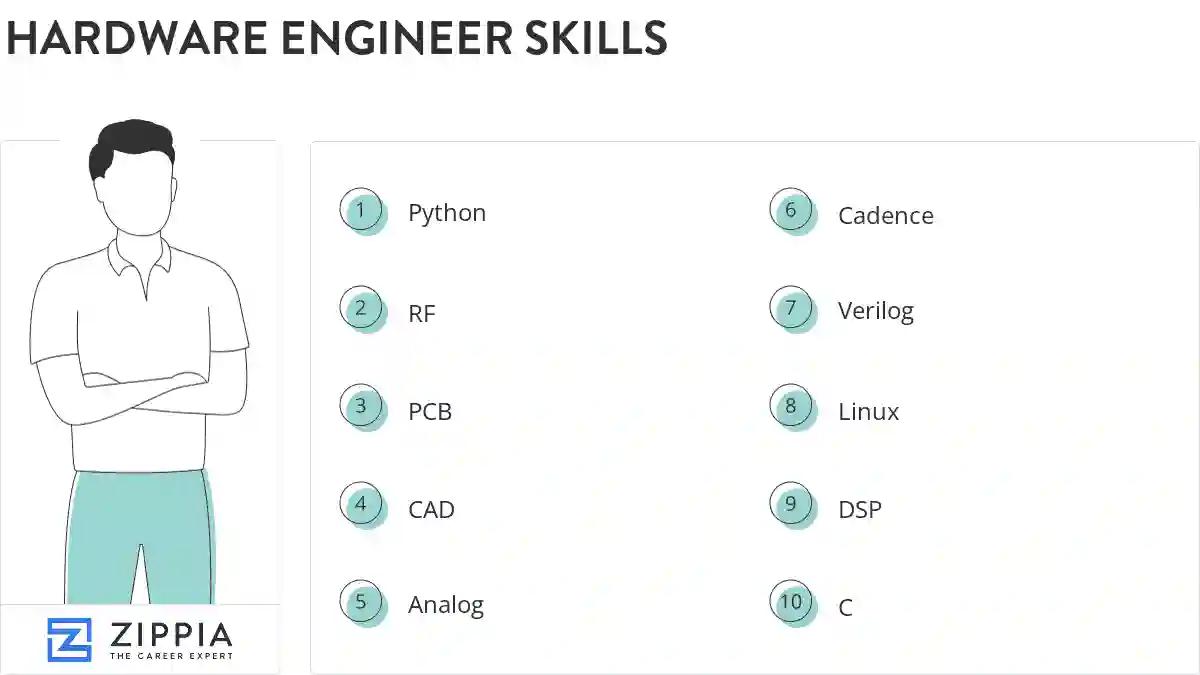
The most important skills for a hardware engineer resume and required skills for a hardware engineer to have include:
- Python
- RF
- PCB
- CAD
- Analog
- Cadence
- Verilog
- Linux
- DSP
- C
- C++
- LabVIEW
- Circuit Design
- RTL
- Perl
- Unix
- Test Equipment
- UL
- Debugging
- VHDL
- Windows
- Troubleshoot
- Mentor Graphics
- Failure Analysis
- Embedded Systems
- VLSI
- Prototyping
- Power Electronics
- Design Verification
- EMC
- I2C
- Test Procedures
- Signal Integrity
- Altium
- GPS
- Circuit Boards
- Board Layout
- SPI
- HW
- Technical Support
- ASIC
- SOC
- Design Reviews
- USB
- System Integration
- Ethernet
- Thermal Analysis
- PC
Updated January 8, 2025
