
Automatically apply for jobs with Zippia
Upload your resume to get started.
Hardware installer skills for your resume and career
12 hardware installer skills for your resume and career
1. Door Hardware
Door hardware, also called door furniture, refers to any equipment attached to a door or drawer. This equipment is often added to the door in order to better the door or drawer's function, however certain items may also be added for purely aesthetic purposes. This includes the door knob, hinges, knocker, and any locking mechanisms.
- Install bathroom hardware and accessories, toilet dividers, doors and door hardware, commercial structures.
- Installed shower doors, mirrors, and Door hardware.
2. Install Hardware
- Install hardware for electronic tracking systems, determine correct location from blueprints and install in correct location and in correct orientation.
- Install hardware/NIC cards on Cisco 2800/3800 series routers and test/configuration of router or switch after install of hardware.
3. Hand Tools
- Installed hardware for custom built cabinetry*Operated various stationary machines and hand tools*Proficient at reading a tape measure
- Shape or cut materials to specified measurements, using hand tools, machines, or power saws.
4. Network Printers
- Assisted with planning and installation of desktop computers, laptop computer docking stations, network printers and VOI phone systems.
- Configured and customized network printers.
5. PC
- Imaged and rolled out PC's, wireless scanners, installed cabling and WIFI antenna's in an encrypted environment.
- Backed up and imaged PC's, created users in Active Directory issued user rights as requested.
6. Troubleshoot
Troubleshooting is the process of analyzing and fixing any kind of problem in a system or a machine. Troubleshooting is the detailed yet quick search in the system for the main source of an issue and solving it.
- Coordinate with NIC Bridge for pre-checks as well as issues at the site and troubleshoot alarms.
- Implement firmware/software upgrade and troubleshoot for proprietary Micros hardware.
Choose from 10+ customizable hardware installer resume templates
Build a professional hardware installer resume in minutes. Our AI resume writing assistant will guide you through every step of the process, and you can choose from 10+ resume templates to create your hardware installer resume.7. Computer System
- Trained new employees to install computer systems, printers, and peripherals to a network.
- Removed old Dell computers and installed new Dell computer systems.
8. POS
POS is an abbreviation of "Point of Sale" which is the time and place where a customer completes a transaction. It can either be a physical shop that consists of POS terminals or a virtual shop. A POS system helps simplify the retail functions and track important sales data.
- Scheduled the set up and configuration of POS equipment and peripherals.
- Installed, setup and configure IBM RISC 6000 systems and IBM 4694 POS cash registers via Ethernet connection using TCP/IP topology.
9. Load Trucks
- Organized stock in warehouse, as well as help load and unload trucks.
- Install handels on caskets,load trucks,and push repairs to repair
10. CAT6
- Configured Cat6 cabling/wall jack terminations, testing voice/data line activity to confirm connections.
- Worked with Cat6, coax, and flooded cable -Installed punch down panels -Terminated cable lines -Installed J hooks/D rings for pathway
11. Network Connectivity
- Tested network connectivity and rolled out computers for teachers throughout the DC Public School system.
- Implemented network connectivity, wireless 802.11 signals analysis and troubleshooting.
12. Medicine Cabinets
- Install miscellaneous door knobs, medicine cabinets.
- towel bars, towel rings, medicine cabinets, ect.

What skills help Hardware Installers find jobs?
Tell us what job you are looking for, we’ll show you what skills employers want.
List of hardware installer skills to add to your resume
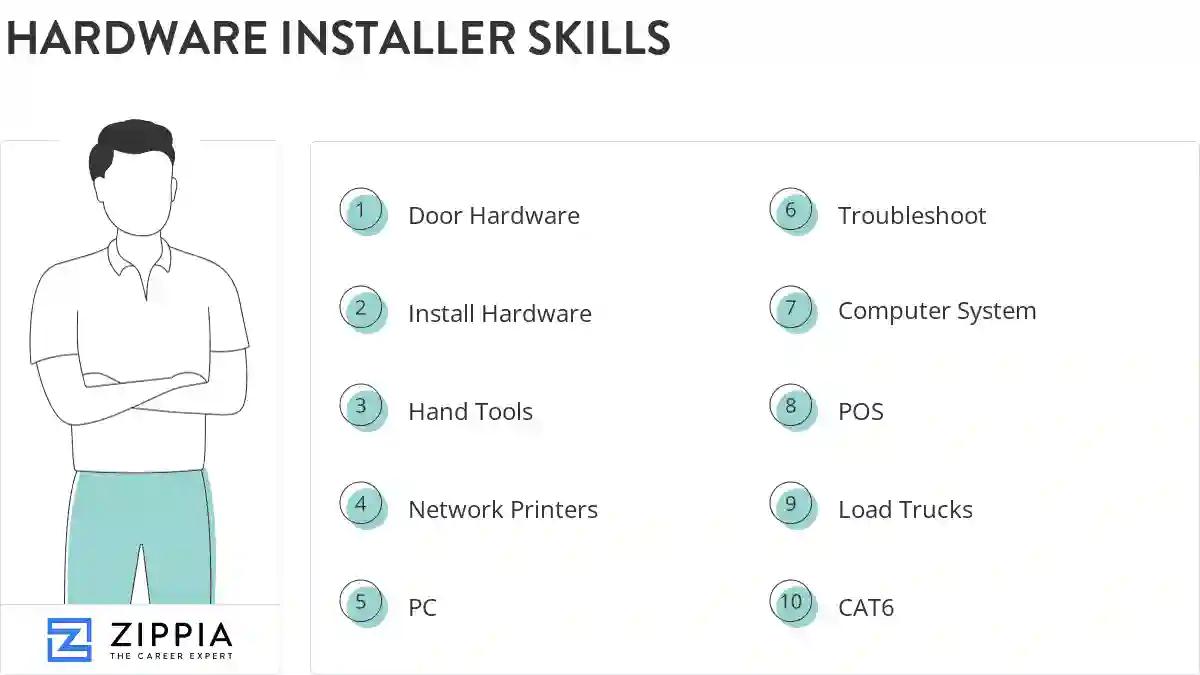
The most important skills for a hardware installer resume and required skills for a hardware installer to have include:
- Door Hardware
- Install Hardware
- Hand Tools
- Network Printers
- PC
- Troubleshoot
- Computer System
- POS
- Load Trucks
- CAT6
- Network Connectivity
- Medicine Cabinets
Updated January 8, 2025
