
Automatically apply for jobs with Zippia
Upload your resume to get started.
Head machinist skills for your resume and career
12 head machinist skills for your resume and career
1. Calipers
- Calculate dimensions and tolerances using knowledge of mathematics and instruments such as micrometers and vernier calipers.
- Calculate dimensions and tolerances using knowledge of mathematics and instruments such as micrometers and vernier calipers.
2. CNC
CNC stands for Computer Numerical Control. It is a subtractive manufacturing technique that usually uses computerized controls and machine tools to strip layers of material from a stock piece.
- Job Responsibilities: Programming all parts, as well as setting-up and running the CNC mill.
- Process development for integrating new CNC Machine Tools into an existing production chain.
3. Engine Lathes
- General manual machining of customer requirements on conventional engine lathes and vertical milling machines.
- Tool repair on broken fixtures using milling machines, engine lathes, horizontal milling and welding.
4. Safety Procedures
Safety procedures are a set of standardized procedures, that ensures minimal to no risk to people, resources, and the work environment. A company follows the step-by-step safety procedures as it they not only keep the customers and the employees safe, but also help in avoiding legal claims.
- Performed damage control and improved safety procedures.
5. MIG
MIG is a specific type of welding in which two base materials are welded together using a solid wire electrode fed through a welding gun and into the weld pool.
- Tool Room Performed preventative maintenance on machines Operated ARC, TIG, and MIG welders
- General metal working (Grinding, welding - MIG and some TIG, operating band saw, lathe, mill)
6. Drill Press
A drill press refers to a device used to produce holes in hard substances. When drilling the holes, you need to clamp the workpiece on a table and hold the drill in a rotating spindle and feed it into the workpiece.
- Manufacture parts for power plants using mills, lathes, radial arm drill presses and plasma cutter.
- Fabricate and design various custom parts, sharpen drill bits and operate drill press.
Choose from 10+ customizable head machinist resume templates
Build a professional head machinist resume in minutes. Our AI resume writing assistant will guide you through every step of the process, and you can choose from 10+ resume templates to create your head machinist resume.7. Stainless Steel
Stainless steel is an alloy of iron, chromium, carbon, and some other metals with corrosion-resistant properties. The components of steel include less than 1% carbon, 1% manganese, and small quantities of other elements such as phosphorus, silicon, sulfur, and oxygen. Iron and carbon are the two essential components of steel. Stainless steel is resistant to tarnishing and rust.
- Make parts using raw wire which consist of aluminum, monel and stainless steel to print specifications.
- Functioned independently on weekend shift in decision-making and producing close-tolerance stainless steel parts.
8. CAD
- Manufacture technical parts to CAD specifications* Operate three CNC milling machines simultaneously to produce components for medical equipment
- Balanced operation between Digital Printers and Cad Cutters.
9. Jigs
- Fabricated tools and jigs to remove and install given parts.
- Designed and welded jigs and fixtures to increase production.
10. Rollers
- Skilled in P & E rollers and Hartford rollers.
11. Blueprint Specifications
Blueprints are layouts or designs about the construction of a building or structure. It consists of accurate engineering drawing on light-sensitive sheets allowing to create copies easily.
- Read and complete job to specific blueprint specifications.
- Skilled machinist functions; ability to comprehend blueprint specifications, set up machinery in accordance with job specifications.
12. Manual Lathes
- Manufactured precise parts on Manual Lathe and Milling Machinery according to Blue Print Specifications
- Learned Conventional milling machine and manual lathe

What skills help Head Machinists find jobs?
Tell us what job you are looking for, we’ll show you what skills employers want.
What type of skills will young head machinists need?
Miles Free
Director, Industry Affairs, Precision Machined Products Association
Needs - people that can communicate an issue verbally and in writing.
That's where we see it. Critical thinking, ability to understand problems and their potential causes, ability to work well with others, without this, even a super-competent technically skilled person will probably find themselves changing jobs many times.
List of head machinist skills to add to your resume
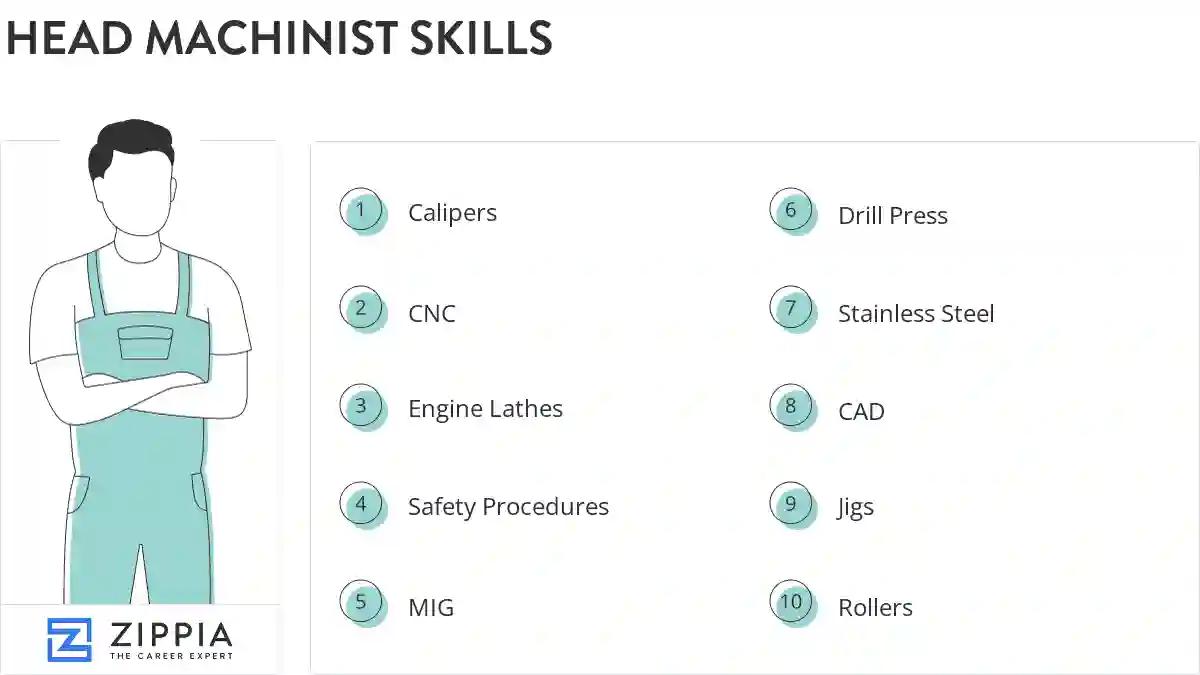
The most important skills for a head machinist resume and required skills for a head machinist to have include:
- Calipers
- CNC
- Engine Lathes
- Safety Procedures
- MIG
- Drill Press
- Stainless Steel
- CAD
- Jigs
- Rollers
- Blueprint Specifications
- Manual Lathes
Updated January 8, 2025
