
Automatically apply for jobs with Zippia
Upload your resume to get started.
Health information coder skills for your resume and career
15 health information coder skills for your resume and career
1. Medical Terminology
- Maintained a working knowledge of medical terminology to interpret medical and statistical reports.
- Translate dental terminology to medical terminology to bill medical insurances for certain procedures performed in the dental field.
2. ICD-10-CM
- Review complex medical records and accurately code primary/secondary diagnosis and procedures using ICD-10-CM and or CPT/HCPS coding conventions.
- Provided timely and accurate ICD-10-CM codes for specific information for statistical purposes.
3. CPC
CPC is a digital marketing metric that measures the amount of money paid for each click in a pay-per-click (PPC) marketing campaign. Several factors determine your cost per click, including your maximum bid, Quality Score, and ad rank from other advertisers bidding on the same keyword. When using cost-per-click advertising, it is important to understand how to create your ad, choose the price you want to pay each time the ad is clicked, and how you will not only drive traffic to your website but increase conversion as well. Cost per click (CPC) is calculated by dividing ad costs by the number of clicks an ad generated.
- Assist with enrolling students in the AAPC Professional Medical Coding program, assist with proctoring AAPC CPC examinations.
- Certified Professional Coder (CPC)TrustHCS is a consulting firm for hospital and physicians in the US.
4. Patients
- Obtain ICD-9 and CPT codes for authorizations and for the hospital to help them figure out their prices for self-funded patients.
- Registered patients for lab appointments and notifying provider staff of patient's arrival, escorted patients to the correct area.
5. Quality Standards
Quality standards are a specific level of standards of products that are set by the companies for the customers that have to be met and maintained throughout the process until the time of delivery. Quality standards are information that includes the customer's requirements, guidelines, and characteristics for the needed final product or service.
- Required to meet productivity and quality standards, audited quarterly for accuracy to be maintained to at least 95%.
- Coded and abstracted medical records (3M-Meditech System), while maintaining productivity and quality standards surpassing 95%.
6. AHIMA
- Attended educational seminars for AHIMA certification and educated other staff as needed.
- Attended state and local AHIMA, Medicare, CPT-4 and ICD-9 meetings/seminars.
Choose from 10+ customizable health information coder resume templates
Build a professional health information coder resume in minutes. Our AI resume writing assistant will guide you through every step of the process, and you can choose from 10+ resume templates to create your health information coder resume.7. DRG
- Conduct review of Insurance Company DRG reassignments and appeal records when indicated.
- Abstracted medical records with ICD9-CM, CPT and DRG coding.
8. Surgery
- Position for Health Information Coder includes E/M coding and surgery coding utilizing CPT and ICD-9 CM.
- Experienced as an outpatient coder coding Emergency, Ambulatory Surgery, and Ancillary encounters.
9. CPT-4
- Interpreted and reviewed medical record documentation to assign accurate CPT-4 procedure and assigned ICD-9 diagnosis codes.
- Review medical record documentation and accurately code the primary/secondary diagnoses and procedures using ICD-9-CM and CPT-4 coding conventions.
10. Radiology
Radiology means a division of medicine that concentrates on the use of radiant energy or any other radioactive material in the process of diagnosis and ailment treatments. It deals specifically with X-rays and radiations bearing high-energy, used in medicine and diagnosis.
- Job Task: Radiology, Outpatient, Inpatient
- Used coded data to produce and submit claims to insurance companies both manually and electronically for Radiology outpatient and emergency services.
11. Procedure Codes
Procedure codes are usually referred to as the medical classification that is used to identify surgical, medical, or diagnostic interventions like durable medical equipment, surgeries, medications. These codes can be structured alphanumerically, alphabetically, or numerically depending on where they are being used.
- Applied ICD-9-CM and CPT coding guidelines to assign and sequence the correct diagnosis and procedure codes for outpatient services.
- Reviewed inpatient medical records and assigned diagnosis and procedure codes for acute care and community hospitals with trauma centers.
12. Epic
Epic is a private healthcare company which developed and continues to provide a software intended for healthcare professionals and the organization and management of medical records. It is by far one of the largest in its field, with over 50% of patients having a medical record present in their system. Patients, as well as clinics and various medical professionals and facilities are all able to use this system to keep medical history and information safe and easy to reach, alter, and share with the necessary people.
- Provide coding opportunities for enhanced reimbursement and abstracting data into EPIC system.
- Utilize Epic and 3M Encoder to code home health encounters.
13. Home Health
- Review all Oasis for the home health care for SOC, REC, ROC.
- Code Home Health insurance claims for reimbursement Home Health end of episode chart audits
14. APC
- Correct coding and billing errors on APC error report daily.
15. Rehabilitation
- Provided coverage guidelines, developed data, analyzed and made recommendations to the rehabilitation concurrent coding pilot project.
- Review all admission data to determine the etiologic diagnosis for all inpatients admitted to rehabilitation.
5 Health Information Coder resume examples
Build a professional health information coder resume in minutes. Browse through our resume examples to identify the best way to word your resume. Then choose from 5+ resume templates to create your health information coder resume.

What skills help Health Information Coders find jobs?
Tell us what job you are looking for, we’ll show you what skills employers want.
List of health information coder skills to add to your resume
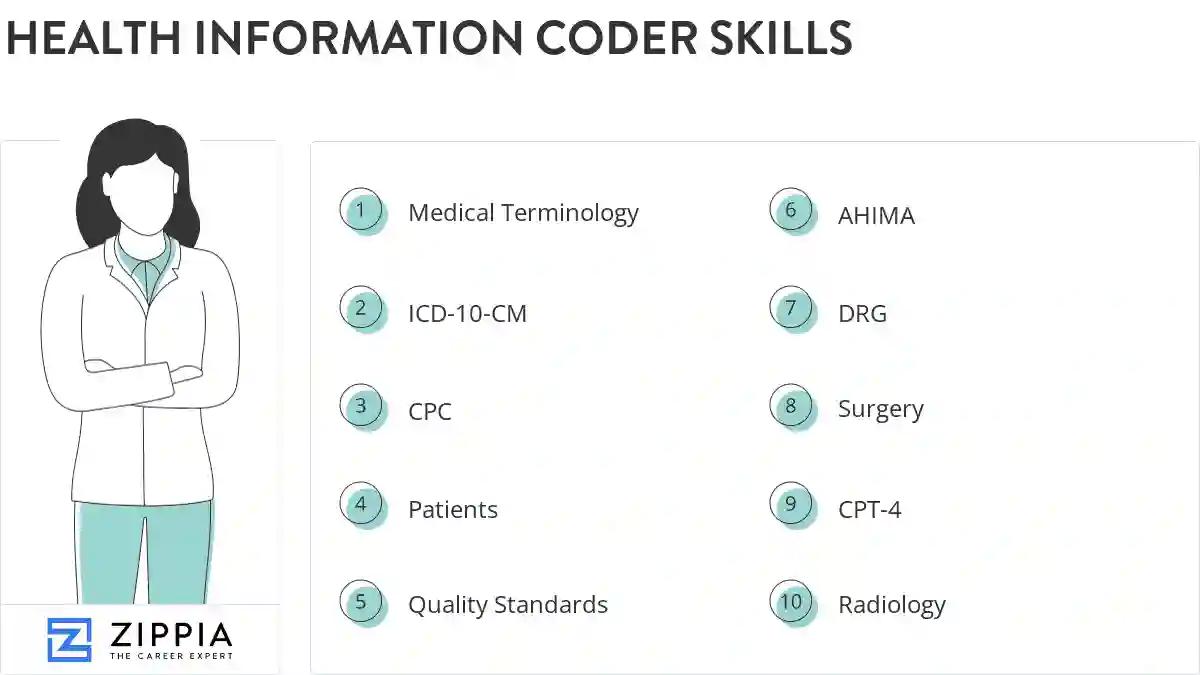
The most important skills for a health information coder resume and required skills for a health information coder to have include:
- Medical Terminology
- ICD-10-CM
- CPC
- Patients
- Quality Standards
- AHIMA
- DRG
- Surgery
- CPT-4
- Radiology
- Procedure Codes
- Epic
- Home Health
- APC
- Rehabilitation
- HIPAA
- E/M
- Federal Regulations
- Diagnosis Codes
- Data Entry
- Emergency Room
- Medicaid
- Physician Documentation
- Medical Necessity
- Accuracy Rate
- Classification System
- Encoders
- Patient Charts
- Outpatient Services
- Diagnostic Codes
- Meditech
- Nursing Home
- Transcription
- Chart Audits
- EMR
- State Guidelines
- Dictation
- Charge Entry
- Medical Charts
- ICD-9-CM
- Physical Therapy
- Hippa
Updated January 8, 2025
