
Automatically apply for jobs with Zippia
Upload your resume to get started.
Hospitalist coordinator skills for your resume and career
15 hospitalist coordinator skills for your resume and career
1. Patient Care
Patient care entails the diagnosis, recovery, and control of sickness as well as the maintenance of physical and emotional well-being through the use of healthcare providers' services. Patient care is described as services provided to patients by health practitioners or non-professionals under guidance.
- Developed marketing strategies such as brochures and informational meetings with physicians to coordinate patient care.
- Attend meetings and update PCP's and Specialists on patient care and procedures.
2. Home Health
- Handle the incoming calls, mail, and faxes including home health agency orders and pharmacy calls.
- Handle phone calls, mail, faxes, home health orders, pharmacy orders, etc.
3. Patients
- Communicated medical concepts to patients and families in layman s terms to facilitate understanding of hospital discharge instructions.
- Developed follow-up program for high-risk and non-compliant patients.
4. Relevant Data
- Collected relevant data to measure physicians for Quarterly Bonus and Relative Value Units (RVUs)
5. Meeting Minutes
- Scheduled meetings and take meeting minutes for 15+ providers.
- Attend bi-weekly meetings for the Economic Development Commission Committee* Take meeting minutes bi-weekly* Prepare and type bi-weekly agendas.
6. Computer System
- Developed and oversaw retirement plan program, including training, compliance and coordination with other financial institutions in shared computer system.
- Plan and produce informational and promotional materials; update website and computer system with inventory and schedules to keep community informed.
7. Epic
Epic is a private healthcare company which developed and continues to provide a software intended for healthcare professionals and the organization and management of medical records. It is by far one of the largest in its field, with over 50% of patients having a medical record present in their system. Patients, as well as clinics and various medical professionals and facilities are all able to use this system to keep medical history and information safe and easy to reach, alter, and share with the necessary people.
- Perform audits of proxy use with Epic EHR "MyChart" to ensure patient confidentiality and security of health records.
8. On-Site Coordination
- Provide on-site coordination and facilitation for credentialing and privileging of the hospitalists.
- Assure on-boarding logistics are in place for new physicians Provide on-site coordination and facilitation for credentialing and privileging of the hospitalists.
9. Business Cards
- Order office supplies, business cards, and various other items.
10. Sound Program
- Support the Medical Director of the Sound Program.
- Support the Chief Hospitalist of the Sound Program in scheduling meetings and ensuring attendance for hospital.
11. Patient Complaints
- Coordinated staff meetings and handle patient complaints working with staff to mitigate escalations and create understanding and a profitable environment.
- Handle patient complaints and try to achieve a resolution that suits both the patient and the organization.
12. CME
Continuing Medical Education (CME) is the medical education required for physicians to obtain to earn CME credits needed to maintain their medical licenses. To stay up-to-date and stay relevant in the field, medical professionals need to be active in the field. They can do so by taking courses, attending medical conferences, taking tests, attending workshops, seminars, and be involved in researches.
- Track physician vacation and cme days.
- Complete hospital credentialing application and maintained CME data for staff physicians.
13. Patient Charts
- Audit patient charts/histories to ensure proper documentation that supports the physician billing levels in alignment with Medicare/Medicaid reimbursement rules.
- Review patient charts for completeness and follow up on any missing or incomplete information.
14. Patient Satisfaction
- Conduct PCP satisfaction, Patient satisfaction and Case Management surveys.
- Educated Hospitalists on customer service which drove their patient satisfaction scores from <5% to 92%.
15. CPT
CPT is a medical term that stands for Current Procedural Terminology. Whenever a procedure like surgery or diagnosis occurs or some other medical service is rendered to a patient, it is reported to the concerned physician, insurance company, or organization. The aforementioned practice is widely referred to as CPT.
- Verified all hospitalist progress notes and dictation to ensure complete for billing and check that all CPT codes were posted correctly.
- Handled accounts requiring prior radiology authorizations, insure proper CPT codes are approved according to patient diagnosis and/or radiology protocol.

What skills help Hospitalist Coordinators find jobs?
Tell us what job you are looking for, we’ll show you what skills employers want.
List of hospitalist coordinator skills to add to your resume
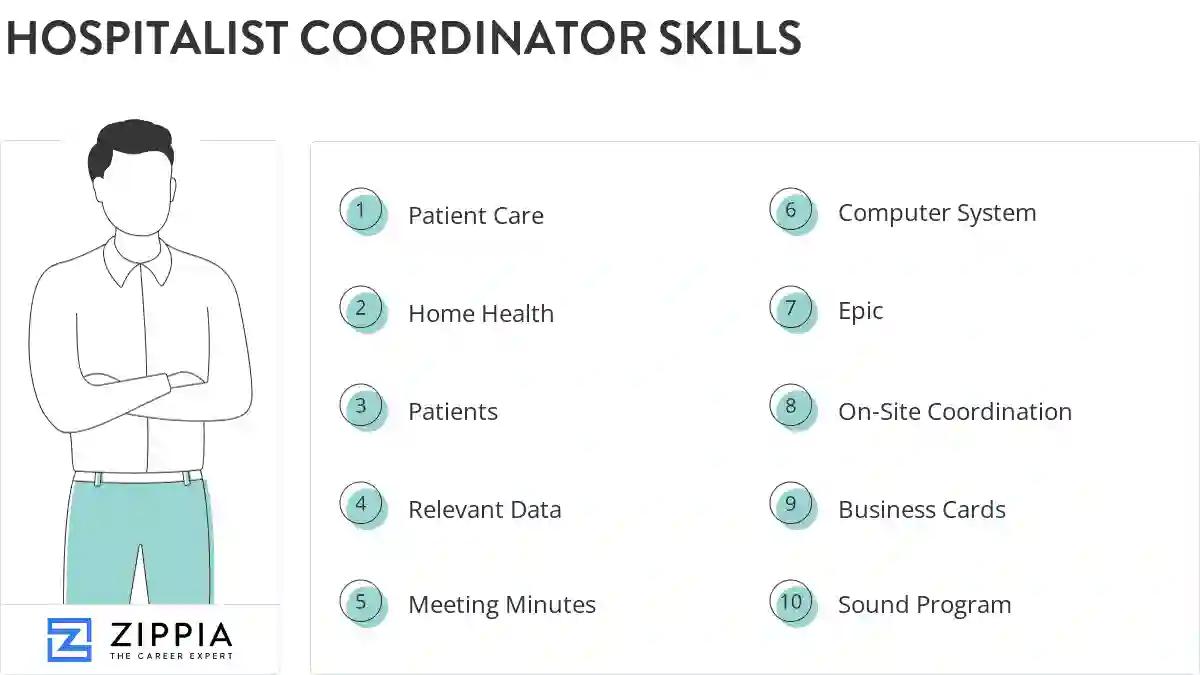
The most important skills for a hospitalist coordinator resume and required skills for a hospitalist coordinator to have include:
- Patient Care
- Home Health
- Patients
- Relevant Data
- Meeting Minutes
- Computer System
- Epic
- On-Site Coordination
- Business Cards
- Sound Program
- Patient Complaints
- CME
- Patient Charts
- Patient Satisfaction
- CPT
- Billing Data
- Patient Demographics
- Coats
Updated January 8, 2025
