Explore jobs
Find specific jobs
Explore careers
Explore professions
Best companies
Explore companies
Job outlook for hris analysts in the United States
Are hris analyst jobs in demand?
Hris analyst job and salary trends over time
Hris analyst jobs over time
Hris analyst job growth rate over time
| Year | # of jobs | % of population |
|---|---|---|
| 2021 | 1,663 | 0.00% |
| 2020 | 1,773 | 0.00% |
| 2019 | 1,834 | 0.00% |
| 2018 | 2,470 | 0.00% |
| 2017 | 2,445 | 0.00% |
Average hris analyst salary over time
Hris analyst salary by year
| Year | Avg. salary | Hourly rate | % Change |
|---|---|---|---|
| 2025 | $74,380 | $35.76 | +3.4% |
| 2024 | $71,929 | $34.58 | +2.3% |
| 2023 | $70,300 | $33.80 | +0.5% |
| 2022 | $69,928 | $33.62 | +1.2% |
| 2021 | $69,096 | $33.22 | +1.7% |
Hris analyst jobs by state
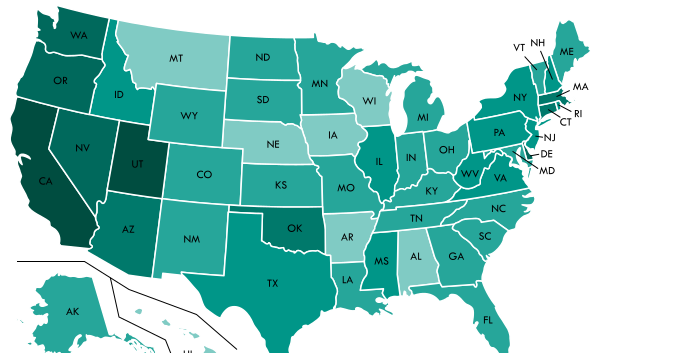
Most common states for hris analysts
| Rank | State | Population | # of jobs | Employment/ 1000ppl |
|---|---|---|---|---|
| 1 | District of Columbia | 693,972 | 445 | 64% |
| 2 | Virginia | 8,470,020 | 1,395 | 16% |
| 3 | Delaware | 961,939 | 133 | 14% |
| 4 | Alaska | 739,795 | 104 | 14% |
| 5 | Massachusetts | 6,859,819 | 869 | 13% |
| 6 | Maryland | 6,052,177 | 755 | 12% |
| 7 | Colorado | 5,607,154 | 646 | 12% |
| 8 | Arizona | 7,016,270 | 667 | 10% |
| 9 | Oregon | 4,142,776 | 403 | 10% |
| 10 | Rhode Island | 1,059,639 | 104 | 10% |
| 11 | Vermont | 623,657 | 60 | 10% |
| 12 | Minnesota | 5,576,606 | 476 | 9% |
| 13 | Connecticut | 3,588,184 | 319 | 9% |
| 14 | Utah | 3,101,833 | 290 | 9% |
| 15 | New Hampshire | 1,342,795 | 124 | 9% |
| 16 | California | 39,536,653 | 3,028 | 8% |
| 17 | Illinois | 12,802,023 | 1,014 | 8% |
| 18 | North Carolina | 10,273,419 | 830 | 8% |
| 19 | New Jersey | 9,005,644 | 705 | 8% |
| 20 | Washington | 7,405,743 | 598 | 8% |
Most common cities for hris analysts
| Rank | City | # of jobs | Employment/ 1000ppl | Avg. salary |
|---|---|---|---|---|
| 1 | Urbandale | 3 | 7% | $64,927 |
| 2 | White Plains | 2 | 3% | $77,974 |
| 3 | Annapolis | 1 | 3% | $72,349 |
| 4 | Springfield | 2 | 2% | $72,245 |
| 5 | Aliso Viejo | 1 | 2% | $93,231 |
| 6 | Tampa | 3 | 1% | $72,632 |
| 7 | Fort Lauderdale | 2 | 1% | $70,113 |
| 8 | Knoxville | 2 | 1% | $68,192 |
| 9 | Plano | 2 | 1% | $77,914 |
| 10 | Chicago | 8 | 0% | $74,061 |
| 11 | Los Angeles | 5 | 0% | $96,257 |
| 12 | Boston | 3 | 0% | $83,282 |
| 13 | Denver | 3 | 0% | $69,676 |
| 14 | Dallas | 2 | 0% | $78,069 |
| 15 | Houston | 2 | 0% | $78,913 |
| 16 | San Diego | 2 | 0% | $90,342 |
| 17 | Arlington | 1 | 0% | $78,125 |
Hris Analyst job outlook: Expert opinions
Our panel of hris analyst experts

UMass Lowell
Merrimack College
University of Cincinnati Clermont College
University of Washington
Widener University
University of Southern Maine
Western Kentucky University
John Jay College of Criminal Justice of the City University of New York
University of California, Santa Cruz
University of Minnesota - Twin Cities
Coastal Carolina University
Drexel University
Molloy College
North Carolina State University
Michael Ciuchta Ph.D.
Associate Professor, Program Coordinator, Masters of Science in EntrepreneurshipUMass Lowell
Department of Marketing, Entrepreneurship & Innovation
What Hris Analyst skills would you recommend for someone trying to advance their career?
Michael Ciuchta Ph.D.: Obviously we are seeing a tremendous increase in AI and other digital technologies. These will become a more crucial skill set for many careers going forward. But I wouldn't downplay the role of what are traditionally seen as soft skills like empathy, communications, and judgment. Not only can these distinguish you from robots but from your human competitors as well.
What will help Hris Analysts increase their earning potential?
Michael Ciuchta Ph.D.: If all you want is the highest potential starting salary, then you should aim for careers that offer them. But that is a shortsighted way to view things. For example, many careers that have tournament-like pay structures (think entertainment) often have very low starting salaries but the so-called winners enjoy outsized financial gains. If you are thinking about a more traditional career, I think it's important to make sure you are more valuable to your employer than they are to you. This means you have to market yourself, both to your current employer as well as to potential ones. Of course, this approach may not be for everyone and maximizing your salary potential is only one thing you should be considering when assessing job and career opportunities.
What Hris Analyst skills would you recommend for someone trying to advance their career?
Adam Roth: I recommend that students start by identifying a specific skill in demand within your field, such as data analysis or social media marketing, and focus on developing expertise in that area. Research salary ranges and living costs in particular areas where you’re interested in working to ensure your compensation aligns with the local market. Always negotiate a salary and consider other aspects of the offer, such as funds for continuing education, technology and more. Continuing to network and establish demand for your services is essential; attend industry events, join professional associations, and engage with professionals in your field. Never miss an opportunity to reach out to and check in with your professional contacts. Pursue additional learning opportunities and education, such as certifications or advanced degrees, to provide a competitive advantage and increase your earning potential over time.
What will help Hris Analysts increase their earning potential?
Melissa Zimdars: Recognize that your first career opportunity won't be your last. If the job you land after college does not have opportunities for growth or advancement, it's imperative that you keep an eye out for them elsewhere as you continue to gain experience in your field.
Fawen Zhang PhD
Professor of AudiologyUniversity of Cincinnati Clermont College
Communication Disorders Sciences And Services
What will help Hris Analysts increase their earning potential?
Fawen Zhang PhD: This is perfect! Thank you so much. We will be sure to feature your response in the article and send a draft over for your review before we promote it.
What Hris Analyst skills would you recommend for someone trying to advance their career?
Victor Menaldo: Interacting with AI and knowing how to best exploit it to get the most out of it: increase productivity and value added in whatever field one is in.
Tongyang Yang Ph.D.
Assistant Professor of Economics and Business AnalyticsWidener University
Business/Commerce
What general advice would you give to a Hris Analyst?
Tongyang Yang Ph.D.: There are many reasons that people like about being a business analyst, including reasons listed as follows: 1. Analytical Skills and Data Exploration: BAs often analyze data to understand trends and identify areas for improvement. Seeing a successful implementation and its positive impact can be very rewarding. 2. Problem-solving. BAs get to identify inefficiencies and propose solutions that can improve how a business operates. 3. Continuous learning. Business analysts may work on a range of projects and the field of business analysis may be constantly evolving, which required BAs to actively cultivate skills in new businesses. For example, the coming of the AI era requires BAs to master AI fundamentals and data fluency. 4. While some thrive on the problem-solving and communication aspects of a BA role, others may find them less appealing. Carefully consider your personality and preferences to see if this aligns with your career goals.
What Hris Analyst skills would you recommend for someone trying to advance their career?
Tongyang Yang Ph.D.: The rise of AI has brought many opportunities for the professions like business analysts in terms of AI integration. Businesses will need analysts who can bridge the gap between AI and human needs and focus on more strategic areas like identifying ethical considerations of AI implementation, developing plans to mitigate AI bias, and designing human-AI collaboration workflows. For people who are interested in entering this profession, I would suggest adapting your skillset to include AI understanding, data storytelling, and strategic thinking to be well-positioned in the future.
Tove Rasmussen
LecturerUniversity of Southern Maine
Specialized Sales, Merchandising And Marketing Operations
What general advice would you give to a Hris Analyst?
Tove Rasmussen: Tove Rasmussen advises graduates beginning their career in the field to...
What Hris Analyst skills would you recommend for someone trying to advance their career?
Tove Rasmussen: Tove Rasmussen believes that the skills that will become more important and prevalent in the field in the next 3-5 years are...
What Hris Analyst skills would you recommend for someone trying to advance their career?
Timothy Rich PhD: Think about the types of jobs that interest you and the skills necessary for those jobs early. So many students start thinking about post-graduation life spring their senior year, when it should be an incremental process much earlier. Another pieces of advice would be to talk to faculty and alum about your interests, find internship or research opportunities when possible, and try to figure out early your strengths and weaknesses. It's easy for students, especially high performing ones, to not fully consider what their weaknesses are. I encourage students to jot down what they see as their skills too and to share them with others. It helps them to identify what's a common skill versus something that might make them stick out.
Professor Shonna Trinch Ph.D.
ProfessorJohn Jay College of Criminal Justice of the City University of New York
Ethnic, Cultural Minority, Gender, And Group Studies
What general advice would you give to a Hris Analyst?
Professor Shonna Trinch Ph.D.: Being able to negotiate a salary is also a skill that students need to learn and one that is rarely taught in college. Students need to be able to ask for more than they are offered, but also take jobs at entry levels, prove themselves and then ask for an increase in pay six months into the job after they have shown that they are doing the work and achieving their goals.
What Hris Analyst skills would you recommend for someone trying to advance their career?
Stephanie Lain Ph.D.: I would advise graduates to be open to considering jobs in lots of different fields. The skills acquired through their major- such as problem-solving, critical thinking, and writing- are ones that transfer well to a variety of situations.
What general advice would you give to a Hris Analyst?
Oliver Keys Jr: The power of mentorships and networking early in your career will be beneficial in the long run. Also, understanding that professional skills can be half the battle. Showing up on time, dressing appropriately, and communicating effectively can be challenging for some students. Internships and externships are great for students to get technical and professional experience.
What general advice would you give to a Hris Analyst?
Dr. Paige Novak P.E. (Minnesota), BCEE: Ask questions, stay curious and open minded, take opportunities to learn and develop new skills.
Mark Chandler
Director of Government Relations and Professor of PracticeCoastal Carolina University
Intelligence, Command Control And Information Operations
What Hris Analyst skills would you recommend for someone trying to advance their career?
Mark Chandler: First, focus on being good at your job. Focus on learning your specific assigned area. Get the basics down – analytic skills, communication skills. Build a strong work ethic and professional foundation. If you can find a good mentor, link up with them. Be willing to go the “extra mile” in being a team player and doing things to help others on the team, and put in the hours. In intelligence, you will not always like what policy makers do or say. It’s not our job to agree or disagree with the policy, our job is to study the situation, present the facts and then present a fact-based analytic assessment. Keep opinion, bias, and politics out of our work. This will be a challenge, but it’s one you have to recognize in order to not succumb to it.
What Hris Analyst skills would you recommend for someone trying to advance their career?
Mark Stehr PhD: At the start of your career, it's very important to land a role where you learn a lot and find good mentors. The additional skills will pay dividends as your career progresses.
What Hris Analyst skills would you recommend for someone trying to advance their career?
Michael Rosino PhD: First, I would suggest taking stock of your community or the communities where you would like to work or serve and looking at the local demographics, opportunities, institutions, and organizations. You can then use those resources to network by contacting others who do the type of work you are interested in. Building your reputation and connections with others in the career or field, whether in the space of policy work, nonprofit organizations, business, law, or education, will help you gain further access to mentorship and opportunities. Another suggestion I would give is to develop and refine an area of expertise, whether that is a specific type of research skill or topic to help figure out what your network should look like (for instance, connecting with other folks passionate about health equity, housing, environment, consumer insights, opinion data, etc.) Look at what areas of the economy are growing or what complex problems are emerging as there are always organizations and institutions that will be addressing those issues and opportunities. The payoffs of networking may not come immediately but they will absolutely help down the line in terms of resources and opportunities and help you feel less alone in your work.
What will help Hris Analysts increase their earning potential?
Mary Rodena-Krasan Ph.D.: A degree in German Studies is extraordinarily flexible, giving you a skill set that makes you suitable to a variety of fields. Be open to every opportunity and never underestimate the skill sets learning a new language has afforded you - cross-cultural competence, interlinguistic technological adeptness, problem solving, information analysis, and critical thinking. Employers want someone they don't have to hand-hold. Studying a foreign language requires a lot of self-initiative - apply that to every assignment at the job and don't be afraid to suggest approaches! Your ability to undertake something new and be successful has already been proven by your German studies degree!
What general advice would you give to a Hris Analyst?
Dr. Kathryn Young Ph.D.: Learn everything you can about what other people in the company are doing. Network with every possible person in the company, read books, watch YouTube videos, and continue to learn. The more you know about your industry, the more valuable you become.
What Hris Analyst skills would you recommend for someone trying to advance their career?
Prof. Kim Jovanovich P.E.: Attached please see the responses to your interview questions. I hope this sheds some light on the questions you asked!
What will help Hris Analysts increase their earning potential?
Joseph Taylor: The role of a Business Analyst can vary greatly from company to company, and even from department to department, so it is very important to look at the details of a particular position that you are applying for. One common factor from all Business Analyst is that they are generally expected to make sense of data, and to be effective communicators that can apply insights to real-world problems.
What general advice would you give to a Hris Analyst?
Jeffery Braden PhD: Professors teach their discipline (e.g., psychology) from the perspective of a scholar. Students will use disciplinary knowledge in entirely different contexts (e.g., work, life). Recognizing how to generalize ways of thinking from the classroom to the real world is difficult, but highly beneficial. The things most likely to generalize are processes (e.g., quantitative reasoning, scientific method, testing different perspectives) rather than specific knowledge content. Don't worry about not having the content--you'll have lots of opportunity to learn it. Remember to use the processes you learned as a student as you do, and you'll increase your chances of success.