
Automatically apply for jobs with Zippia
Upload your resume to get started.
Humanities coordinator skills for your resume and career
15 humanities coordinator skills for your resume and career
1. Background Checks
- Audit and process drug tests, background checks and validate new hire information in the HR system.
- Prepared the necessary paper work for medical, employment & criminal background checks.
2. HRIS
- Draft, Designed and Implement JIRA HRIS tracking system to effectively organize and store candidate information.
- Prepare new hire paperwork for Scanning Coordinator, HRIS and Payroll.
3. Payroll Processing
- Assisted with reference checks, employment verifications, and payroll processing.
- Advocated for automatic payroll processing.)
4. Reference Checks
- Conducted background and reference checks for all staff.
- Completed I9 Employment Eligibility Verification forms, new hire documents, background investigations, and employment verifications / reference checks.
5. Federal Regulations
Federal regulations refer to the set of rules, both general and permanent that are published in the Federal Register by the agencies of the federal government and the executive departments. Federal regulations are the large body of rules that govern federal practice. Examples of these laws include taxes and financial regulation, discrimination law, wages law, and so on.
- Served as member of university-wide IRB policies committee to develop SOPs to address federal regulations.
- Filed customized appeals that included medical necessity along with state and federal regulations to support all services that were rendered.
6. FMLA
- Created District Specific-employee manual covering issues including disciplinary procedures, code of conduct, FMLA policy and benefits information.
- Determine leave eligibility for FMLA, approval/denial correspondence, and disability claims.
Choose from 10+ customizable humanities coordinator resume templates
Build a professional humanities coordinator resume in minutes. Our AI resume writing assistant will guide you through every step of the process, and you can choose from 10+ resume templates to create your humanities coordinator resume.7. I-9
I-9 is a government verification form that indicates, whether an individual is eligible for work in the US. The form was created by the United States Department of Homeland Security division, named as the United States Citizenship and Immigration Services (USCIS) which requires that all US citizens must fill out and submit an I-9 form to start their working career in the US. An I-9 form includes a person's identification information and education credentials, that are ought to be verified by the employer.
- Oversee new hire process including interview, drug screen, paperwork, I-9 documentation, and orientation.
- Maintained I-9 documents for all office and campus locations.
8. Conflict Resolution
Conflict resolution is an often necessary skill in business, employed for processes such as contract negotiations, legal matters, and even personal, emotional situations and conflicts. It is the ability to find and create an appropriate and peaceful solution to some sort of dilemma or argument in which two or more parties are involved. The resolution itself must benefit and satisfy all parties and this is what makes it so difficult to reach a peaceful point sometimes.
- Mediate individual and/or groups in disagreement through conflict resolution to reach a mutually acceptable agreement to resolve dispute(s).
- Worked alongside managers to achieve the appropriate conflict resolution.
9. Open Enrollment
Open enrollment means a duration that comes every year that a person can sign up for health insurance or change the plan that a person has, for instance, if a person needs to deregister. The activity always features in a few weeks or months within a year. It allows workers to alter their benefit plans, including vision, dental, health insurance, life insurance, and disability.
- Participated in presenting the annual Benefits Open Enrollment Session presentation.
- Facilitate and conduct meetings with all associates for Open Enrollment and benefits review.
10. Regulatory Compliance
- Formulate and recommend solutions to complex problems that would help bring protocols into human subjects' protection regulatory compliance.
11. Human Rights
- Arranged training and technical assistance for consumers, advocates, and family members requested by the human rights consumer committees.
- Provided advocacy and education to support clients with Human Rights concerns and attended monthly Department of Quality Improvement team meetings.
12. Exit Interviews
Exit interviews are meetings conducted by management representatives with employees who are separating from the company. These interviews act as a measurement scale to assess the individual's overall experience with the organization. Having a standardized procedure of exit interviews helps the company to manage risks effectively. It can increase employee retention, engagement and helps to decide what decisions are fruitful and what aren't inside the organization.
- Prepared all necessary paper work for terminated employees and executed exit interviews.
- Captured feedback during exit interviews which identified development opportunities and succession gaps.
13. Human Subjects
Human subjects are human beings used in research studies, which may be medical or non-medical and involve a researcher intervening or only observing. The test may be conducted to determine the effectiveness of a particular drug, a person's reaction to a medical device, or an observation of a person's reaction to waiting in a room for a long period of time.
- Provided regulatory guidance related to the protection of human subjects to IRB members, investigators, and research staff.
- Managed monthly review process of University Committee on Activities Involving Human Subjects.
14. PeopleSoft
- Redesigned the security policy for PeopleSoft access, and served as the security administrator.
- Analyzed client needs, developed business requirements and prioritization of PeopleSoft requests.
15. IRB
An institutional review board (IRB), is a form of committee that applies research ethics by vetting research procedures to ensure they are ethical. In order to decide whether or not research can be undertaken, they often perform a kind of risk-benefit analysis. The IRB's function is to ensure that adequate safeguards are in place to protect the interests and health of humans who are participants of a research sample.
- Developed and designed various educational projects for open house and IRB web-site for continuing education.
- Provided accurate and timely IRB correspondence and written reports as required by IRB action, policy and regulations.
5 Humanities Coordinator resume examples
Build a professional humanities coordinator resume in minutes. Browse through our resume examples to identify the best way to word your resume. Then choose from 5+ resume templates to create your humanities coordinator resume.

What skills help Humanities Coordinators find jobs?
Tell us what job you are looking for, we’ll show you what skills employers want.
What skills stand out on humanities coordinator resumes?
Dr. Katherine Conley
Associate Professor of English, University of Central Arkansas
So, for example, although it might look like an English major who writes a paper on Shakespeare, Frederick Douglass, or Alice Walker is unprepared for a job in marketing and public relations, the opposite is true. Training in the humanities and liberal arts requires students to analyze ideas and perspectives that differ from their own, to discern relevant and high-quality research and sources, to articulate an original concept/point of view, to back it up with evidence-based analysis, and, ultimately, to convey the ideas in a form best suited to a specific audience.
In essence, you might say that humanities and liberal arts majors learn how to learn.
We frequently hear about how things like increased automation and artificial intelligence will irrevocably change the landscape of employment in America. The skills that will be most needed in the future are not those which can be automated by a machine or replicated by a computer program, but rather those which are uniquely human in empathetic and adaptive thinking.
What soft skills should all humanities coordinators possess?
Alejandra Rodriguez-Villar Ph.D.
Assistant Professor of Spanish, Hanover College
What hard/technical skills are most important for humanities coordinators?
Amy Minervini
Instructor of English, Lewis-Clark State College
List of humanities coordinator skills to add to your resume
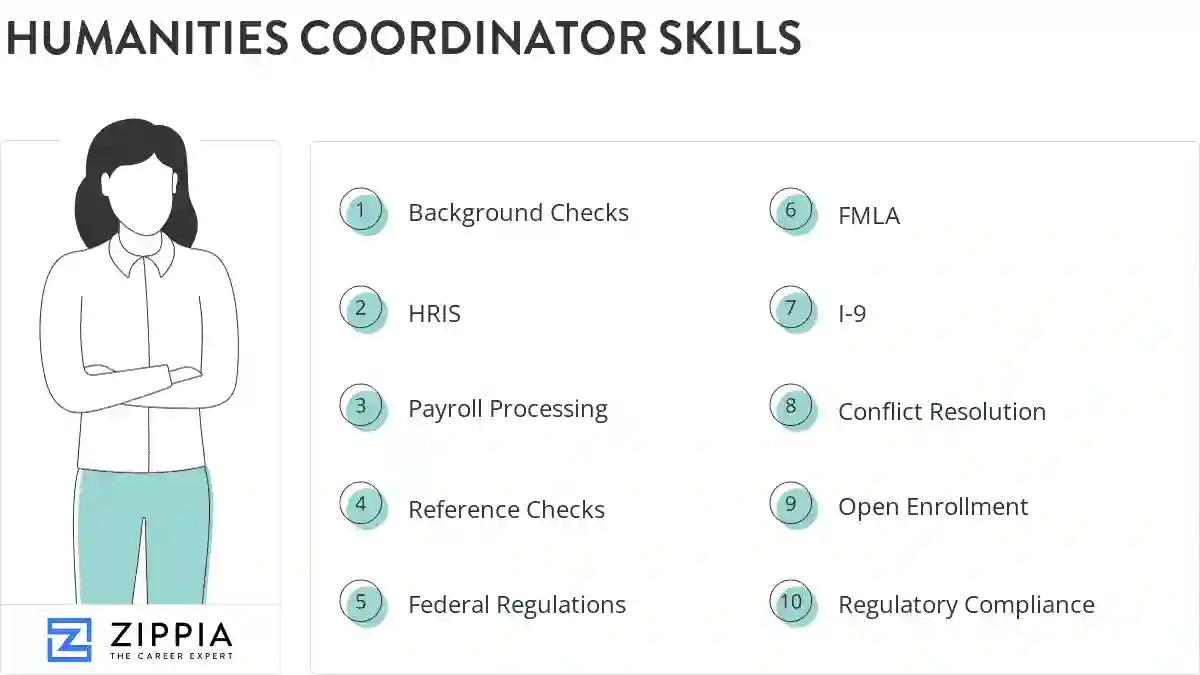
The most important skills for a humanities coordinator resume and required skills for a humanities coordinator to have include:
- Background Checks
- HRIS
- Payroll Processing
- Reference Checks
- Federal Regulations
- FMLA
- I-9
- Conflict Resolution
- Open Enrollment
- Regulatory Compliance
- Human Rights
- Exit Interviews
- Human Subjects
- PeopleSoft
- IRB
- ADP
- Career Fairs
- Public Health
- Nuclear Power
- Research Projects
- Patient Care
- Outage
- Performance Reviews
- Technical Assistance
- HIPAA
- Professional Development
- Performance Management
- Inpo
Updated January 8, 2025
