
Automatically apply for jobs with Zippia
Upload your resume to get started.
In-flight refueling craftsman skills for your resume and career
15 in-flight refueling craftsman skills for your resume and career
1. Test Equipment
Test equipment is a mechanical tool or a device which is used create signals and gather response from an electronic device under test. It helps in detecting any faults in the device and it also proves the proper operation of the electronic device.
- Diagnosed maintenance malfunctions with technical orders, schematics, built-in test, wiring diagrams, and test equipment.
- Utilize varied and specialized electronic test equipment in the function of repairs and test and inspections.
2. Performance Standards
A performance standard is an expected level of quality that must be met for a process, procedure, or goal to be considered successful or complete. They can be found across a variety of industries including everything from product testing to educational testing.
- Established performance standards and implemented improved work procedures.
- Established methods and performance standards.
3. Technical Orders
- Completed full inspections of all emergency equipment and determine repairs in accordance with technical orders/manuals.
- Maintained explosive device storage program, inventoried and inspected explosive IAW Air Force technical orders.
4. Parachutes
- Worked closely with parachute fabrication shop on inspections of parachutes and flotation equipment.
5. Flight Equipment
- Developed, and maintained, first Aircrew Flight Equipment ancillary training for the MC-12 aircraft.
- Supervised and conducted Aircrew Flight Equipment customer service for more than 1,100 62AW aircrew.
6. Aircraft Maintenance
- Planned, organized, and directed aircraft maintenance while reviewing maintenance data collection summaries to determine trends and production effectiveness.
- Trained and supervised junior members on aircraft maintenance procedures.
Choose from 10+ customizable in-flight refueling craftsman resume templates
Build a professional in-flight refueling craftsman resume in minutes. Our AI resume writing assistant will guide you through every step of the process, and you can choose from 10+ resume templates to create your in-flight refueling craftsman resume.7. GPS
GPS stands from Global Positioning System. It is a navigation system comprising of satellites that helps in determining the location, velocity, and synchronize time data for different modes of travel like air, sea, or land.
- Maintained, troubleshot, inspected and repaired aircraft avionics systems such as, GPS, Flight Director, Autopilot, Communication.
- Performed launch and on orbit operations for military communications and GPS satellites.
8. Hazardous Waste
- Store, handle and dispose of hazardous waste and materials in accordance with health and environmental standards.
- Store, handle, use, and dispose of hazardous waste and materials based on environmental standards.
9. C-17
- Facilitated C-17 instrument & flight control system modifications/overhauls; re-programs, resolves and verifies avionics system software.
- Supported wide variety of aircraft, including C-5, C-17, C-141 and C-130.
10. Protective Equipment
- Follow MSDS, Personal Protective Equipment and other safety regulations.
11. Aircraft Systems
Aircraft systems refer to the subsystems necessary for the efficient and safe operation of an aircraft, including flight controls, landing gear, electrical systems, hydraulics, avionics, navigation, communications, and instrumentation. All aircraft require essential systems such as engine, propeller, induction, ignition systems, as well as fuel, lubrication, cooling, electrical, landing gear, and environmental control systems to aid flight. Understanding aircraft systems in flight is essential for safe operation and proper maintenance.
- Performed maintenance to include aircraft systems servicing, towing, fault isolation analysis, inspections, and launch/recovery operations.
- Managed and monitored maintenance production while also troubleshooting and performing operational checks of aircraft systems Pilot 8,542 Total Flight Hours
12. Flotation
- Have been the section supervisor for the parachute, flotation, and sewing sections.
13. Emergency Operations
- Performed emergency operations and procedures as required for emergency off-load and on-load of fuel.
- Performed emergency operations and procedures as required for emergency off-load and on-load of fuel.
14. Flight Control Systems
- Performed maintenance of installed instrument indicating systems and flight control systems on nine MC-130H/P aircraft worth $990M.
- Maintained Instrument and Flight Control Systems on KC/EC-135(A/E/R) and B-52G and B-52H aircraft.
15. Hazardous Materials
Any substance or good that is harmful to human health as well as the environment are called hazardous materials. Such materials must be handled carefully to avoid any mishaps. Harmful gases. chemicals, strong medicines or drugs, radioactive elements required for radiation purposes, a human blood sample that carries germs, all of these are considered hazardous materials.
- Maintained base hazardous materials program and worked closely with base manager to ensure smooth operations during daily base operations.
- Leveraged extensive experience in ensuring successful evacuation and cleanup operations in incidents involving spillage of hazardous materials.
5 In-Flight Refueling Craftsman resume examples
Build a professional in-flight refueling craftsman resume in minutes. Browse through our resume examples to identify the best way to word your resume. Then choose from 5+ resume templates to create your in-flight refueling craftsman resume.

What skills help In-Flight Refueling Craftsmen find jobs?
Tell us what job you are looking for, we’ll show you what skills employers want.
List of in-flight refueling craftsman skills to add to your resume
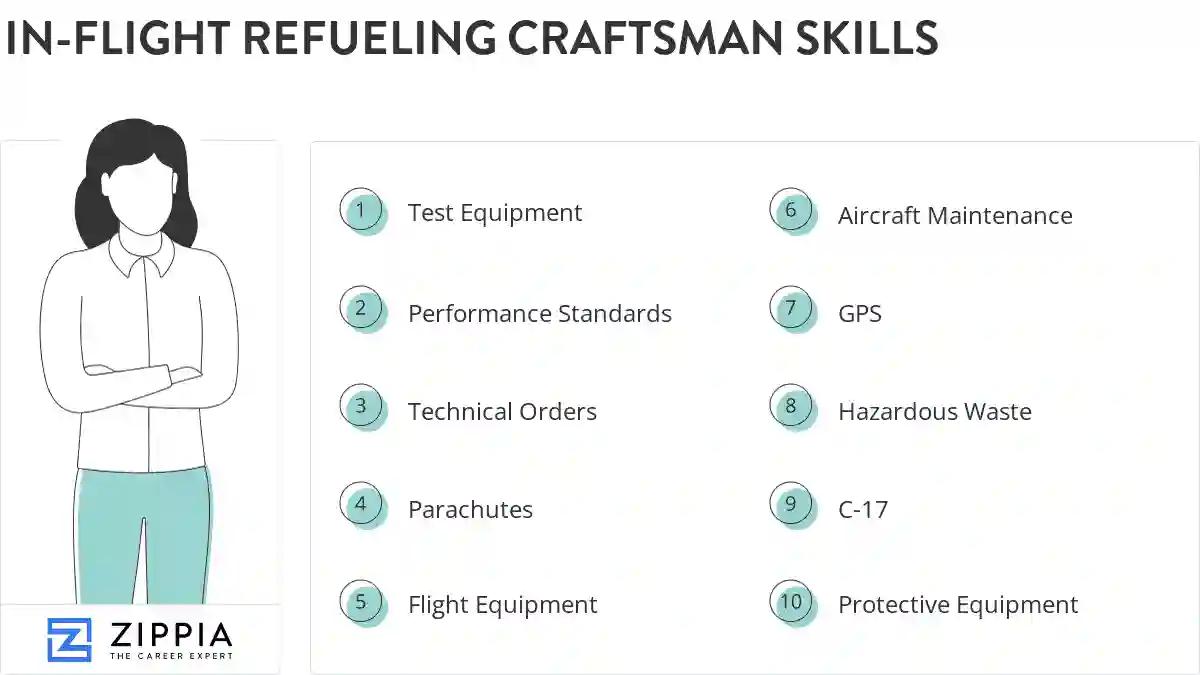
The most important skills for an in-flight refueling craftsman resume and required skills for an in-flight refueling craftsman to have include:
- Test Equipment
- Performance Standards
- Technical Orders
- Parachutes
- Flight Equipment
- Aircraft Maintenance
- GPS
- Hazardous Waste
- C-17
- Protective Equipment
- Aircraft Systems
- Flotation
- Emergency Operations
- Flight Control Systems
- Hazardous Materials
- Troubleshot
- Balance Data
Updated January 8, 2025
