Explore jobs
Find specific jobs
Explore careers
Explore professions
Best companies
Explore companies
Job outlook for incident managers in the United States
Are incident manager jobs in demand?
Incident manager job and salary trends over time
Incident manager jobs over time
Incident manager job growth rate over time
| Year | # of jobs | % of population |
|---|---|---|
| 2021 | 1,596 | 0.00% |
| 2020 | 1,671 | 0.00% |
| 2019 | 1,657 | 0.00% |
| 2018 | 1,606 | 0.00% |
| 2017 | 1,535 | 0.00% |
Average incident manager salary over time
Incident manager salary by year
| Year | Avg. salary | Hourly rate | % Change |
|---|---|---|---|
| 2026 | $87,053 | $41.85 | +3.2% |
| 2025 | $84,317 | $40.54 | +2.9% |
| 2024 | $81,948 | $39.40 | +2.2% |
| 2023 | $80,178 | $38.55 | +2.2% |
| 2022 | $78,437 | $37.71 | +1.5% |
Incident manager jobs by state
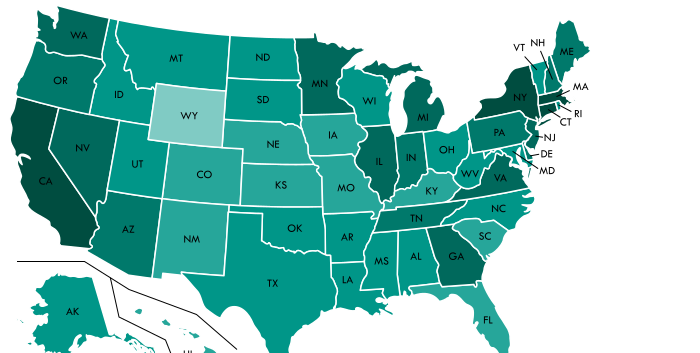
Most common states for incident managers
| Rank | State | Population | # of jobs | Employment/ 1000ppl |
|---|---|---|---|---|
| 1 | District of Columbia | 693,972 | 93 | 13% |
| 2 | Washington | 7,405,743 | 501 | 7% |
| 3 | California | 39,536,653 | 2,230 | 6% |
| 4 | Virginia | 8,470,020 | 472 | 6% |
| 5 | Massachusetts | 6,859,819 | 395 | 6% |
| 6 | Oregon | 4,142,776 | 203 | 5% |
| 7 | Utah | 3,101,833 | 147 | 5% |
| 8 | Delaware | 961,939 | 47 | 5% |
| 9 | Colorado | 5,607,154 | 247 | 4% |
| 10 | Maryland | 6,052,177 | 242 | 4% |
| 11 | Minnesota | 5,576,606 | 208 | 4% |
| 12 | Connecticut | 3,588,184 | 126 | 4% |
| 13 | New Hampshire | 1,342,795 | 53 | 4% |
| 14 | Rhode Island | 1,059,639 | 42 | 4% |
| 15 | Vermont | 623,657 | 26 | 4% |
| 16 | New York | 19,849,399 | 509 | 3% |
| 17 | Illinois | 12,802,023 | 359 | 3% |
| 18 | Pennsylvania | 12,805,537 | 327 | 3% |
| 19 | New Jersey | 9,005,644 | 231 | 3% |
| 20 | Arizona | 7,016,270 | 204 | 3% |
Most common cities for incident managers
| Rank | City | # of jobs | Employment/ 1000ppl | Avg. salary |
|---|---|---|---|---|
| 1 | Annapolis | 7 | 18% | $82,370 |
| 2 | Frankfort | 4 | 14% | $72,507 |
| 3 | Dover | 4 | 11% | $84,713 |
| 4 | Allen Park | 3 | 11% | $94,872 |
| 5 | Topeka | 4 | 3% | $75,313 |
| 6 | Baton Rouge | 4 | 2% | $82,576 |
| 7 | Des Moines | 4 | 2% | $70,958 |
| 8 | Little Rock | 4 | 2% | $75,812 |
| 9 | Tallahassee | 4 | 2% | $69,912 |
| 10 | Hartford | 3 | 2% | $106,233 |
| 11 | Washington | 7 | 1% | $89,199 |
| 12 | Atlanta | 6 | 1% | $95,551 |
| 13 | Boston | 5 | 1% | $106,379 |
| 14 | Indianapolis | 5 | 1% | $83,426 |
| 15 | Sacramento | 4 | 1% | $107,410 |
| 16 | Los Angeles | 4 | 0% | $102,626 |
| 17 | Phoenix | 4 | 0% | $84,205 |
| 18 | Chicago | 3 | 0% | $92,334 |
Incident Manager job outlook: Expert opinions
Our panel of incident manager experts

University of Iowa

University of Maryland - College Park

Kettering University
California State University - Sacramento
What skills stand out on Incident Manager resumes?
Casey DeRoo Ph.D.: Rather than a concrete skill, previous experience in managing teams to accomplish engineering-related tasks is sure to make you a standout. Showcasing familiarity with work management software (e.g., Jira) or budget/total effort tracking systems is important. Find out what software the company you're seeking employment with uses, and be sure to highlight this if you're familiar with it.
Donald Yeung
Professor and Associate Chair for Undergraduate Education, Affiliate Professor, Computer Science DepartmentUniversity of Maryland - College Park
Department of Electrical and Computer Engineering
What skills stand out on Incident Manager resumes?
Donald Yeung: A degree at a highly rated engineering school is always a plus. For example, the ECE dept at UMD has a good reputation among local employers as well as employers elsewhere, such as Silicon Valley. Many of our students go to companies in these areas, and so we have a reputation based on the quality of students that go out. I think employers know what they're getting. Beyond the school from which you receive your degree, your GPA is also important. How well you do in the program you come from is important, too, obviously. And employers also know about grade inflation or deflation at different schools, so they can calibrate any student's GPA against what experience they've had with previous students' records. Besides that, employers also look for experience outside of the degree program, so internships, research experiences, any significant project experience, etc., are also a real plus.
What hard/technical skills are most important for Incident Managers?
Donald Yeung: In terms of hard technical skills, I believe the courses students take along with their GPA in these courses is one level of demonstration. (As I mentioned above, employers know about our program probably down to specific courses, and so if someone gets an A+ in some notoriously challenging course, that's probably known and appreciated). Some employers will give technical interviews and require students to solve problems on their feet. But I think most employers will judge this based on a student's transcript.
What technical skills for an Incident Manager stand out to employers?
Patrick Atkinson: Broadly speaking, employers are looking for employees who can jump in, take on a project and move things forward. Since engineers are data-driven, knowing how to read and interpret findings from a variety of sources is key. This can be very challenging if the data conflicts between sources or the data is unclear. Whether the data is from a mathematical model, a physical test laboratory, or from the field, learning how to synthesize the findings and balance the strengths/weaknesses of a given data source are key. At the end of the day, every project needs a way forward and it is the engineer's job to optimize a design to meet the objectives for the product.
What are the biggest trends we'll see in the Incident Manager job market given the pandemic?
Steven Fernandez: No sure, with respect to mechanical engineering there is so many variables as to what new trends ME grads can experience. One of the greatest challenges Mechanical Engineering students face is the broadness of the field of study they have chosen. Surprisingly, many ME grads find themselves at a bit of a loss as to what carrier path to choose when they finally get their degree. As a mechanical engineer you can be designing anything from a supersonic missile, to a food processing line, in multiple functions. Mechanical engineers can be project engineers, design engineers, operation engineers, or manufacturing engineers with all options in just one industrial field. Each industrial field is affected differently by the pandemic. Take Space X, Google, Amazon, and Raytheon which are all industries ME's work in. These company seem to be doing the same if not better during the pandemic. How about the bicycle industry? With more families at home looking for activities there is a backlog of bicycles as the manufacturers cannot keep up with the orders. Try and order a NordicTrack treadmill, or a concept-2 rowing machine and you will be put on a waiting list due to the shortage of supply. Mechanical engineers work in all these industries. On the flip side look at some industries tied to travel and vacation. Yes, Boeing took a hit because of their 737 planes being grounded, but also because of the massive decrease in flight travel. So, all that said, I would say the pandemic trend for now would follow the course as such; industries which are negatively affected due to the loss of public activities will continue to struggle or have slow growth, while other industries where the mass public has been redirected will flourish and grow.