
Automatically apply for jobs with Zippia
Upload your resume to get started.
Industrial nurse skills for your resume and career
15 industrial nurse skills for your resume and career
1. OSHA
- Participated in OSHA and Safety Committee programs, personnel work and EEO programs.
- Maintained OSHA, State and team member health records.
2. Safety Training
The guidance and skills taught to workers and employees of a company to carry out their duties safely and efficiently are referred to as safety training. The purpose of safety training is to inform workers about the potential and risks associated with this kind of work and to teach them ways to avoid such risks.
- Case Management, Ergonomic Evaluations, Safety Training.
- Coordinated annual employee medical exams Collaborated with Ministry of Health on workplace safety training programmes
3. Emergency Care
- Provide emergency care and medical attention to employee illnesses and occupational injuries.
- Provided First Aid and emergency care to employees and clients.
4. Drug Screens
A drug screen is a drug test that consists of a collection of blood, urine, saliva, or even a hair sample. The samples are used to determine the presence of any chemical remnants which are present in the body after the intake of any drug.
- Administered vision exams, and conducted post-accident and reasonable suspicion drug screens.
- Nurse for facility, drug screens, injuries, first aid.
5. Health Education
Health education refers to education concerning healthcare.
- Present employee safety and health education and training.
- Provided health education on wellness topics such as diabetes care/prevention, hypertension/cardiac care, and behavior modification (obesity/substance abuse)
6. Hearing Conservation
- Plant Safety, Hearing conservation.
- Conducted clinic assessments; medical surveillance, annual physicals; Travel Vaccination clinic and Hearing Conservation Program.
Choose from 10+ customizable industrial nurse resume templates
Build a professional industrial nurse resume in minutes. Our AI resume writing assistant will guide you through every step of the process, and you can choose from 10+ resume templates to create your industrial nurse resume.7. Pre-Employment Physicals
- Performed pre-employment physicals and drug-screens.
- Performed pre-employment physicals and drug screening.
8. Safety Program
Safety programs are a series of measures to protect employees from any mishaps and make the work environment safer. Safety programs include checklists, guidelines, and direct procedures that a specific area or department must follow. Safety programs take care of office space safety, maintenance and repairs, and identification of frauds as well.
- Support for Safety Coordinator with development and implementation of plant safety programs and Emergency Response Team.
- Developed employee safety programs such as First Aid, Blood Borne Pathogens, Ergonomics and CPR.
9. AED
AED is a medical device used to revive people suffering from unexpected cardiac arrest. Apart from hospitals, you will see these machines at homes, offices, and schools since they are easy to use without a prescription.
- Ordered medical, ergonomic and AED supplies as needed.
- Maintain and coordinate AED and written AED program.
10. Health Screenings
- Performed physical assessments, health screenings and immunizations.
- Conducted occupational health screenings in a corporate environment.
11. FMLA
- Case Management of employee Family Medical Leave (FMLA).
- Devised process and then coordinated second and third FMLA opinion evaluations nationwide, recognized for efficiency and considerable cost savings.
12. Blood Pressure
- Developed, implemented and maintained Self-Monitoring Blood Pressure stations and Over-the-Counter Medication Self-Dispensation centers at both Fort Wayne sites.
- Greet patients* Patient teaching/health education* Automatic and manual blood pressure readings* BMI readings* Full Lipid Panel Cholesterol/Glucose
13. Pathogens
- Instruct CPR/First Aid/Bloodborne pathogens; Regulatory permits and reports.
- Manage all medical surveillance programs including Respiratory Protection, Hearing Conservation, and Blood borne Pathogens.
14. Workers Compensation Claims
- Provide an innovate wellness program, administers workers compensation claims, and ergonomic program.
- Maintain records for all workers compensation claims.
15. Human Resources
Human resources is a set of people in a business or a corporation that are designated to locate, interview, and recruit new employees into the company. They are also responsible to maintain the integrity of the employees and help them sort their problems out. They try to introduce and manage employee-benefit programs.
- Collaborate with Safety, Environmental, Industrial Relations, and Human Resources.
- Functioned within the Human Resources leadership team.
5 Industrial Nurse resume examples
Build a professional industrial nurse resume in minutes. Browse through our resume examples to identify the best way to word your resume. Then choose from 5+ resume templates to create your industrial nurse resume.

What skills help Industrial Nurses find jobs?
Tell us what job you are looking for, we’ll show you what skills employers want.
What skills stand out on industrial nurse resumes?
Terrica Durbin Ph.D.
Associate Professor, Director, School of Nursing, Western Carolina University
What soft skills should all industrial nurses possess?
Terrica Durbin Ph.D.
Associate Professor, Director, School of Nursing, Western Carolina University
What hard/technical skills are most important for industrial nurses?
Terrica Durbin Ph.D.
Associate Professor, Director, School of Nursing, Western Carolina University
What industrial nurse skills would you recommend for someone trying to advance their career?
Kara Sump MSN, CNE
Assistant Professor of Nursing, George Fox University
What type of skills will young industrial nurses need?
Jeffery Christian
Professor, Sac City
Building relationships with patients is vital for patient education and teaching. So much of nursing is teaching. If the nurse does not have the skill of relationship building, many opportunities to truly create change in the patient's life will be lost. When we (the nursing profession) truly see and understand what our patient's lives look like, then we put ourselves and our patients in the best possible position to create life-long change.
Life-long learning - nursing is based on Evidence-Based Practice. What that means is that the nursing profession is constantly researching and developing best practices. That means, if you are entering the profession, you have to be quick to adapt and open to constant change. Even more so than open, eager to find the best way to deliver world-class patient care.
Maintaining life balance - I have been a nurse for 28 years, and this profession is much more difficult now than it was when I started. In order for bedside nurses to be effective, and to not develop compassion fatigue/burnout... homeostasis has to be achieved. A young nurse just entering the profession has to know how to keep balance. Whether it is yoga, journaling, exercising, eating well, sleeping well,... all of these components have to be in balance so the nurse can come to work refreshed and recharged.
Obviously - one of the key components to being a great nurse and having sustainability in this profession is to be a critical thinker. Nothing is as it seems, and this profession demands nurses to constantly be on their toes and to be thinking critically about why they do what they do. Whether it is passing a specific medication, performing a diagnostic test, ... the ability to constantly think critically is vital for patient safety.
There are so many more, but I have to get back to work, and this is taking longer than I thought...
List of industrial nurse skills to add to your resume
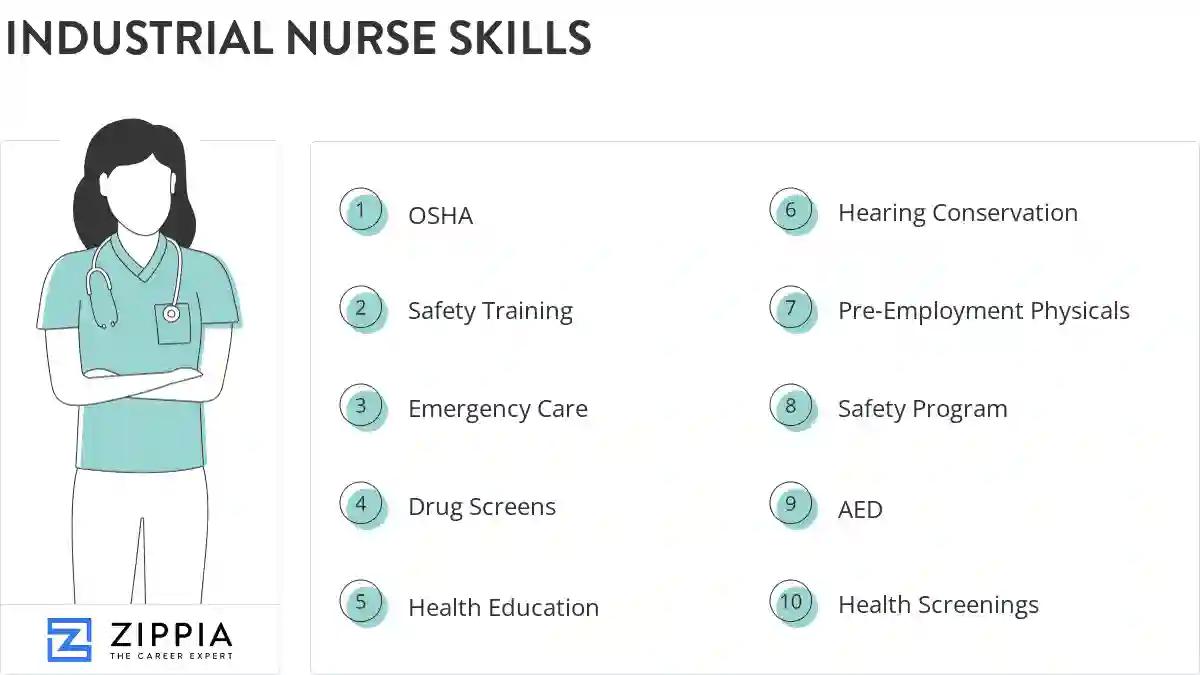
The most important skills for an industrial nurse resume and required skills for an industrial nurse to have include:
- OSHA
- Safety Training
- Emergency Care
- Drug Screens
- Health Education
- Hearing Conservation
- Pre-Employment Physicals
- Safety Program
- AED
- Health Screenings
- FMLA
- Blood Pressure
- Pathogens
- Workers Compensation Claims
- Human Resources
- DOT
- BWC
- Health Insurance
- Patient Care
- Emergency Response
- Computer Data Entry
- Acute Care
- Vital Signs
- Wellness Programs
- Blood Draws
- Emergency Situations
- Medical Care
Updated January 8, 2025
