
Automatically apply for jobs with Zippia
Upload your resume to get started.
Industrial waste inspector skills for your resume and career

15 industrial waste inspector skills for your resume and career
1. Regulatory Agencies
A regulatory agency is a Public Benefit Corporation (PBC) that is responsible for supervising certain human activities and controlling them to some extent. They are set up in some areas such as hospitals, law firms, and governmental setup to regulate safety standards. They prevent undue and unjust abuse of power in these setups.
- Communicate with regulatory agencies to address environmental reporting, deviations, and notices of non-compliance.
- Developed strategic relationships with internal staff, regulatory agencies, and other stakeholders.
2. Compliance Inspections
- Complete compliance inspections and assist with periodic environmental audits, coordinate completion of corrective actions resultant of either.
- Documented inspections results by completing reports through compliance inspections of establishments.
3. Enforcement Actions
- Investigate and respond to instances of IU's noncompliance and address enforcement actions for pretreatment violations.
4. Pollution Prevention
- Support Environmental Manager in the preparation and/or review of storm water pollution prevention plans (SWPPPs).
5. Destructive Testing
- Performed non-destructive testing at nuclear, coal-fired & natural gas power plants, as well as pharmaceutical and chemical plants.
- Performed non-destructive testing in the lab, fabrication shops, coal-fired power plants, and chemical plants.
6. Inspection Reports
An inspection report is a written document provided after a thorough evaluation of a specific procedure/ process.
- Coordinate, schedule, and conduct post-inspection of businesses that installed energy efficient technologies Prepare post-inspection reports
- Conducted site inspections at permitted facilities and illegal dumps and prepared inspection reports in accordance with Delegation Agreement.
Choose from 10+ customizable industrial waste inspector resume templates
Build a professional industrial waste inspector resume in minutes. Our AI resume writing assistant will guide you through every step of the process, and you can choose from 10+ resume templates to create your industrial waste inspector resume.7. On-Site Inspections
- Performed on-site inspections of the entire project with inspection report generation, including recommendations and client approved work order generation.
- Performed on-site inspection to ensureproject specifications.
8. Environmental Compliance
Environmental compliance means to fulfill official environmental requirements. It comprises environmental rules, laws, and regulations, and permits regarding which sites to operate. Environmental concerns have raised compliances across the globe. Environmental compliance includes managing and monitoring the required permits for correct parameters, performing and processing calculations, generate daily compliance reports, and record data with compliance to any risk alert
- Worked with construction management and government agencies to ensure comprehensive environmental compliance throughout all phases of transmission line construction.
- Provided environmental compliance monitoring and management of private and public construction projects for local government regulatory authority.
9. Hazardous Waste Regulations
- Inspected businesses and other hazardous waste generating entities for compliance with state hazardous waste regulations.
10. Hazardous Waste Materials
- Identified unacceptable or hazardous waste materials and ensures proper removal.
- Educated the public on hazardous waste materials and otherunacceptable materials and informed the public on disposal methods.
11. Environmental Quality
- Collect samples from state waters, soil and discharges for field and laboratory analyses to determine environmental quality and compliance.
- Evaluated the nature, extent and cause of environmental quality standard violations.
12. PT
PT which stands for Prothrombin Time is a test to evaluate the body's ability to properly form blood clots using one's blood sample. PT results are used to calculate the International Normalized Ratio (INR) which detects the effectiveness of blood-thinning medications like Warfarin taken by patients that have blood-clotting disorders.
- Level II certified inspector UT, RT, PT, MT, VT.
13. Lab Analyses
- Provided sample collection, lab analyses, and record keeping.
14. City Codes
- Uphold compliance with city codes, state, and federal requirements.
15. Federal Regulations
Federal regulations refer to the set of rules, both general and permanent that are published in the Federal Register by the agencies of the federal government and the executive departments. Federal regulations are the large body of rules that govern federal practice. Examples of these laws include taxes and financial regulation, discrimination law, wages law, and so on.
- Developed local limits and regulated for City, State and Federal regulations for all industry.
- Conducted industrial hygiene inspections to ensure compliance with state and federal regulations regarding asbestos, lead and demolitions in North Carolina.
5 Industrial Waste Inspector resume examples
Build a professional industrial waste inspector resume in minutes. Browse through our resume examples to identify the best way to word your resume. Then choose from 5+ resume templates to create your industrial waste inspector resume.

What skills help Industrial Waste Inspectors find jobs?
Tell us what job you are looking for, we’ll show you what skills employers want.
List of industrial waste inspector skills to add to your resume
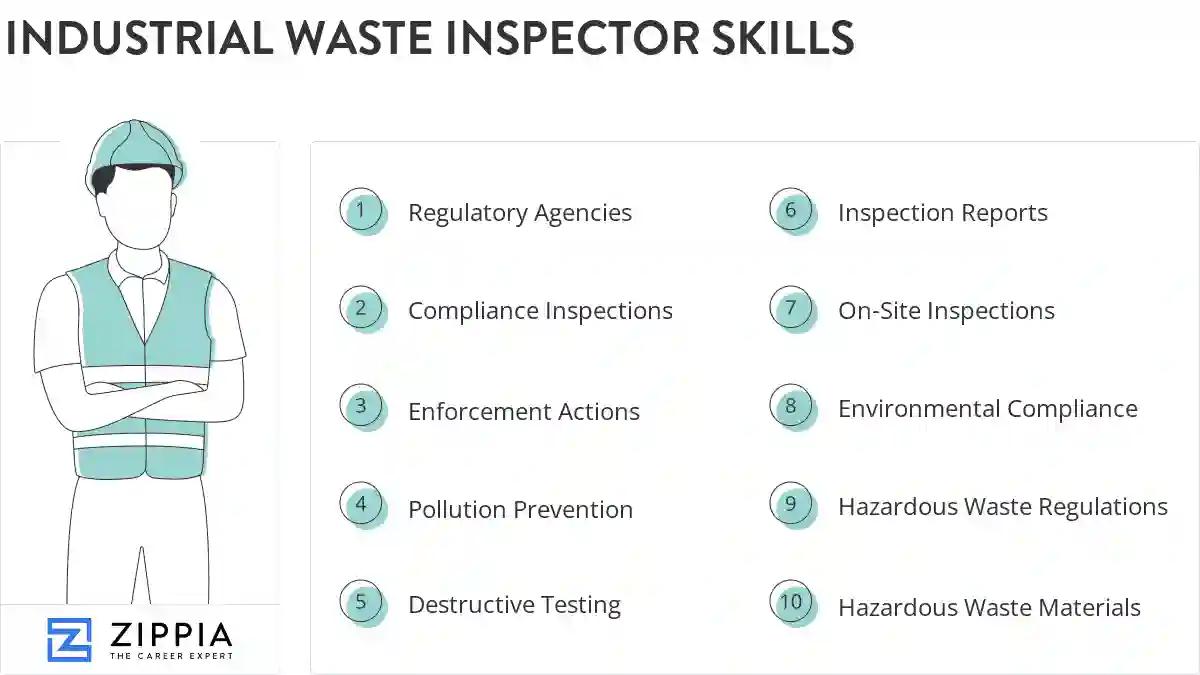
The most important skills for an industrial waste inspector resume and required skills for an industrial waste inspector to have include:
- Regulatory Agencies
- Compliance Inspections
- Enforcement Actions
- Pollution Prevention
- Destructive Testing
- Inspection Reports
- On-Site Inspections
- Environmental Compliance
- Hazardous Waste Regulations
- Hazardous Waste Materials
- Environmental Quality
- PT
- Lab Analyses
- City Codes
- Federal Regulations
- RT
- Magnetic Particle
- Storm Water
- Legal Action
Updated January 8, 2025
