
Automatically apply for jobs with Zippia
Upload your resume to get started.
Information architect skills for your resume and career
15 information architect skills for your resume and career
1. Java
Java is a widely-known programming language that was invented in 1995 and is owned by Oracle. It is a server-side language that was created to let app developers "write once, run anywhere". It is easy and simple to learn and use and is powerful, fast, and secure. This object-oriented programming language lets the code be reused that automatically lowers the development cost. Java is specially used for android apps, web and application servers, games, database connections, etc. This programming language is closely related to C++ making it easier for the users to switch between the two.
- Designed and co-implemented a configuration framework (XML, XLST, Java, VB and SQL).
- Used Java to develop weatherproof Android tablets for mounting to retail shopping carts.
2. Data Architecture
- Provided expertise our clients in Enterprise Information Management with an emphasis on data analysis, data architecture and data quality.
- Designed the data architecture to optimize usability and reuse for different audiences and facilitate collaborative development.
3. Data Models
- Consulted with both the business and technical stakeholders to develop logical and physical data models to fulfill business and technical requirements.
- Produce logical data models for systems development efforts for operational applications, data warehousing, data marts and reporting solutions.
4. Metadata
Metadata is a combination of two words, meta and data. Meta is a prefix defined as more comprehensive, and data means collection of data. Metadata is defined as the data that describes other data. It is used to summarize data about data to make the data easier to analyze.
- Formulated a method for integrating relational and NoSQL data structures using metadata integration bridges combined with RDBMS and Big Data Modeling.
- Worked closely with the Information and Data Management team on Data governance & Metadata management activities.
5. Data Quality
- Created and documented solution architecture, data and process flows, technical specifications for system components and data quality gap analysis.
- Developed dashboard for Supply Chain planning data quality reporting that improved accuracy of planning effort and improved customer relationship.
6. Data Governance
Data governance is an assortment of cycles, jobs, arrangements, principles, and measurements that guarantee the successful and productive utilization of data in empowering an association to accomplish its objectives. Information administration characterizes who can make a what move, upon what information, in what circumstances, utilizing what strategies
- Design and provide enterprise data governance, information management, and enterprise content management solutions.
- Defined and deployed formal data governance structure and activated formal Data Governance Organization.
Choose from 10+ customizable information architect resume templates
Build a professional information architect resume in minutes. Our AI resume writing assistant will guide you through every step of the process, and you can choose from 10+ resume templates to create your information architect resume.7. ETL
- Managed a team of ETL developers and cube developers, including planning and work breakdown, assigning tasks and tracking progress.
- Reviewed data and ETL design of MS SQL Server credit data warehouse and recommended functional and performance improvement.
8. BI
- Established the scope and focus of the BI opportunity through a process of data exploration and requirements gathering.
- Project Goal: Select an Enterprise BI Tool to align with the organization technical and business strategy.
9. Project Management
- Involved in effort estimation, status reporting, team management, Project Management and onshore-offshore project co-ordination.
- Led the interactive team focusing on user interface/user experience design and project management.
10. Html Css
- Designed information models, concept and interaction flows and wireframes, created low-fidelity sketches, mockups and high-fidelity HTML CSS prototypes.
11. Data Warehouse
Data warehouse, often abbreviated as either DW or DWH is a system used in computing for data analysis as well reporting. The DW is also considered to be an integral component of business intelligence as they also provide storage facilities for both real-time and historical data. ETL and ELT are the two driving forces behind a data warehouse system.
- Provided consultative advice to team tasked to establish strategic data warehouse direction.
- Consulted with Operational Risk Management on Governance, Risk and Compliance (GRC) tool and data warehouse integration.
12. Data Analysis
- Conducted business analysis, data analysis, database optimization, load strategy design, implementation, security and change management.
- Performed data analysis for data migration from existing Purisma solution presenting the assessment to interested parties.
13. User Experience
- Created UX documentation to effectively articulate content, structure and behavior of user experience solutions while following an iterative design process.
- Recommended and developed site architecture and user experience executions along with design solutions for desktop and mobile environments.
14. Develop User
- Develop user tasks, surveys, questionnaires, test scripts, difficulty ratings, and reporting documents.
- Led technical and creative team to develop user interface for an on-line solution for Target vendors.
15. Visualization
- Collaborated with Agile development team, rapidly iterating business/functional/user requirements in wireframing and content visualization with customers and internal team.
- Contributed several solutions that worked directly with big data which included data analysis, data processing and visualization.
5 Information Architect resume examples
Build a professional information architect resume in minutes. Browse through our resume examples to identify the best way to word your resume. Then choose from 5+ resume templates to create your information architect resume.

What skills help Information Architects find jobs?
Tell us what job you are looking for, we’ll show you what skills employers want.
What skills stand out on information architect resumes?
James Shields
Design Principal at HGA Architects and Associate Professor of Architecture, University of Wisconsin - Milwaukee
What information architect skills would you recommend for someone trying to advance their career?
Dr. Barry Stiefel Ph.D.
Associate Professor, College of Charleston
College and graduate degrees are costly these days, so they should be done as a means to end and not to pass the time (unless one is in a financial position to do so). During that time off, they should find employment (regular, temp, part-time, or apprenticeship) related to something that they are interested in and volunteer at a relevant organization or government agency. This way, the person continues to build their resume and professional social network.
Putting yourself out there is very important for making informed decisions on what career moves you want to do next. Even adverse employment and volunteer experiences can be beneficial because you now have learned what you don't want to do. Knowing what you don't want to do before spending significant money on a college or graduate degree is a financially smart idea.
What type of skills will young information architects need?
Clyde Eiríkur Hull
Professor of Strategic Management, Rochester Institute of Technology
What hard/technical skills are most important for information architects?
Dak Kopec Ph.D.
Associate Professor, Coordinator, BA Interior Architecture and Design and Master of Design Program, University Of Nevada, Las Vegas
List of information architect skills to add to your resume
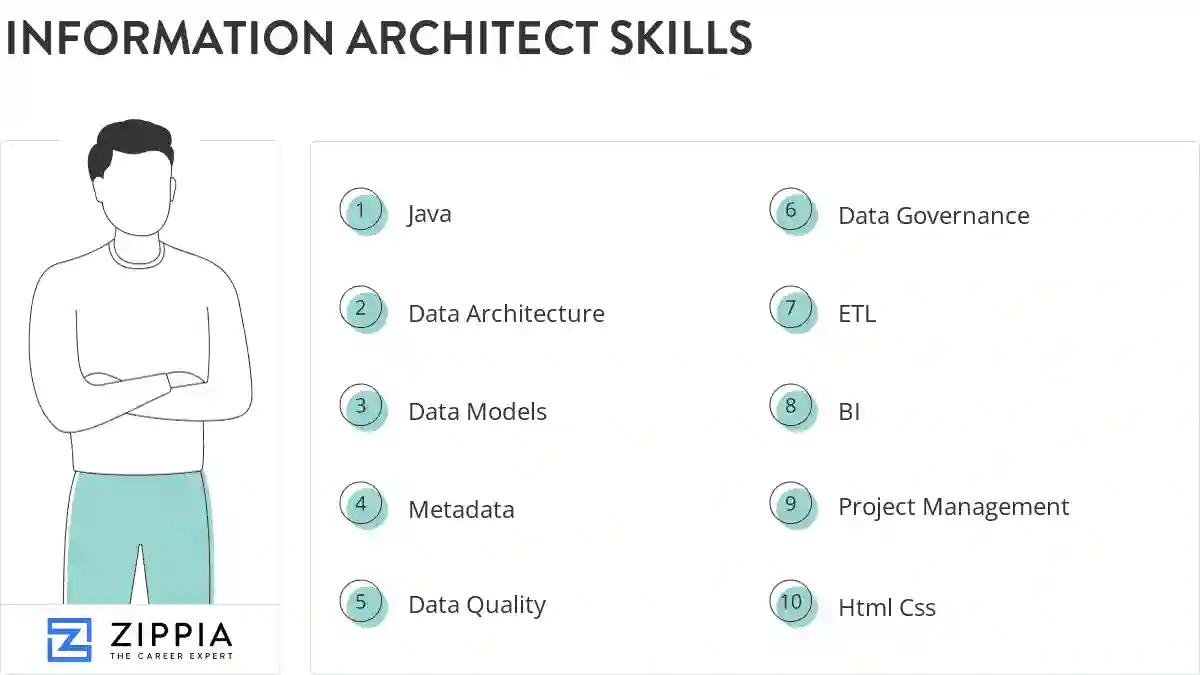
The most important skills for an information architect resume and required skills for an information architect to have include:
- Java
- Data Architecture
- Data Models
- Metadata
- Data Quality
- Data Governance
- ETL
- BI
- Project Management
- Html Css
- Data Warehouse
- Data Analysis
- User Experience
- Develop User
- Visualization
- Content Strategy
- SQL Server
- Data Warehousing
- User Interface
- Sketch
- Site Architecture
- Business Stakeholders
- Site Maps
- Usability Tests
- Azure
- Emerging Technologies
- Business Process
- Profiling
- MDM
- Enterprise Architecture
- User Research
- XML
- Visual Design
- Visio
- Scheme
- Content Management System
- Ssis
- Web Site
- HTML
- SME
- SEO
- Axure
- Wire Frames
- SharePoint
- Interaction Design
- UI
- Invision
Updated January 8, 2025
