Explore jobs
Find specific jobs
Explore careers
Explore professions
Best companies
Explore companies
Job outlook for information technology programmers in the United States
Information technology programmer job growth summary. After extensive research, interviews, and analysis, Zippia's data science team found that:
The projected information technology programmer job growth rate is -7% from 2018-2028.
About -17,900 new jobs for information technology programmers are projected over the next decade.
Information technology programmer salaries have increased 12% for information technology programmers in the last 5 years.
There are over 65,274 information technology programmers currently employed in the United States.
There are 283,349 active information technology programmer job openings in the US.
The average information technology programmer salary is $89,063.
Are information technology programmer jobs in demand?
Information technology programmer job and salary trends over time
Information technology programmer jobs over time
Information technology programmer job growth rate over time
| Year | # of jobs | % of population |
|---|---|---|
| 2021 | 65,274 | 0.02% |
| 2020 | 84,541 | 0.03% |
| 2019 | 78,219 | 0.02% |
| 2018 | 162,746 | 0.05% |
| 2017 | 169,942 | 0.05% |
Average information technology programmer salary over time
Information technology programmer salary by year
| Year | Avg. salary | Hourly rate | % Change |
|---|---|---|---|
| 2026 | $89,063 | $42.82 | +3.4% |
| 2025 | $86,129 | $41.41 | +2.3% |
| 2024 | $84,179 | $40.47 | +2.5% |
| 2023 | $82,141 | $39.49 | +3.0% |
| 2022 | $79,744 | $38.34 | +0.4% |
Information technology programmer jobs by state
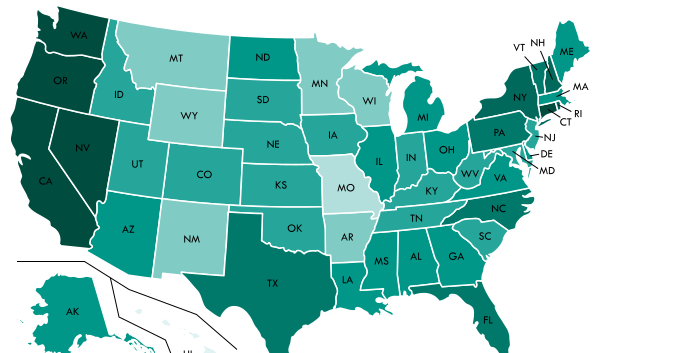
Most common states for information technology programmers
| Rank | State | Population | # of jobs | Employment/ 1000ppl |
|---|---|---|---|---|
| 1 | District of Columbia | 693,972 | 813 | 117% |
| 2 | Rhode Island | 1,059,639 | 506 | 48% |
| 3 | Delaware | 961,939 | 462 | 48% |
| 4 | Virginia | 8,470,020 | 3,982 | 47% |
| 5 | Vermont | 623,657 | 283 | 45% |
| 6 | Massachusetts | 6,859,819 | 3,035 | 44% |
| 7 | Maryland | 6,052,177 | 2,643 | 44% |
| 8 | North Dakota | 755,393 | 333 | 44% |
| 9 | Oregon | 4,142,776 | 1,679 | 41% |
| 10 | Utah | 3,101,833 | 1,188 | 38% |
| 11 | New Hampshire | 1,342,795 | 506 | 38% |
| 12 | Montana | 1,050,493 | 380 | 36% |
| 13 | Washington | 7,405,743 | 2,612 | 35% |
| 14 | Wyoming | 579,315 | 195 | 34% |
| 15 | Minnesota | 5,576,606 | 1,841 | 33% |
| 16 | Nebraska | 1,920,076 | 636 | 33% |
| 17 | South Dakota | 869,666 | 274 | 32% |
| 18 | Alaska | 739,795 | 236 | 32% |
| 19 | New Jersey | 9,005,644 | 2,735 | 30% |
| 20 | Colorado | 5,607,154 | 1,706 | 30% |
Most common cities for information technology programmers
| Rank | City | # of jobs | Employment/ 1000ppl | Avg. salary |
|---|---|---|---|---|
| 1 | Ramsey | 1 | 4% | $67,757 |
| 2 | Atlantic City | 1 | 3% | $77,940 |
| 3 | Greer | 1 | 3% | $75,937 |
| 4 | Newnan | 1 | 3% | $84,178 |
| 5 | Lansing | 2 | 2% | $82,055 |
| 6 | Jupiter | 1 | 2% | $88,154 |
| 7 | Tallahassee | 1 | 1% | $88,663 |
| 8 | West Palm Beach | 1 | 1% | $87,947 |
| 9 | Baltimore | 2 | 0% | $78,612 |
| 10 | Houston | 1 | 0% | $87,570 |
Information Technology Programmer job outlook: Expert opinions
Our panel of information technology programmer experts
Nova Southeastern University

University of Guam

University of Hawaii at Hilo
Indiana University Southeast

Gannon University

Eastern Washington University

Murray State University

Allegheny College

Saint Xavier University

Taylor University
Loyola University Chicago
John Brown University
Rider University

Union University
Defiance College

Seminole State College of Florida

Harding University
What will help Information Technology Programmers increase their earning potential?
Dr. Frank Mitropoulos Ph.D.: As we look toward the future of careers in Computer Applications, several skills stand out for their growing importance. These skills revolve around specific technologies that are expected to continue to grow and evolve. Technologies related to Cloud Computing, Artificial Intelligence (AI), Cybersecurity, and Data Science are quickly evolving and being applied across the technology sector. Cloud Computing: Given the widespread adoption of Cloud services, Cloud computing expertise is indispensable. Understanding how to leverage platforms like Azure, AWS, and Google Cloud is crucial to developing scalable, efficient solutions that meet business needs. Artificial Intelligence: AI and Machine Learning are transforming the world. Skills in these areas to solve real-world problems will be even more critical in the future. Cybersecurity: Digital threats are becoming more sophisticated. Safeguarding data, networks, and systems will require encryption, intrusion detection, development, and regulation skills. Data Science: Skills in Data Science will be increasingly sought after as businesses embrace data-driven decision-making. Extracting meaningful insights from extensive datasets and effectively communicating these findings will be essential. Soft skills: Finally, soft skills such as teamwork, problem-solving, and effective communication cannot be overlooked. Adapting, communicating, and leading will be essential for success.
James Sellmann Ph.D.
Dean, Professor of Philosophy and Micronesian StudiesUniversity of Guam
College of Liberal Arts & Social Sciences
What general advice would you give to an Information Technology Programmer?
James Sellmann Ph.D.: General advice is to keep in mind that you must leverage your skills, especially your soft skills of being able to work with people, to communicate effectively and to be able to solve problems. Be real. Don't try to pretend to be someone else to impress others. Be your authentic self. And show up on time.
Travis Mandel Ph.D.
Assistant ProfessorUniversity of Hawaii at Hilo
Department of Computer Science
What soft skills should all Information Technology Programmers possess?
Travis Mandel Ph.D.: Although computer science seems like a highly technical field, soft skills are really what differentiates software engineers. One of the most important qualities of any software engineer is explaining their code clearly at various levels of technical depth and explaining why certain design decisions were made. You could write code that does amazing things, but if that code consists of snippets you pasted from StackOverflow without really fully understanding them, it will be a huge headache for anyone who needs to come into the codebase later and maintain or update it.
Another one is asking the right questions. Imagine you are dropped into a huge codebase and asked to add a new feature (very common!). There's no time to understand everything that is going on, but on the other hand, you need to understand enough of the code to do your task effectively, which involves asking questions. A failure to ask questions will likely result in you wasting a huge amount of time working on something that is ultimately not useful, for instance, re-implementing a complex function that already exists somewhere in the codebase.
Chris Sexton
Visiting Lecturer of Computer ScienceIndiana University Southeast
Computer Science Department
What hard/technical skills are most important for Information Technology Programmers?
Chris Sexton: As with soft skills, technical skills in teamwork matter, a candidate must have the ability to work with revision control, be it git or some similar system. In addition, it is vital that fundamental computing skills such as operating the shell of a Linux machine are good signs that a candidate will be able to adapt to new systems.
How do you envision technology impacting Information Technology Programmers in the next 5 years?
Dr. Stephen Frezza Ph.D.: Breadth and depth: Computing is becoming more like engineering; where the value of the product, its lifetime risks, costs, and benefits are more critical than just it's roll-out. So the engineering competencies that have always been a part of computing will become more central. Computing is also expanding; the role of data and the shift of once-research technologies (like machine learning) into production applications will continue to require computing graduates to broaden their base and continue as learners. This will cause shifts in what is considered 'fundamental' and the need for professionals to continue to hone and redevelop their technical skill sets.
Are there any particularly good places in the United States for Information Technology Programmers to find work opportunities?
Dr. Stephen Frezza Ph.D.: Computing is ubiquitous, and with more industries moving to remote work, location is becoming less critical. If the internet reaches a place reliably, computing jobs can be located there.
Christian Hansen Ph.D.
Professor and Department ChairEastern Washington University
Department of Mathematics
What's a day at work look like for an Information Technology Programmer?
Christian Hansen Ph.D.: In the post-pandemic era, a typical workday for a recent graduate will likely involve some form of remote work. I predict that many businesses will benefit from the reduced cost of remote infrastructure compared to the cost of maintaining brick and mortar office space. Many new graduates will continue to spend their day on a computer while collaborating in teams via Zoom and other teleconference tools. People working in disciplines that have traditionally been "on the ground" will move towards more hybrid modes of work, reducing the need for travel and participating in face-to-face meetings and training.
Dr. Matthew Tennyson Ph.D.
Associate Professor of Computer ScienceMurray State University
Computer Science and Information Systems
What certifications/licenses/courses can have the biggest impact for Information Technology Programmers?
Dr. Matthew Tennyson Ph.D.: A bachelor's degree in computer science is extremely valuable. It has been and continues to be one of the most valuable college degrees a student can pursue. I really think all areas of computing are in demand, but web and mobile computing might be one of the strongest. Some employers do like to see extra certifications in addition to the bachelor's degree. There are literally hundreds of certifications available in the computing industry. They all vary in the required amount of time, effort, and money. I think anything that can set a candidate apart from other candidates is valuable, and that includes any certification. I would not recommend investing thousands of dollars into additional certifications after completing a bachelor's degree, but I don't think it's a bad idea for students to pursue one of the free or lower-cost certifications that are available - especially those students who might not have strong internship experience, extracurricular activities, projects, etc. to put on their resumes. I think anything DevOps related or cloud-based like Amazon's AWS or Microsoft's Azure are especially valuable right now.
Oliver Bonham-Carter Ph.D.
Assistant ProfessorAllegheny College
Department of Computer Science and Affiliated Faculty in Integrative Informatics
What are the biggest trends we'll see in the Information Technology Programmer job market given the pandemic?
Oliver Bonham-Carter Ph.D.: Pandemic has accelerated social connectivity trends using technology, including technology for remote work, and e-learning, and technology to make e-commerce more comfortable and faster. I foresee these accelerated technology trends to continue, even after the pandemic, and therefore job markets in these areas to continue to grow. Another big surge we have seen is in data analytics, which has been increasing over the last decade, and COVID-19 has spotlighted this field. I expect data analyst jobs to continue to be in demand and to grow. Also, the pandemic showed us the interconnectedness of technology with other areas. As the need to develop better solutions to fight various diseases heightens, for example, I expect jobs in biotech to grow.
What technology do you think will become more important and prevalent for Information Technology Programmers in the next 3-5 years?
Oliver Bonham-Carter Ph.D.: In the next few years, technologies related to artificial intelligence, data analytics, cloud computing, container-orchestration systems, and cybersecurity will continue to become more important and prominent. These technologies have the foundation to improve the quality of life in terms of health, education, fighting misinformation, creating better connections, fighting climate change, etc. IoT with smart devices connected online will continue to rise, thus producing more data, which will necessitate AI, data analytics, and security solutions. Additionally, I foresee 5G technology to play an essential role in the next few years, as e-commerce expands into autonomous delivery services. In the software engineering field, to enable fast, secure, and connected software development, technologies allowing to automate a part of that process, such as version control, containerization, and Kubernetes, will also become increasingly important.
Will there be an increase or decrease in demand for Information Technology Programmers in the next 5 years?
James Vanderhyde: There has been a steady increase in software and IT jobs for the last 20 years, and this is not going to slow down any time soon. In the next 5 years, demand will increase, particularly in software development and cybersecurity. The technology field changes so quickly that beyond 5 years, it is difficult to make predictions. That is why we thoroughly prepare our computer science and information systems students for technology changes and career shifts to discover the best in themselves and to be prepared to meet the demand and excel within the field.
Are there any particularly good places in the United States for Information Technology Programmers to find work opportunities?
James Vanderhyde: Any big city will have lots of opportunities for computing, software, and IT work. Silicon Valley and the rest of the west coast are the most famous, but innovation is happening everywhere around the country and around the world, including here in Chicago. Chicago tech companies have hired our students upon graduation, and likewise, our graduates have found success and gratification in the field.
What are the best companies to work for an Information Technology Programmer?
James Vanderhyde: The best companies to work for are companies that respect you as a person and not just a cog in the machine. They are inclusive, and they recognize and appreciate diversity. They have a track record of handling sick leave and family leave as needed. They will not expect you to eat dinner in your office and then go back to work after an already long day. All software companies experience crunch times around release dates, but the best companies do not experience constant crunch. That is a sign of poor management. The best companies will give you challenging problems to work on and reward innovation.
Dr. Jonathan Geisler
Associate ProfessorTaylor University
Department of Computer Science and Engineering
What are the best companies to work for an Information Technology Programmer?
Dr. Jonathan Geisler: The best companies to work for are the ones that are responsive to both their customers' and employees' needs. They are the ones that have tried to be proactive during the pandemic and not just survive until everything got "back to normal." They know that a damaged workforce leads to a damaged company, and so they provide good management, encouraging everyone to be healthy mentally and physically.
Will there be an increase or decrease in demand for Information Technology Programmers in the next 5 years?
Dr. Jonathan Geisler: There will be a continued increase in demand for computer engineering
graduates as computers become more heavily integrated into the fabric
of our lives. Things like self-driving cars, the Internet of Things, and
mobile computing will become more commonplace and increase the demand for engineering talent; the long-term trend of using smartphones and web-based applications will not slow, leading to an increase in the
demand for computing talent.
What type of skills will young Information Technology Programmers need?
Peter Dordal Ph.D.: I'm leaving off software developers, and answering about our Information Technology graduates.
IT students entering the business world will need to know how to get the maximum leverage out of business systems. In many cases, this will mean writing their own specialized queries to extract the precise business intelligence needed; general-purpose "canned" queries just won't cut it. They will need a broad understanding of what software can accomplish for the enterprise and how to deploy new software effectively; this applies to software used in the office as well as to software used in manufacturing and shipping. And they will need to understand how to lease storage and computing resources from the cloud to meet not only predictable, long-term demands but also sudden short-term business projects.
Students working in database administration and management will need to be able to manage much larger volumes of data than a few years ago. They will need to be familiar with the great variety of new databases in order to pick the best tool for the job.
Students working in network management will need to be able to ensure that everyone has the bandwidth and server access they need, as those demands expand to include extensive video, low-latency real-time connectivity, and the regular transfer of huge amounts of data.
Students in cybersecurity will need to be fully acquainted with all the recommended best practices. However, they will also have to be able to anticipate and guard against potential new vulnerabilities. "By the book" protection is no longer sufficient.
How do you envision technology impacting Information Technology Programmers in the next 5 years?
Dr. Ted Junseok Song: The question is not whether technology will advance or not. It is, rather, how it will advance. Professionals in the industry need to be equipped to see the customers' demand and where our society is headed. I would recommend college students to be interested in broad topics apart from topics in their major. Well-rounded people will have more opportunities to impact the future.
Dr. Howard Rees
Adjunct Assistant Professor of Information SystemsRider University
Information systems
What technology do you think will become more important and prevalent for Information Technology Programmers in the next 3-5 years?
Dr. Howard Rees: Hmm, what technology? That's a question with many different levels of context. For some undergraduates in CS and IT, I would look at systems programming in massively parallel environments, application programming with particular focus on security and privacy, and data science and analytics. For other undergraduates, they might look at artificial intelligence and machine learning, for business applications especially. AI is becoming ubiquitous throughout the business, but it's often used as a "black box."
Meaning that the applications (and those "operating" them) do not understand what's happening inside. AI systems are often "designed, trained, and tested" by the provider and certified as generating the output most desired by the customer but only in a statistical sense. There is no "proof" that the AI black box is, with certainty, doing what the business customer (or the provider for that matter) thinks it is doing - it just does a good job when tested on data. There will be a significant need for tech-savvy people to design, train, monitor, and apply them so that they do not deviate from the desired goals. Such deviations can result in socially destructive business practices. As you can't properly manage what you don't understand, there is a risk in using AI too blindly. CS and IT graduates will need to help out.
Will there be an enduring impact of the coronavirus pandemic on Information Technology Programmers?
Dr. Howard Rees: We're moving into a volatile time for the economy, and planning for an uncertain future is what big companies are concerned with. In many ways, the pandemic and concerns over future pandemics that we now know can be globally devastating will be a boon for CS and IT graduates. Face to face business interactions and transactions will be dramatically reduced, both in the short term and in the long run, as there will be a need to hedge against future pandemics. Everything changes from production and operations to supply chain and risk management and diversification to the nature of "office work." And all of that must be underpinned by computer technology: communications, security, data analytics. These are trends that have been developing for the past few decades but the pandemic will accelerate them, and that's all useful, if you're a CS or IT graduate with a broad base of knowledge, which provides you the freedom to adapt.
What general advice would you give to an Information Technology Programmer?
Brian Glas: Build relationships: Different technologies will interest and challenge you, but throughout your career, you'll find that it's the relationships that are the most important. This is harder to grasp earlier in your career, but much easier to understand after 15-20 years.
Gain different perspectives: Spend time with people in other roles that your job interacts with, and gain a solid understanding of how they view things; this is most valuable for career progression and understanding of how your work fits into the big picture.
Will there be an enduring impact of the coronavirus pandemic on Information Technology Programmers?
Aaron Napierala: I think the pandemic's lasting impact on graduates will be decisive in preparing them for careers in technology. A recent graduate of mine just completed training for a new position with a company, completely remote. It was the first time the company had ever done anything like this before. It was a success, and the graduate raves at the entire process. The pandemic is forcing companies to scrutinize how they operate, to ensure the best possible outcome, for whatever it is they are doing. Once they see the success of being able to accomplish something more efficiently, or they are more cost-effective, they may continue on this path. Why would a company post their ad locally and interview a handful of candidates, when they can open up access globally and draw from a much larger pool? So for graduates just now entering the workforce, they have a distinct advantage: having access to technology for the majority of their lives and just coming out of situations that were forced on them to communicate remotely.
Craig Tidwell Ph.D.
Professor/Program ManagerSeminole State College of Florida
Center for Information Technology
Will there be an enduring impact of the coronavirus pandemic on Information Technology Programmers?
Craig Tidwell Ph.D.: Many I.T. employees already have the option to work remotely (telecommute), but this will become even more important with the Coronavirus challenges. Employees must be able to work remotely and be organized and self-directed. Employers are looking for teleworkers that can work on a task from anywhere.
Will there be an enduring impact of the coronavirus pandemic on Information Technology Programmers?
Frank McCown Ph.D.: Many companies have changed their hiring practices. It's not unusual for a new graduate to jump straight into remote work. I predict the move from in-person work to remote work is only going to accelerate as we get more comfortable with it. Once the pandemic dies down, and economic uncertainties start to go away, companies that had been on hiring freezes will likely jump back in, creating a strong market for graduates.