Explore jobs
Find specific jobs
Explore careers
Explore professions
Best companies
Explore companies
Job outlook for infrastructure architects in the United States
Infrastructure architect job growth summary. After extensive research, interviews, and analysis, Zippia's data science team found that:
The projected infrastructure architect job growth rate is 5% from 2018-2028.
About 18,200 new jobs for infrastructure architects are projected over the next decade.
Infrastructure architect salaries have increased 10% for infrastructure architects in the last 5 years.
There are over 54,740 infrastructure architects currently employed in the United States.
There are 102,531 active infrastructure architect job openings in the US.
The average infrastructure architect salary is $119,786.
Are infrastructure architect jobs in demand?
Infrastructure architect job and salary trends over time
Infrastructure architect jobs over time
Infrastructure architect job growth rate over time
| Year | # of jobs | % of population |
|---|---|---|
| 2021 | 54,740 | 0.02% |
| 2020 | 48,274 | 0.01% |
| 2019 | 47,449 | 0.01% |
| 2018 | 114,929 | 0.03% |
| 2017 | 111,843 | 0.03% |
Average infrastructure architect salary over time
Infrastructure architect salary by year
| Year | Avg. salary | Hourly rate | % Change |
|---|---|---|---|
| 2026 | $119,786 | $57.59 | +3.4% |
| 2025 | $115,839 | $55.69 | +2.3% |
| 2024 | $113,216 | $54.43 | +2.0% |
| 2023 | $111,009 | $53.37 | +2.3% |
| 2022 | $108,501 | $52.16 | +1.5% |
Infrastructure architect jobs by state
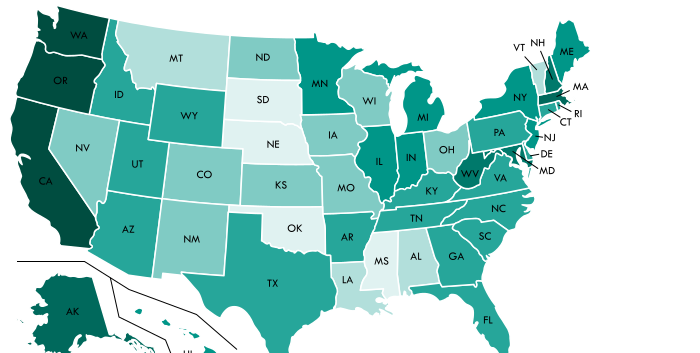
Most common states for infrastructure architects
| Rank | State | Population | # of jobs | Employment/ 1000ppl |
|---|---|---|---|---|
| 1 | District of Columbia | 693,972 | 620 | 89% |
| 2 | Virginia | 8,470,020 | 2,224 | 26% |
| 3 | Maryland | 6,052,177 | 1,420 | 23% |
| 4 | North Dakota | 755,393 | 167 | 22% |
| 5 | Rhode Island | 1,059,639 | 224 | 21% |
| 6 | Massachusetts | 6,859,819 | 1,373 | 20% |
| 7 | Colorado | 5,607,154 | 1,040 | 19% |
| 8 | Vermont | 623,657 | 113 | 18% |
| 9 | Oregon | 4,142,776 | 698 | 17% |
| 10 | New Hampshire | 1,342,795 | 233 | 17% |
| 11 | Washington | 7,405,743 | 1,166 | 16% |
| 12 | Utah | 3,101,833 | 511 | 16% |
| 13 | Illinois | 12,802,023 | 1,882 | 15% |
| 14 | Georgia | 10,429,379 | 1,438 | 14% |
| 15 | North Carolina | 10,273,419 | 1,401 | 14% |
| 16 | New Jersey | 9,005,644 | 1,280 | 14% |
| 17 | Minnesota | 5,576,606 | 802 | 14% |
| 18 | Connecticut | 3,588,184 | 514 | 14% |
| 19 | Delaware | 961,939 | 136 | 14% |
| 20 | Montana | 1,050,493 | 132 | 13% |
Most common cities for infrastructure architects
| Rank | City | # of jobs | Employment/ 1000ppl | Avg. salary |
|---|---|---|---|---|
| 1 | Annapolis | 2 | 5% | $127,103 |
| 2 | Troy | 3 | 4% | $121,225 |
| 3 | Hartford | 3 | 2% | $113,997 |
| 4 | Detroit | 5 | 1% | $121,234 |
| 5 | Boston | 4 | 1% | $131,472 |
| 6 | Atlanta | 3 | 1% | $113,308 |
| 7 | Jersey City | 3 | 1% | $124,569 |
| 8 | Tampa | 3 | 1% | $114,828 |
| 9 | Arlington | 2 | 1% | $114,449 |
| 10 | Birmingham | 2 | 1% | $101,261 |
| 11 | Des Moines | 2 | 1% | $109,685 |
| 12 | Chicago | 5 | 0% | $121,945 |
| 13 | Phoenix | 5 | 0% | $113,703 |
| 14 | Indianapolis | 4 | 0% | $120,423 |
| 15 | San Francisco | 4 | 0% | $148,546 |
| 16 | Los Angeles | 3 | 0% | $137,069 |
| 17 | Washington | 3 | 0% | $118,880 |
| 18 | Baltimore | 2 | 0% | $127,148 |
| 19 | Colorado Springs | 2 | 0% | $109,410 |
Infrastructure Architect job outlook: Expert opinions
Our panel of infrastructure architect experts
Worcester Polytechnic Institute
University of Florida
University of Nevada - Las Vegas
SUNY at Buffalo
University of Nevada - Las Vegas
Massachusetts Maritime Academy

University Of Nevada, Las Vegas
University Of Nevada, Las Vegas

University of Idaho

University of Maryland

The Catholic University of America

University of Wisconsin - Milwaukee

University at Buffalo – The State University of New York

Seminole State College of Florida

Rochester Institute of Technology

NCARB

Kansas State University
College of Charleston
The Pennsylvania State University
Dr. Steven Van Dessel Ph.D. Assoc. AIA
Associate Professor, Director Architectural Engineering ProgramWorcester Polytechnic Institute
Architectural Engineering
What general advice would you give to an Infrastructure Architect?
Dr. Steven Van Dessel Ph.D. Assoc. AIA: Employers always stress the importance of students knowing the fundamentals of engineering and the integration of engineering fundamentals with architectural design. Our program is quite unique in this respect as we are the only degree program in the country where students can earn an architectural engineering degree that is ABET accredited (they can get their PE) - and then also can gain their NAAB accredited architecture degree with one additional year (allowing them to also become architects). Knowledge of building information modeling is required, and I would think that AI at some point will also play a role when combined with advanced surveying technologies.
What general advice would you give to an Infrastructure Architect?
Martin Gold FAIA: The most widespread complaint from people in the field is that it consumes ones attention, requires long hours, and relative to other professions, such as medicine, law, accounting, or engineering, the pay is lower on a per hour basis. On the other hand, architecture is more of an art than other professions and offers opportunities for creative people to have prosperous careers. The famous French architect Le Corbusier would say, architecture is a way of life.
What general advice would you give to an Infrastructure Architect?
Grant Mosey Ph.D.: The path to salary maximization often seems to be a willingness to advocate on one's own behalf and be willing to move firms if necessary. Early career professionals may want to also think about where they are building their expertise. It is likely that architects who work on healthcare or multifamily housing are more likely to have abundant work in the future than those who work on places of religious worship or primary schools. The region in which one chooses to work and make connections can also be important. It never hurts to have a 'name brand' firm on one's resume early in one's career.
What Infrastructure Architect skills would you recommend for someone trying to advance their career?
Grant Mosey Ph.D.: I would advise architecture students to be as flexible as possible. While NAAB accredited schools award 6,000 to 7,000 professional degrees per year, NCARB states that fewer than 3,500 architects reach licensure each year. This suggests that many of those educated as architects are actually finding work in allied subjects. I know of many graduates who are set to become architects who end up becoming real estate professionals, construction professionals, policy-makers, academics, and more. Even for those dead set on architectural practice, these opportunities in adjacent fields can open doors to more design-focused practice.
What will help Infrastructure Architects increase their earning potential?
Grant Mosey Ph.D.: Familiarity with Building Information Modeling software like Revit is already all but a requirement to find professional work. Increasingly, firms are also looking for those who are capable of using visual programming like Grasshopper or Dynamo not only to generate forms but to optimize their workflow. In addition to those, professionals should familiarize themselves with modeling programs including SketchUp and Rhino and visualization platforms like VRay, Enscape, and Twin Motion. Soft skills like being personable and being able to present ideas extemporaneously will never go out of style.
What general advice would you give to an Infrastructure Architect?
Elaine Chow AIA, RA, NCARB: Adaptability will always be an important skill. There will be software improvements and changes that you need to stay aware of and technology that will benefit both the design and construction sides of the industry. Communication will remain an important part of the way we work together in teams.
What Infrastructure Architect skills would you recommend for someone trying to advance their career?
Elaine Chow AIA, RA, NCARB: Architecture licensure will help maximize salary potential, as well as pursuing other certifications such as LEED, CPHC, WELL, etc. Be your own advocate and request regular/annual reviews that allow you to highlight accomplishments and value you bring to your employer. If specialization appeals to you, there are opportunities to market yourself as an expert in a specific subject area.
What general advice would you give to an Infrastructure Architect?
Alfredo Fernandez-Gonzalez: It is important for recent graduates to recognize that Architecture is no longer limited to the physical realm, as transformative technologies are providing interesting career opportunities in the digital realm as well. This rapidly evolving context offers many opportunities and new directions for the discipline and remaining (or becoming!) current in new developments in computing power, digital visuals, manufacturing technologies, and robotics, are ways in which a recent graduate can secure a good paying job.
What Infrastructure Architect skills would you recommend for someone trying to advance their career?
Alfredo Fernandez-Gonzalez: Globally, there is significant demand for architects who are facile in the use of transformative technologies that support designers to generate and evaluate innovative ideas to provide solutions in a rapidly changing environment. Needless to say, being extremely competent in the many applications of Building Information Modeling (BIM), Extended Reality (XR), Generative Design, and Sustainability, will make new graduates effective at a time in which the profession and the world are rapidly transforming.
What will help Infrastructure Architects increase their earning potential?
Alfredo Fernandez-Gonzalez: In addition to mastering the skills that will become more important in the next 3-5 years, committing to work long hours and becoming credentialed in LEED, WELL, and/or other building performance standards is a way to quickly increase your worth for a firm. However, in the long run, working towards becoming a licensed architect is the best way to advance in the profession.
What will help Infrastructure Architects increase their earning potential?
Mark Whalen P.E.: There are many complex systems in existence or being developed that require knowledge and experience across many different technologies. Also, system engineering careers can often lead to managerial positions like becoming a project manager, operations manager or chief engineer.
Dak Kopec Ph.D.
Associate Professor, Coordinator, BA Interior Architecture and Design and Master of Design ProgramUniversity Of Nevada, Las Vegas
School of Architecture
What skills stand out on Infrastructure Architect resumes?
Dak Kopec Ph.D.: Having an area of expertise beyond the common skills that most graduates possess. Many firms are looking for those promotable employees, and these folks often speak with a high degree of intelligence about one or more aspects of design. I see that those with added skills in Health, Education, Sustainability, Technology, etc., often lead those departments in the firm, which becomes their mobility path to executive management. It's all about having something different or better than your competitors.
Dak Kopec Ph.D.
Associate Professor, Coordinator, BA Interior Architecture and Design and Master of Design ProgramUniversity Of Nevada, Las Vegas
School of Architecture
What experience really stands out on Infrastructure Architect resumes?
Dak Kopec Ph.D.: Experience in the areas where one intends to practice. If someone wants to work in hospitality design, an employer will see what kind of experience they have. This is why selecting one's internship location is so important.
Many employers are also looking to see how well the Interior Designer can think outside the box and develop innovative design ideas.
An area of specialized knowledge that will complement the existing design team. Most firms are looking for future leaders.
Randall Randall
Program Head Architecture, ProfessorUniversity of Idaho
Architecture Department
What skills stand out on Infrastructure Architect resumes?
Randall Randall: Diversity of creative work demonstrated in a portfolio.
What soft skills should all Infrastructure Architects possess?
Randall Randall: Communication skills (both disciplinary and interpersonal); strong work ethic; reliability.
What skills will help Infrastructure Architects earn the most?
Randall Randall: Strength in all of the above, i.e., being the "whole package."
Brian Kelly
Associate Dean for Development and Faculty Affairs, Area Chair / Director, Architecture ProgramUniversity of Maryland
IEEE Senior Member, ACM Senior Member, IARIA Fellow, Professor, Program Coordinator | Department of Computer Science and Digital Technologies, Director, Cybersecurity Activities
What skills stand out on Infrastructure Architect resumes?
Brian Kelly: The best employers are looking for leadership potential and the ability to collaborate with others. These attributes are more than just "skills." The worst employers focus on a particular skill.
What soft skills should all Infrastructure Architects possess?
Brian Kelly: Critical Thinking and Design Thinking are the two most important skills that successful candidates need. The ability to communicate in writing, orally, and with visual media is essential.
What hard/technical skills are most important for Infrastructure Architects?
Brian Kelly: The ability to draw with one's hands, study architectural propositions with physical models, and comfort with a wide array of digital media. The first two must be mastered in School, whereas digital media skills will be honed in the context of the firm. Everyone uses different platforms and has different protocols for would-be onboarding architects. Many individuals believe that mastery of a particular digital application is paramount, but this is not the case. Digital applications change with time, and individual employers modify and adapt platforms to their own architect.
What skills will help Infrastructure Architects earn the most?
Brian Kelly: It isn't just skills; knowledge of one's discipline and how it interfaces with others is more important than any single skill.
Anonymous Professor
How have salaries changed over time for Infrastructure Architects?
Anonymous Professor : With regard to money and employment compensation ... those who can be willing to try new things and move with the flow will do well ... very well. Those who cannot, it's McDonald's and minimum wage ...
A footnote: ... the people I contact do not care about who you are, what you are, or how you are. So things like pronouns, and victimization, and excuses, and hanging on to reasons for failure will not cut it in the workplace of the future ... learn ... grow ... and you will have success ...
Robin Puttock
Interim Associate Dean for Undergraduate Studies, Visiting Assistant ProfessorThe Catholic University of America
School of Architecture and Planning
What are the biggest trends we'll see in the Infrastructure Architect job market given the pandemic?
Robin Puttock: I think we will continue to see more use of online platforms. I believe we will have an increase in firm participation this year in our annual School of Architecture and Planning career fair due to the online platform. In previous years, we invited representatives who were local and who could attend in person. There were also space limitations in our architecture building. Now that we are online, that opens up a world of possibilities, both for the hiring firms and for the students. In addition, the interviewing process can be quite efficient online, especially in the initial stages.
What general advice would you give to an Infrastructure Architect?
Robin Puttock: In addition to all of the above, I recommend students stay connected with their professors. Most of us have a vast network that we would love to invite you into. Often, an introduction is the pivotal component to a new opportunity. Relationships are key, especially when a recent graduate does not have significant professional experience. In addition, recent graduates should be sure to spend time on crafting their cover letters, their resumes, their work samples, and their portfolios. Make sure you are putting your best foot forward when an opportunity does arise.
What skills stand out on Infrastructure Architect resumes?
James Shields: Many interviews for architecture jobs remain online at the present time, so an ability to communicate via Zoom or Teams is vital. Looking professional on the small screen with an ability to show your work well are skills that can be practiced before an interview. Most architecture employees are currently working online from home, so knowledge of the essential digital architecture programs (like Revit, Bluebeam, Sketchup, et al) is currently very important. On resumes and in portfolios, any experience in the architecture sectors that have remained relatively stable (Housing, Master Planning, Science & Tech, Schools, sustainable infrastructure) should be emphasized. If you have no such experience, read up on current trends in these practice areas online and find some that interest you. Conveying such an interest can go a long way.
What skills stand out on Infrastructure Architect resumes?
Korydon Smith: Integrative thinking, a core competency in architecture, will become all the more important across sectors. Problem solving amidst complexity, resource constraints, and dynamic factors is what architects do; all businesses will need people that think this way.
Christy Graves
Professor/Program ManagerSeminole State College of Florida
School of Engineering, Design and Construction
What technology do you think will become more important and prevalent for Infrastructure Architects in the next 3-5 years?
Christy Graves: BIM (building information modeling) technology will continue to become more important in the architectural engineering technology profession.
What are the biggest trends we'll see in the Infrastructure Architect job market given the pandemic?
Christy Graves: From what I've seen, I believe job opportunities will continue to be available for architectural technology engineering graduates. While many industries have suffered from layoffs and unemployment during this pandemic, it seems that the built environment is still going strong. I think one of the biggest changes we may see is that once the pandemic is over, many employees are going to work remotely full-time, or the amount of time that was previously spent in the office environment will decrease.
What experience really stands out on Infrastructure Architect resumes?
Christy Graves: Software skills, such as AutoCAD and Revit.
Clyde Eiríkur Hull
Professor of Strategic ManagementRochester Institute of Technology
Saunders College of Business
What type of skills will young Infrastructure Architects need?
Clyde Eiríkur Hull: Graduates entering the workforce now and in the future will need to be comfortable in a digital workplace. Working digitally, whether in an established company or as a digital entrepreneur, was a growing trend before the pandemic, but it was pushing against a lot of inertia. That inertia has switched. Anything that works better, for the employer, digitally instead of in person is going to stay. Even if you aren't working remotely, you'll deal with many people who are. Graduates will need to be more capable of independent work, whether in virtual teams or on their own. But at the same time, interpersonal skills are going to become more important. People aren't interacting as much as they did, so their human skills are rusting. Anyone with polished interpersonal skills is going to stand out more.
How do you envision technology impacting Infrastructure Architects in the next 5 years?
Clyde Eiríkur Hull: Architecture is being hit with virtual reality and augmented reality. Anything you can design now can be built in virtual reality for modeling. But the trend toward digital work is going to impact architectural designs for a long time to come. How will future homes be designed when many residents plan to work from home? How will professional buildings be impacted? Those are questions that architects are answering right now.
How do you envision technology impacting Infrastructure Architects in the next 5 years?
Michael Armstrong: While no one technology will completely alter the architect's role, NCARB's Futures Collaborative-composed of leading architects, experts in emerging technologies, and architectural licensing board members-anticipates that three technologies will have the greatest impact on the profession: generative design, computational analysis, and automation. Technological advancements, as well as shifts in market trends and client expectations, will continue to push architects to specialize in niche areas like building systems, 3D rendering, artificial intelligence, and immersive virtual reality.
The current licensure framework ensures that architects are competent in a broad range of skills-effectively providing a generalist license. But as specialization and project complexity becomes more pervasive, so will the need for increased collaboration with other AEC professionals.
Fred Hasler
John W. & Dorothy M. Burke Architectural Engineering ChairKansas State University
Department Architectural Engineering and Construction Science
How do you envision technology impacting Infrastructure Architects in the next 5 years?
Fred Hasler: Design firms in the construction industry have certainly seen increases in the application of technology. Our graduates are well prepared, through course content and summer internships, and have adapted well. Technology issues during COVID have added another dimension. Some employers now appear to be hesitant to bring on new graduates because of the uncertainty of accomplishing that critical mentoring process when they have some or all employees operating remotely.
What experience really stands out on Infrastructure Architect resumes?
Dr. Barry Stiefel Ph.D.: A substantial and diversified background (such as internships, course work, relevant volunteer activities) in the student's professional field is worth pursuing.
What Infrastructure Architect skills would you recommend for someone trying to advance their career?
Dr. Barry Stiefel Ph.D.: I highly recommend a gap year between high school and undergrad, or between undergrad and grad school, if they are unsure of what they want to do.
College and graduate degrees are costly these days, so they should be done as a means to end and not to pass the time (unless one is in a financial position to do so). During that time off, they should find employment (regular, temp, part-time, or apprenticeship) related to something that they are interested in and volunteer at a relevant organization or government agency. This way, the person continues to build their resume and professional social network.
Putting yourself out there is very important for making informed decisions on what career moves you want to do next. Even adverse employment and volunteer experiences can be beneficial because you now have learned what you don't want to do. Knowing what you don't want to do before spending significant money on a college or graduate degree is a financially smart idea.
What technology do you think will become more important and prevalent for Infrastructure Architects in the next 3-5 years?
Dr. Barry Stiefel Ph.D.: No one (except for maybe Steve Jobs) foresaw the Smartphone Revolution. Yet, by 2010 the world had changed. Five years from now (2025), there could be another new technology that we have not even imagined previously.
My suggestion is to try to be aware, as much as possible, of the latest and upcoming tech but focus on a specific set (or two) of hardware and software that most interests you. When I was younger, I tried staying on top of it all but quickly found that so much was coming out so fast that soon I spent all my time just trying to be on top of it all and unable to do much else. Technology has become so vast and diversified that to be good at something, you may not be able to do it all.
Professional and social networking can create professional communities where people who specialize in one set or two of technology or skills can share and exchange knowledge and expertise with colleagues and friends that complement each other. This is a strategy that I recommend.
How do you envision technology impacting Infrastructure Architects in the next 5 years?
Ross Weinreb: I think the industry is going to look very different over the next five years. Most firm representatives I speak with say they are working fully remote or in some sort of hybrid (some days in the office, other days at home). Architecture is inherently a collaborative endeavor, but like most industries right now have made obvious that we can work remotely and still be successful in the way projects are delivered. I think office dynamics, in general, will be affected for many years. Just the way people are put together in a shared space will be different. Remote collaboration software will be critical for success. Architecture has also historically never been a "9 to 5" job, so office hours may work in a different way to maximize flexibility.