Explore jobs
Find specific jobs
Explore careers
Explore professions
Best companies
Explore companies
Job outlook for infrastructure support specialists in the United States
Infrastructure support specialist job growth summary. After extensive research, interviews, and analysis, Zippia's data science team found that:
The projected infrastructure support specialist job growth rate is 10% from 2018-2028.
About 83,100 new jobs for infrastructure support specialists are projected over the next decade.
Infrastructure support specialist salaries have increased 9% for infrastructure support specialists in the last 5 years.
There are over 102,181 infrastructure support specialists currently employed in the United States.
There are 135,837 active infrastructure support specialist job openings in the US.
The average infrastructure support specialist salary is $94,997.
Are infrastructure support specialist jobs in demand?
Infrastructure support specialist job and salary trends over time
Infrastructure support specialist jobs over time
Infrastructure support specialist job growth rate over time
| Year | # of jobs | % of population |
|---|---|---|
| 2021 | 102,181 | 0.03% |
| 2020 | 108,215 | 0.03% |
| 2019 | 97,191 | 0.03% |
| 2018 | 67,293 | 0.02% |
| 2017 | 65,644 | 0.02% |
Average infrastructure support specialist salary over time
Infrastructure support specialist salary by year
| Year | Avg. salary | Hourly rate | % Change |
|---|---|---|---|
| 2025 | $94,997 | $45.67 | +3.4% |
| 2024 | $91,867 | $44.17 | +2.3% |
| 2023 | $89,787 | $43.17 | +1.5% |
| 2022 | $88,431 | $42.51 | +1.7% |
| 2021 | $86,987 | $41.82 | +1.6% |
Infrastructure support specialist jobs by state
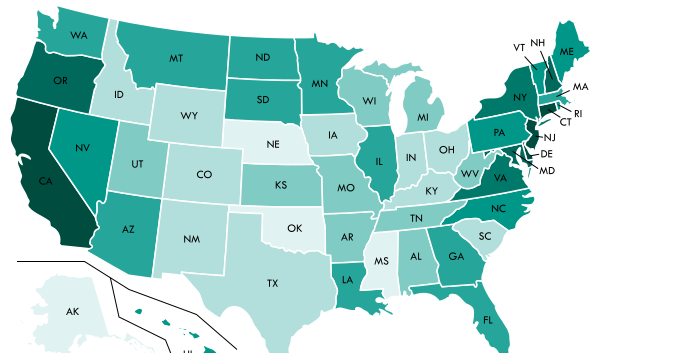
Most common states for infrastructure support specialists
| Rank | State | Population | # of jobs | Employment/ 1000ppl |
|---|---|---|---|---|
| 1 | District of Columbia | 693,972 | 441 | 64% |
| 2 | South Dakota | 869,666 | 239 | 27% |
| 3 | Washington | 7,405,743 | 1,603 | 22% |
| 4 | Virginia | 8,470,020 | 1,815 | 21% |
| 5 | Missouri | 6,113,532 | 1,197 | 20% |
| 6 | Utah | 3,101,833 | 595 | 19% |
| 7 | New Mexico | 2,088,070 | 405 | 19% |
| 8 | Nebraska | 1,920,076 | 363 | 19% |
| 9 | Vermont | 623,657 | 120 | 19% |
| 10 | Massachusetts | 6,859,819 | 1,264 | 18% |
| 11 | Maryland | 6,052,177 | 1,110 | 18% |
| 12 | North Dakota | 755,393 | 139 | 18% |
| 13 | Colorado | 5,607,154 | 937 | 17% |
| 14 | Oregon | 4,142,776 | 697 | 17% |
| 15 | Arkansas | 3,004,279 | 498 | 17% |
| 16 | Wyoming | 579,315 | 97 | 17% |
| 17 | California | 39,536,653 | 6,157 | 16% |
| 18 | Michigan | 9,962,311 | 1,582 | 16% |
| 19 | South Carolina | 5,024,369 | 807 | 16% |
| 20 | Montana | 1,050,493 | 171 | 16% |
Infrastructure Support Specialist job outlook: Expert opinions
Our panel of infrastructure support specialist experts

Grand Valley State University
Tiffin University

California State University - Long Beach
Dominican University

Governors State University

New York Institute of Technology

Slippery Rock University

Stetson University

Saint Peter's University

American University
Laura Kier
Network Design and Administration InstructorWhat general advice would you give to an Infrastructure Support Specialist?
Laura Kier: Students graduating from the Computer Network Design and Administration program will enter the job market with a solid foundation in networking technologies. Above that they should also be able to develop and demonstrate excellent communication and interpersonal skills. Networking has a strong emphasis on teamwork and being able to communicate well with customers, co-workers and teammates is vital. Attaining certifications in Cisco, Linux, Windows, and security will also help the student stand out within the industry (classes in the program help to learn the knowledge needed to attain certifications). Students should participate in any local or online communities and groups to enhance skills and knowledge and find networking opportunities.
What Infrastructure Support Specialist skills would you recommend for someone trying to advance their career?
Laura Kier: Computer Networking is a dynamic field with a wide variety of opportunities in many different industries. Some skills that will be more important in general are skills in software defined networking and automation. Skills in the DevOps field will be necessary, as well as skills leveraging AI tools. Cybersecurity is always important and using AI tools to enhance security and monitoring is necessary.
What will help Infrastructure Support Specialists increase their earning potential?
Laura Kier: Learn to present your skills well from the interview and into your career. Those communication skills count! Industry certifications like CCNA matter. They help you demonstrate a willingness to grow and learn beyond what was required for your degree. Be willing to take on new challenges with your new job and keep learning new skills. It is really important for graduates to understand that talented IT professionals can move up quickly in a company, but they often must start at the bottom to showcase their technical and soft skills. Because of that, they should not shy away from entry level jobs if there is potential for growth.
What technical skills for an Infrastructure Support Specialist stand out to employers?
Chirag Parikh Ph.D.: If you ask me, I consider valuable experience over good paycheck. Once you have gained that experience the paycheck will follow. As soon as you are out of college, the knowledge gained is very fresh and raring to go. If put into the right place can enhance your technical skills and you can do wonders.
As a Computer Engineering professor, I would say the job opportunities are tremendous for students out of college as they can venture into hardware field (technical support, hardware engineer, test engineer and much more) as well as software field (software engineer, software developer, software tester and much more). The possibilities are endless.
With COVID and employees working remotely there is still ample opportunity to enhance your technical and interpersonal skills as I believe remote working might stay for a while till things get back to normal.
What type of skills will young Infrastructure Support Specialists need?
George Miller: Many organizations realize graduates cannot learn everything in college about their major but want the graduate to have a solid foundation on their field of study. The organization wants to mold the graduate to their company environment with how they do things related to the field of study. Most companies want college graduates to have good communication skills (both oral and written), critical thinking skills and be able to work well in teams. These skills have been a staple for graduates since I can remember. This is why a college graduate takes many general education courses related to these skills and many of their major courses emphasize these skills.
Going back to the previous answer I believe graduates in all fields of study will need a better knowledge of technology and easier adaptability to changing technology. Again, an IS degree is already preparing students for this.
What general advice would you give to an Infrastructure Support Specialist?
Dr. Lesley Farmer: Get to know the site before interviewing, and remember that even interviews are an opportunity to practice communication skills-and to see if there's a good match between you and the site. Once hired, learn about the organizational culture and develop trustful relationships. Make one memorable contribution the first month, but focus on becoming an expert before changing others. In addition, join a local and national professional association to keep current and network.
What are the biggest trends we'll see in the Infrastructure Support Specialist job market given the pandemic?
Dr. Lesley Farmer: Many employees have trouble pivoting to online work so in the short term, tech support and instructional design jobs are in high demand. Data privacy and security are also hot topics and need ed tech expertise. Tech maintenance, including cloud services and networks, continue to be needed, rather like car maintenance. Thinking forward, software development is another area of need, particularly with more online-based education. If grads have data analytics expertise, they can find jobs on data management and learning analytics.
Disabilities continue to be an issue, particularly in terms of equity, so jobs dealing with assistive technology and other ed tech supports are possible. Finally, grads should broaden their concept of educational settings; informal education is more important than ever: in business/HR, libraries and museums, recreational and youth-serving clubs, mass media, government and non-profit agencies. All of these entities are involved in training, outreach, PR, and public awareness/education. Be creative and persistent.
What Infrastructure Support Specialist skills would you recommend for someone trying to advance their career?
Dr. Lesley Farmer: Internships are probably the best option, even if unpaid. Some institutions provide career placement services, and grads could contact their instructors about possible options. Companies, professional associations, and non-profits also advertise internships.
What are the biggest trends we'll see in the Infrastructure Support Specialist job market given the pandemic?
Kate Marek Ph.D.: Probably an acceleration of existing trends - remote working, skill-set based job openings (rather than degree-specific), along with an ongoing need for necessary skills such as writing, problem-solving, collaboration, and project management.
What Infrastructure Support Specialist skills would you recommend for someone trying to advance their career?
Kate Marek Ph.D.: If possible, find a paid internship in your area of interest, which will help expand your professional network and build your skillset. Use this time to keep scanning job ads to identify skill sets in demand; look for online mini-courses to make those skill sets.
What general advice would you give to an Infrastructure Support Specialist?
Kate Marek Ph.D.: Choose an organization in tune with one's values. Look for a job in growth areas, such as data asset management, data analysis, etc.
Will there be an increase or decrease in demand for Infrastructure Support Specialists in the next 5 years?
Stephen Hyzny: As everything involves technology, more educated people will need it in the future. As our cars, houses, and lives connect, people will be required to make it all work.
What technology do you think will become more important and prevalent for Infrastructure Support Specialists in the next 3-5 years?
Babak Beheshti Ph.D.: -The enormous growth of IoT and wearables. The number of connected devices is expected to be more than 26 billion in 2020. That includes things like household appliances, controllable lighting, and much more. This trend is likely to continue as it is expected to see the industry grow to 661 billion dollars by 2021.
-We will be witnessing a more widespread commercial deployment of 5G in 2020. With the implementation of the Standalone 5G devices based on the 3gpp release 16, we should be seeing the more robust mobile broadband deployment of 5G, wider availability of 5G smartphones, and a push towards an all 5G Network in select urban areas around the world.
-Significant growth in AI-based technologies, from face recognition and voice recognition to business intelligence and market predictions. As machines and deep learning algorithms get integrated into many applications, many industries will undergo substantial changes. AI systems will continue to interact with our phones; cars will interpret and analyze their surroundings and intelligently drive themselves. Online vendors will monitor our browsing habits, and Google decides what kind of search results to give us, based on who it thinks we are.
Abdou Karim Jallow Ph.D.
Associate ProfessorSlippery Rock University
Department of Information Systems
Will there be an enduring impact of the coronavirus pandemic on Infrastructure Support Specialists?
Abdou Karim Jallow Ph.D.: It is obvious that the COVID-19 pandemic has impacted and transformed the lives of many people, including students all over the world. A major effect is requiring students to stay and learn from home because of the closure of educational institutions as a precautionary measure. Missing saying the traditional goodbye to friends, fraternities, and sororities, and having to watch commencement ceremonies in bedrooms online will leave an indelible mark in graduates.
This means a great U-shift in memories of college life, including physical interaction and learning environment, and systems adopting a new way of doing things. Graduates will enter the job market with uncertainties of availability of traditional jobs and how to work in a new normal. Many graduates will find themselves having to search for jobs virtually and having to start working remotely from the beginning in most cases and in most industries. What would have been a new beginning, along with the excitement of stepping through the doors of the new office and career, will not be there physically. This will have an impact on these graduates because of the transformation of society as a result of the pandemic.
How do you envision technology impacting Infrastructure Support Specialists in the next 5 years?
Abdou Karim Jallow Ph.D.: The trend we have witnessed in the past two decades in terms of development in technology is unprecedented. This has a ripple effect on the field of information sciences and systems. Most traditional jobs have changed or rebranded. For example, consider how information and data processing and management (IDPM) has revolutionized into what is today information management or management information systems; business intelligence is almost transformed into business analytics, data science; high-performance computing, and grid computing is today predominantly engulfed by cloud computing services.
These are changing how data and information are managed. The decision-making process is changing in various information and knowledge-intensive and process-oriented industries such as healthcare, banking, transportation, engineering, education, security, just to name a few, despite the fact that roles and services still remain. New and emerging disciplines and services are added, driven by the advancement and greater capabilities of technology. Without a doubt, in the next few years, data and information services will be revolutionized by technology hugely. Consider the development in artificial intelligence, data science, blockchain, 5G, and broadband networks, all of which have huge potential to impact the discipline. This means that information sciences and information systems courses must adapt to take into consideration the emerging skills required by the professionals and businesses of the future. The education and training of professionals in this domain have to be continuously changing to prepare graduates adequately.
Are there any particularly good places in the United States for Infrastructure Support Specialists to find work opportunities?
Abdou Karim Jallow Ph.D.: Sometimes new graduates from college can find it hard to get the perfect or preferred job location. This may be different for those with information sciences or information systems and related degrees. Luckily there are big companies, multinational companies as well as some-sized enterprises who need skills in that discipline. Most of these can be found in some of the big cities beyond Silicon Valley such as NY, San Francisco, Seattle, Los Angeles, Pittsburgh, Atlanta, Denver, Colorado, Philadelphia, Chicago, DC, Charlotte, Houston, Boston, Dallas, and Minneapolis, just to name a few.
Some of these locations are where some of the big tech companies reside, such as Google, Microsoft, Apple, Amazon, Facebook, Twitter, IBM, HP, SAP, etc. The advantage of this degree is that graduates not only can work for tech companies but any company because of the need to manage data, information, process, and technology. Companies all over have or are putting together strategies to harness the potential of big data, and graduates with information sciences, information systems, and related degrees are sought after continuously.
Will there be an enduring impact of the coronavirus pandemic on Infrastructure Support Specialists?
Dr. Hala ElAarag: I didn't see any negative impact of coronavirus on our graduates. Our graduates did not have any problem finding internships and jobs during the pandemic. After the pandemic, there will be even more demand and opportunities for our graduates.
Are there any particularly good places in the United States for Infrastructure Support Specialists to find work opportunities?
Dr. Hala ElAarag: Not really. With the increasing shift of working remotely, the jobs now are not tied to a specific location in the US or anywhere in the world.
How do you envision technology impacting Infrastructure Support Specialists in the next 5 years?
Edward Moskal: Technology will have a significant impact over the next five years. While technology associated with the software, databases, blockchain, cloud computing, and cybersecurity will still have an impact, we are likely to see significant changes and advancements in fields such as artificial intelligence, combinations of augmented and mixed reality, and quantum computing. Industry and business will be driving these advancements, in particular, the healthcare industry and large tech companies like Google and Facebook that have already started establishing a strong presence in these fields.
Are there any particularly good places in the United States for Infrastructure Support Specialists to find work opportunities?
Kathleen Riley: My computer science students from the class of 2020 had a variety of experiences when they entered the job market after graduation. Those who had already signed on at companies like Amazon or Google, whose business stayed strong during the pandemic and whose workplace models adjusted easily to remote work, had a relatively easy time starting their industry jobs. Others, especially those who had planned to work for companies whose business depended on clients or industries which suffered under the pandemic, saw delays, changes in their work plans, and even cancellations of contracts; several found themselves job hunting again over the summer, interviewing remotely and having to assess companies without setting foot outside their own home. Fortunately, there are still a lot of jobs out there for Computer Science graduates, and most of the students I know have found other placements or are well into that process.
We all know about the abundance of computer science opportunities in the Silicon Valley, the Dulles Technology corridor, and other tech hubs, but there is also an abundance of computer science opportunities in large and small cities throughout the country. In addition to businesses whose focus or products are technology-related, many other businesses have significant technology and computer science needs that are provided in-house, and those who thrive and survive will continue to hire.