
Automatically apply for jobs with Zippia
Upload your resume to get started.
Inspection clerk skills for your resume and career
15 inspection clerk skills for your resume and career
1. Customer Service
Customer service is the process of offering assistance to all the current and potential customers -- answering questions, fixing problems, and providing excellent service. The main goal of customer service is to build a strong relationship with the customers so that they keep coming back for more business.
- Involved in all aspects of customer service including taking orders, answering questions, and problem solving.
- Provided customer service on phone and in person and handled administrative tasks.
2. Customer Satisfaction
- Collected customer feedback, which resulted process changes to exceed customer satisfaction goals.
- Maintained a positive attitude while providing great customer service to ensure customer satisfaction in a safe and healthy environment.
3. Inspection Reports
An inspection report is a written document provided after a thorough evaluation of a specific procedure/ process.
- Enter inspection reports into computer database.
- Typed daily quality inspection reports.
4. Warehouse Inventory
- Maintained records of warehouse inventory.
- Performed product packaging and labeling for transfer to the warehouse inventory.
5. Medical Devices
Medical devices refer to apparatus for use in medical procedures.
- Inspected medical devices to ensure they were properly created.
- Packed the medical devices after they passed inspection.
6. Part Numbers
Part Numbers are special sets and strings of numbers used to identify and label parts. There is no one specific kind or set of parts for which this is used and the term can be found in various industries and used for various parts. Most often, a part number is only used to refer to one part and product within one company or organization. Part numbers, also, tend to inadvertently describe the item's purposes and physical features, too, through an organized code of sorts.
- Perform systems assistance by defining part numbers, created sales orders, purchase orders and ran various reports utilizing PeopleSoft.
- Resolved any discrepancies such as quantity, quality and part numbers with vendors.
Choose from 10+ customizable inspection clerk resume templates
Build a professional inspection clerk resume in minutes. Our AI resume writing assistant will guide you through every step of the process, and you can choose from 10+ resume templates to create your inspection clerk resume.7. Inspection Results
Inspection Results are provided after inspecting and analyzing a structure for various defects, including whether a home is ready to be occupied or sold. There may also be inspection results during construction to ensure the structure abides by local zoning, electrical, and plumbing regulations. Without satisfactory inspection results, the structure may need additional work before continuing construction or becoming occupied.
- Entered all relevant inspection results data into company's ERP system.
- Complete hardware inspections and SAP transactions associated with inspection results.
8. Micrometers
A micrometer is a measuring instrument used in various laboratories to measure even the tiniest components in-depth with great precision and accuracy and to make precise linear measurements of dimensions such as diameters, thicknesses, and lengths of solid bodies. They are essential measuring instruments used by mechanical engineers, machinists, and workers in other technical professions. They allow workers to take extremely precise measurements, which can be viewed either in imperial or metric format. Most micrometers are designed to measure within one-thousandth of an inch! It's a snug fit. Accurate measurements like this are needed when even the smallest distance between objects can cause problems or difficulties.
- Inspected materials using a variety of tools such as micrometers, calipers and fluid bath.
- Use of micrometers and size gages, and dying of ware.
9. Computer System
- Reviewed and verified that all pertinent information in the computer systems was up to date and accurate.
- Credit returned products in computer system upon scrapping, repacking, or restocking.
10. Electronic Components
Electronic Components refer to the structure of a circuit that controls and directs electric current to perform various tasks. These functions include signal computation, amplification, and data transfer. It includes several components such as resistors, capacitors, inductors, transistors, or diodes and connected using conductive wires or traces. Though, a circuit is complete only when it forms a loop.
- Receive and perform in process inspections of electronic components and devices.
11. Customer Returns
Customer return refers to merchandise returned by customers after purchase to receive a refund in the original form of payment.
- Checked in daily Fed Ex packages Maintained customer returns Maintained billing files
12. Inspection Forms
- Process security deposits and request for inspection forms.
13. Scheduling Appointments
Scheduling appointments is the practice of finding a free slot with the person(s) you want to meet. The process of scheduling appointments involves finding mutually free time, negotiating follow-ups, sending reminders, and creating new appointments. Scheduling appointments is important to ensure that the timings of consecutive meetings do not clash with each other.
- Operate telephone switchboard to answer, screen, or forward calls, providing information, taking messages, or scheduling appointments.
14. Input Data
- Input data into computer to keep track record of all arriving shipments.
- Audited meter readings and input data to establish accounts.
15. DOT
- DOT inspections inspected and graded tires shipping and receiving of parts Warranty parts and inventory
- Coordinate and schedule drivers for random DOT drug testing.
5 Inspection Clerk resume examples
Build a professional inspection clerk resume in minutes. Browse through our resume examples to identify the best way to word your resume. Then choose from 5+ resume templates to create your inspection clerk resume.

What skills help Inspection Clerks find jobs?
Tell us what job you are looking for, we’ll show you what skills employers want.
List of inspection clerk skills to add to your resume
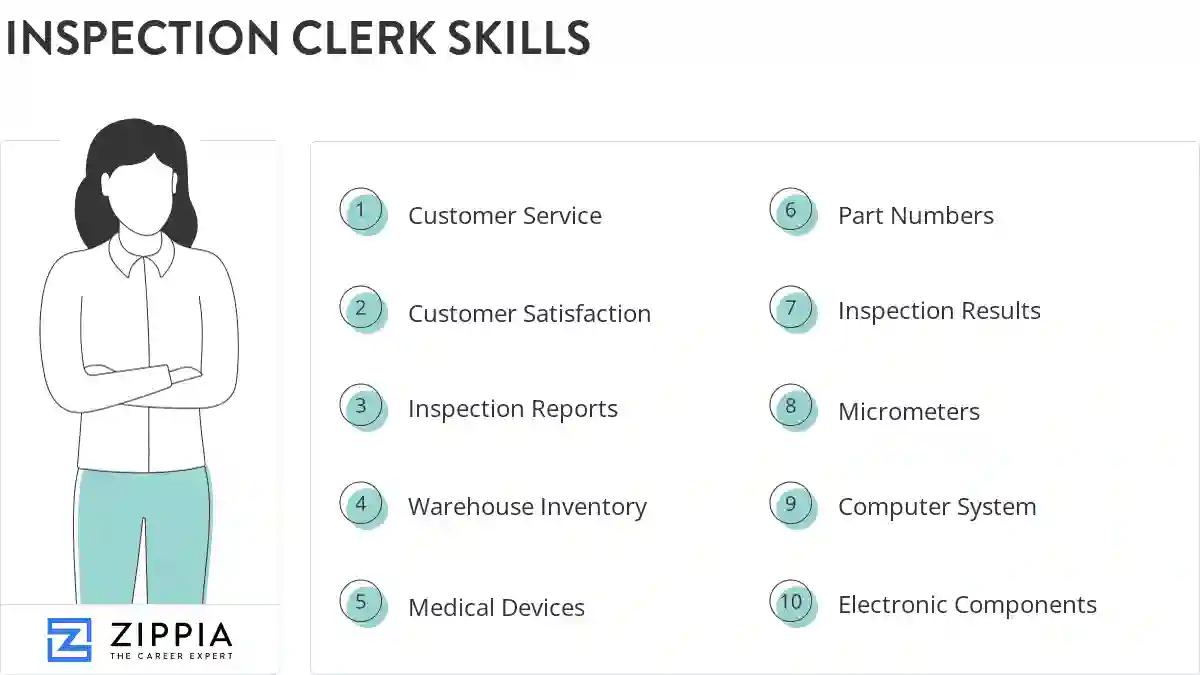
The most important skills for an inspection clerk resume and required skills for an inspection clerk to have include:
- Customer Service
- Customer Satisfaction
- Inspection Reports
- Warehouse Inventory
- Medical Devices
- Part Numbers
- Inspection Results
- Micrometers
- Computer System
- Electronic Components
- Customer Returns
- Inspection Forms
- Scheduling Appointments
- Input Data
- DOT
Updated January 8, 2025
