Explore jobs
Find specific jobs
Explore careers
Explore professions
Best companies
Explore companies
What is an intake worker and how to become one
The intake workers determine the type of medical service a patient would need. As an intake worker, you have to greet new patients, collect their information, and determine their needs. From the gathered information, intake workers can check for eligibility for available assistance programs. You then proceed to refer the patients to the appropriate medical staff and direct them through the medical facility and processes. You are to schedule appointments for the patients to meet with the right medical staff. Intake workers assist patients with their files and application completion.
A degree in health care administration or a similar field is required for this role. To be an intake worker, you must have an in-depth knowledge of medical terms and procedures. You must also possess good customer service and communication skills. Furthermore, you should be good at record-keeping, be proficient in the use of a computer, and be a good team player. Intake workers earn an average of $34,983 per year.
What general advice would you give to an intake worker?
Debra Minsky-Kelly
Director of Field Education / Clinical Assistant Professor of Social Work, Carthage College
Avg. Salary $36,052
Avg. Salary $59,228
Growth rate 9%
Growth rate 0.3%
American Indian and Alaska Native 1.51%
Asian 2.67%
Black or African American 13.37%
Hispanic or Latino 15.12%
Unknown 4.19%
White 63.14%
Genderfemale 79.83%
male 20.17%
Age - 42American Indian and Alaska Native 3.00%
Asian 7.00%
Black or African American 14.00%
Hispanic or Latino 19.00%
White 57.00%
Genderfemale 47.00%
male 53.00%
Age - 42Stress level is very high
7.1 - high
Complexity level is advanced
7 - challenging
Work life balance is fair
6.4 - fair
Intake worker career paths
Key steps to become an intake worker
Explore intake worker education requirements
Start to develop specific intake worker skills
Skills Percentages Social Work 18.24% Assistance Program 7.98% Scheduling Appointments 7.66% Intake Assessments 7.03% Social Services 6.56% Complete relevant intake worker training and internships
Accountants spend an average of Less than 1 month on post-employment, on-the-job training. New intake workers learn the skills and techniques required for their job and employer during this time. The chart below shows how long it takes to gain competency as an intake worker based on U.S. Bureau of Labor Statistics data and data from real intake worker resumes.Research intake worker duties and responsibilities
- Manage assignments of paying medical bills limit in depth that include organizing and researching regulations as pertain to veterans eligibility.
- Develop effective, trusting relationships with identify veterans, with a focus on facilitating housing placement, stability, and independence.
- Provide interventions for at-risk children with emotional disabilities, including sexual/physical abuse, delay development, autism, and social impairment.
Prepare your intake worker resume
When your background is strong enough, you can start writing your intake worker resume.
You can use Zippia's AI resume builder to make the resume writing process easier while also making sure that you include key information that hiring managers expect to see on an intake worker resume. You'll find resume tips and examples of skills, responsibilities, and summaries, all provided by Zippi, your career sidekick.
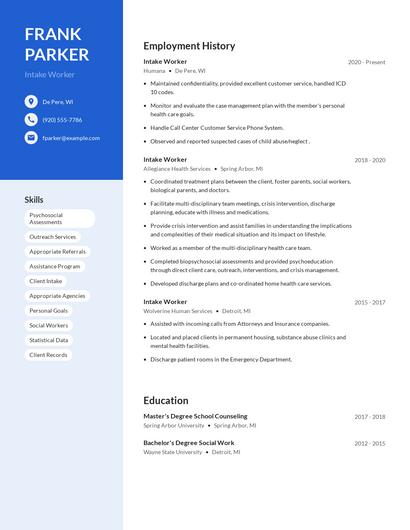
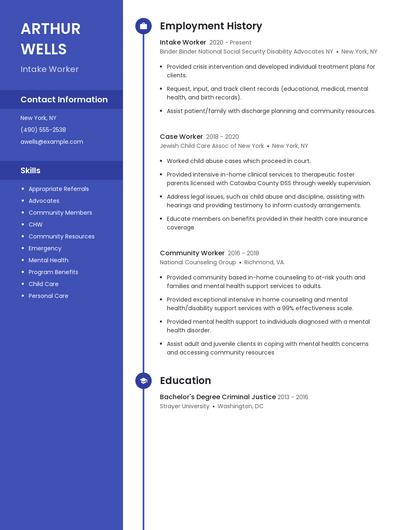
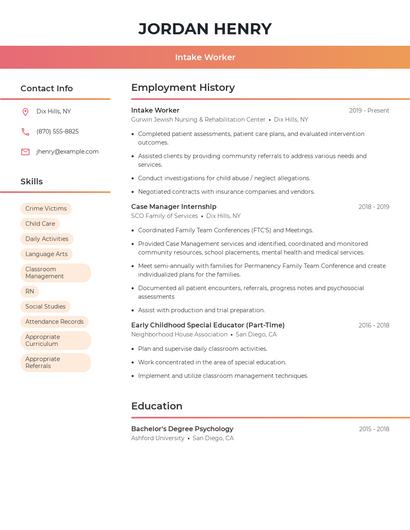
Choose from 10+ customizable intake worker resume templates
Build a professional intake worker resume in minutes. Browse through our resume examples to identify the best way to word your resume. Then choose from 10+ resume templates to create your intake worker resume.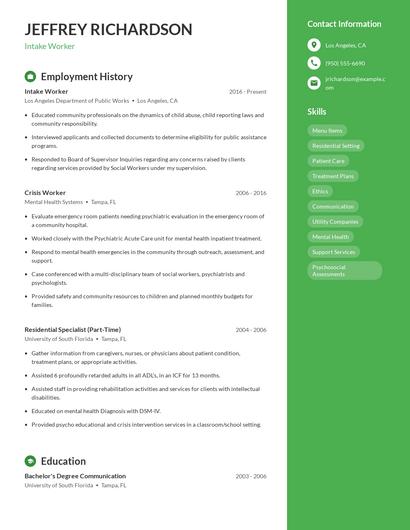

Apply for intake worker jobs
Now it's time to start searching for an intake worker job. Consider the tips below for a successful job search:
- Browse job boards for relevant postings
- Consult your professional network
- Reach out to companies you're interested in working for directly
- Watch out for job scams
How did you land your first intake worker job

Are you an intake worker?
Share your story for a free salary report.
Average intake worker salary
The average intake worker salary in the United States is $36,052 per year or $17 per hour. Intake worker salaries range between $27,000 and $47,000 per year.
What am I worth?

How do intake workers rate their job?
Intake worker reviews

Fulfilling, has a flexible schedule, and very team-oriented environment.
Working collaboratively with clients to help them understand themselves and experience their authentic selves. Learning from my clients.
Updated January 8, 2025
